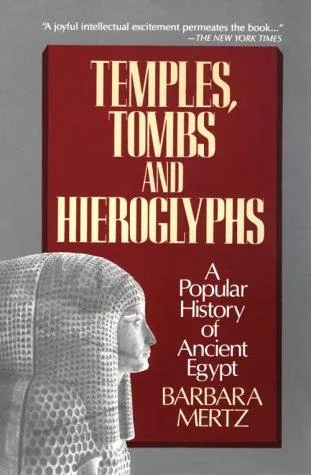
Temples, Tombs, and Hieroglyphs

 79
79

Temples, Tombs, and Hieroglyphs
Barbara Mertz's Temples, Tombs, and Hieroglyphs succeeds remarkably in demystifying ancient Egyptian religion and writing for the educated layperson. The strength of the book lies in Mertz's ability to synthesize vast amounts of archaeological and textual evidence into a coherent narrative. Her prose is clear, and she avoids the academic jargon that often alienates general readers. A particular highlight is her discussion of the evolution of tomb architecture, tracing the progression from mastabas to the pyramids of Giza, and then to the hidden tombs of the Valley of the Kings. While generally robust, the book occasionally feels a little dated in its approach to certain religious interpretations, reflecting scholarship primarily from the mid-to-late 20th century, though this is a minor quibble in an otherwise excellent survey. The work provides a solid foundation for understanding the Egyptian worldview. It is a comprehensive guide to the sacred and the written word of the Nile.
📝 Description
79
### What It Is Temples, Tombs, and Hieroglyphs offers a scholarly yet accessible exploration of ancient Egyptian civilization, focusing on its religious beliefs, burial practices, and the development of its iconic writing system. Barbara Mertz, writing under her own name for this work and as Barbara Michaels for fiction, presents a comprehensive overview that goes beyond mere chronology to examine the worldview of the ancient Egyptians. The book covers the Old Kingdom through the New Kingdom, detailing the evolution of their pantheon, their intricate funerary rituals, and the decipherment of hieroglyphs.
### Who It's For This work is intended for the serious student of ancient Egypt, particularly those interested in the spiritual and cultural underpinnings of its society. It appeals to readers who prefer a factual, evidence-based approach to history, rather than speculative theories. Scholars of comparative religion, archaeology, and ancient history will find it a valuable resource. Individuals fascinated by the origins of written language and the development of complex belief systems will also find much to engage with.
### Historical Context Published originally in 2010, Temples, Tombs, and Hieroglyphs engages with decades of Egyptological research. Mertz wrote this book during a period where Egyptology was well-established, building upon the foundational work of figures like Jean-François Champollion, who famously deciphered the Rosetta Stone in 1822. The book implicitly addresses popular interest in Egypt, which has a long history, often tinged with romanticism and pseudo-archaeology, by providing a grounded, academic perspective. It contrasts with more sensationalized accounts that were prevalent even in the early 20th century.
### Key Concepts The book systematically introduces core concepts of ancient Egyptian culture. It explores the theological significance of the afterlife, as evidenced by elaborate tomb construction and funerary texts like the Book of the Dead. The development and function of hieroglyphic writing are examined, moving from early inscriptions to complex administrative and religious texts. The nature of Egyptian cosmology, including the roles of major deities like Ra, Osiris, and Isis, is elucidated, providing a framework for understanding their society's values and rituals.
💡 Why Read This Book?
• Learn the foundational principles of Egyptian cosmology and the interconnectedness of their deities, such as the central role of the sun god Ra in their creation myths. • Understand the practical and symbolic evolution of hieroglyphic writing, from its earliest forms to its use in religious and administrative contexts, as detailed in chapters on script development. • Gain insight into the complex Egyptian concept of the afterlife and the elaborate rituals surrounding death and burial, exemplified by the construction and contents of royal tombs from the Old Kingdom onwards.
⭐ Reader Reviews
Honest opinions from readers who have explored this book.
❓ Frequently Asked Questions
When was the first edition of Temples, Tombs, and Hieroglyphs published?
The book was first published in 2010. Barbara Mertz, also known as Barbara Michaels for her fiction, authored this comprehensive study of ancient Egypt.
What is the Rosetta Stone's significance to the study of Egyptian hieroglyphs?
The Rosetta Stone, discovered in 1799, provided the key to deciphering hieroglyphs because it contained the same decree in three scripts: hieroglyphic, Demotic, and ancient Greek, allowing scholars like Champollion to unlock the language.
Who was Jean-François Champollion and why is he important for Egyptology?
Jean-François Champollion was a French scholar who is credited with the decipherment of Egyptian hieroglyphs in the 1820s, using the Rosetta Stone. His work revolutionized the understanding of ancient Egyptian history and culture.
What are the primary periods of ancient Egyptian history covered in the book?
The book covers the major periods of ancient Egyptian history, including the Old Kingdom (c. 2686–2181 BCE), the Middle Kingdom (c. 2055–1650 BCE), and the New Kingdom (c. 1550–1070 BCE), detailing developments in religion, art, and governance.
Does the book discuss the mythology of Osiris?
Yes, the book delves into the mythology of Osiris, his death and resurrection, and his central role as god of the underworld and judge of the dead, a core element of ancient Egyptian religious belief.
What distinguishes Barbara Mertz's approach in this book?
Mertz's approach is characterized by meticulous research grounded in archaeological findings and textual analysis, presented in a clear, engaging style that makes complex subjects accessible without sacrificing scholarly rigor.
🔮 Key Themes & Symbolism
The Sacred Landscape
This work meticulously maps the spiritual geography of ancient Egypt, from the monumental temples dedicated to the gods to the carefully constructed tombs designed for eternity. It explores how the Nile River itself was imbued with divine significance, shaping not only their civilization but also their understanding of life, death, and rebirth. The book illustrates how religious beliefs permeated every aspect of daily life, influencing art, architecture, and social hierarchy, positioning the pharaoh as a divine intermediary.
The Journey to the Afterlife
Central to Egyptian belief was the intricate process of ensuring a successful passage to the afterlife. Temples, Tombs, and Hieroglyphs details the elaborate funerary rituals, mummification techniques, and the provision of grave goods intended to sustain the deceased. The evolution of tomb construction, from simple mastabas to the grand pyramids and concealed Valley of the Kings chambers, reflects the growing importance and complexity of these eschatological preparations and the spells and guides, like the Book of the Dead, intended to aid the soul.
The Language of the Gods
The decipherment and understanding of hieroglyphs form a significant thread throughout the book. It traces the development of this complex writing system, examining its use in religious texts, royal decrees, and monumental inscriptions. The work explains how hieroglyphs were not merely a means of communication but were believed to possess magical potency, capable of preserving names, spells, and divine pronouncements for eternity. The book highlights the intellectual achievement involved in unlocking this ancient script.
Pantheon and Divine Order
Barbara Mertz provides a comprehensive overview of the ancient Egyptian pantheon, explaining the roles and relationships of key deities such as Ra, Osiris, Isis, and Horus. The book elucidates the cyclical nature of their mythology, particularly the stories of creation, death, and resurrection, which mirrored the natural cycles of the Nile and the sun. This understanding of divine order was fundamental to the Egyptians' worldview and their perception of cosmic balance (Ma'at).
💬 Memorable Quotes
“The Egyptian conceived of his world as orderly and divinely ordained.”
— This statement captures the fundamental Egyptian worldview, where a structured universe governed by divine principles and overseen by the gods and the pharaoh was paramount. It underscores their deep need for stability and cosmic balance.
“Hieroglyphs were more than mere writing; they were potent symbols imbued with life.”
— This highlights the magical and sacred nature attributed to the written word in ancient Egypt. Hieroglyphs were believed to have the power to manifest reality, preserve memory, and connect the earthly realm with the divine.
“The tomb was not an end, but a meticulously planned beginning for the next existence.”
— This interpretation emphasizes the Egyptian focus on the afterlife. Their elaborate burial practices and tomb constructions were not about death itself, but about facilitating a successful and eternal transition to a spiritual realm.
“Religion and daily life were inextricably intertwined.”
— This concept points to the pervasive influence of religious belief on all facets of ancient Egyptian society. Rituals, festivals, and the actions of the gods were seen as directly impacting the mundane world and its inhabitants.
“Understanding their gods is key to understanding the Egyptians.”
— This assertion underscores the centrality of the pantheon to Egyptian culture. By examining the attributes, myths, and worship of their deities, one gains profound insight into the values, fears, and aspirations of the ancient people.
🌙 Esoteric Significance
Tradition
While Mertz's work is primarily academic Egyptology, its detailed exploration of Egyptian cosmology, afterlife beliefs, and divine symbolism resonates strongly with Western esoteric traditions. Hermeticism, in particular, draws heavily from ancient Egyptian concepts, often filtered through later interpretations. This book provides direct access to the source material that influenced figures like Hermes Trismegistus and later Rosicrucian and alchemical thinkers, offering a grounded perspective on the origins of ideas often reinterpreted in esoteric circles.
Symbolism
The book illuminates key Egyptian symbols. The Ankh, representing life, is explored in its religious and funerary contexts. The Eye of Horus (Udjat), a powerful symbol of protection, healing, and royal power, is discussed in relation to myth and ritual. The Scarab beetle, symbolizing rebirth and the sun god Ra, is examined for its significance in amulets and funerary practices, connecting the earthly cycle of life and death to cosmic renewal.
Modern Relevance
Contemporary practitioners of various spiritual paths, particularly those interested in ancient wisdom traditions, frequently reference Egyptian mythology and symbolism. Modern occultists, Neopagans, and students of comparative religion find Mertz's clear exposition invaluable for understanding the archetypes and narratives that continue to inspire contemporary spiritual expression and symbolic language.
👥 Who Should Read This Book
• Students of comparative religion seeking to understand the foundational beliefs of one of the world's oldest civilizations, particularly their unique concepts of divinity and the afterlife. • Aspiring Egyptologists and amateur historians who desire a factual, well-researched overview of Egyptian religious practices, tomb construction, and the development of hieroglyphic writing. • Readers interested in the origins of Western esoteric thought, providing direct insight into the ancient Egyptian sources that have influenced Hermeticism and other mystical traditions.
📜 Historical Context
Temples, Tombs, and Hieroglyphs, published in 2010, emerged from a rich tradition of Egyptological scholarship that had been developing for centuries. The era of its writing followed significant archaeological discoveries and scholarly debates throughout the 20th century. Key figures like James Henry Breasted, who published his influential 'A History of Egypt' in 1905, had already laid groundwork for accessible yet scholarly accounts. Mertz's work builds upon this foundation, engaging with established interpretations of Egyptian religion, burial customs, and hieroglyphics. While not directly engaging with a competing school of thought in the sense of a contemporary philosophical movement, the book implicitly stands against the more speculative or fringe theories about ancient Egypt that often gain public traction. Its publication in the early 21st century positions it within a modern academic landscape where digital resources and interdisciplinary approaches are increasingly common, though Mertz's focus remains primarily on textual and archaeological evidence.
📔 Journal Prompts
Reflect on the Egyptian concept of Ma'at and its implications for societal order.
Consider the symbolic journey of the deceased through the Duat as described in funerary texts.
Analyze the development of hieroglyphic script as a tool for both communication and sacred power.
Explore the relationship between the pharaoh and the divine pantheon in Egyptian belief.
Meditate on the Egyptian understanding of cyclical time and its connection to the afterlife.
🗂️ Glossary
Ankh
A hieroglyphic symbol representing 'life.' It is often depicted as a cross with a loop at the top and is a prominent symbol in Egyptian religious iconography and amulets.
Book of the Dead
A collection of ancient Egyptian funerary spells and texts intended to guide and protect the deceased in the afterlife. It was placed in tombs to assist the soul's journey.
Duat
The ancient Egyptian underworld or realm of the dead. It was depicted as a place through which the sun god Ra traveled at night and where the deceased were judged.
Hieroglyphs
The formal writing system used in ancient Egypt, combining logographic, syllabic, and alphabetic elements. Known for its pictorial nature, it was used for religious texts, monumental inscriptions, and administrative purposes.
Ma'at
The ancient Egyptian concept of truth, balance, order, harmony, law, morality, and justice. It was personified as a goddess and was fundamental to the Egyptian worldview.
Osiris
An ancient Egyptian deity, lord of the underworld and judge of the dead. His myth of death and resurrection was central to Egyptian religion and beliefs about the afterlife.
Ra
The ancient Egyptian sun god, often depicted with a falcon's head topped by a sun disk. He was one of the most important deities, considered the creator of everything.