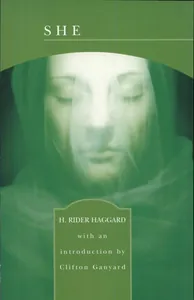
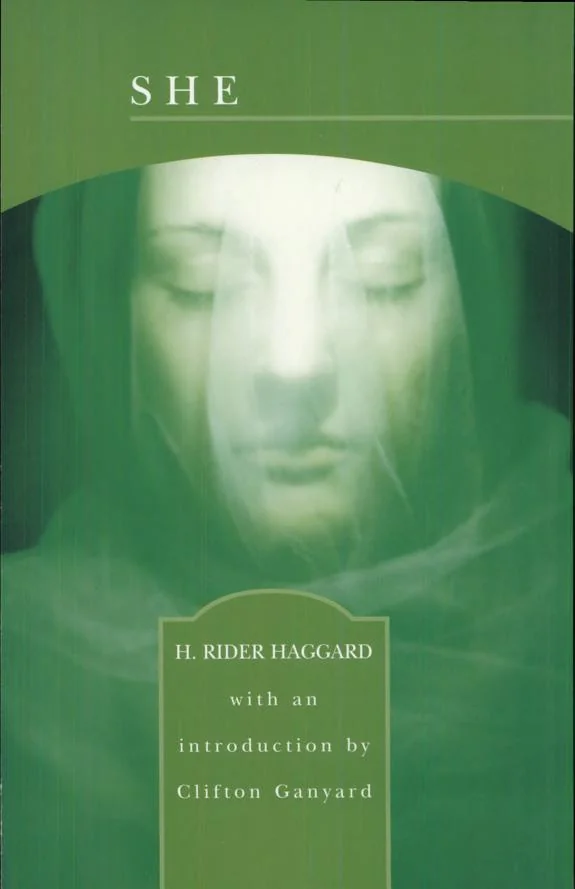
She
 73
73

She
H. Rider Haggard's 'She' presents a singular vision of a lost African civilization ruled by an ageless, formidable queen. The novel's strength lies in its creation of Ayesha, a character who transcends simple villainy or heroism, embodying a potent, almost elemental force. Her presence dominates the narrative, posing complex questions about power, love, and immortality. However, the expedition's narrative framework, while functional, often feels secondary to Ayesha's mystique. The portrayal of the African continent and its peoples, viewed through the lens of early 20th-century British perspectives, can be problematic by modern standards, reflecting colonial attitudes and a romanticized exoticism.
A specific passage detailing the discovery of the ancient city of Kor, with its imposing architecture and sense of millennia-old power, effectively captures the novel's atmospheric appeal. The concept of Ayesha's eternal life, tied to a mystical flame of life, is the work's most compelling esoteric element. While the adventure plot occasionally falters, the character of Ayesha and the mysteries she embodies ensure the book's enduring, if controversial, legacy. Haggard's 'She' remains a potent exploration of female power and ancient mystique.
📝 Description
73
### What It Is 'She' is a seminal adventure novel by H. Rider Haggard, first published in 1920. It chronicles the expedition of three Englishmen into the unexplored interior of Africa in search of a lost white civilization. Their journey leads them to the enigmatic and immortal Queen Ayesha, known as 'She-who-must-be-obeyed'. The narrative blends elements of lost world fiction, romance, and proto-feminist themes, exploring the allure of ancient mysteries and the profound power attributed to a dominant female figure.
### Who It's For This work appeals to readers interested in early 20th-century adventure fiction, particularly those exploring themes of empire, exoticism, and the fascination with the 'other' prevalent during the period. It will engage those who appreciate narratives featuring strong, mysterious female characters and explorations of ancient, hidden civilizations. Readers interested in the evolution of fantasy literature and the mythological archetypes of the eternal feminine will find much to consider within its pages.
### Historical Context Published in 1920, 'She' emerged during a period of significant global change following World War I. The novel reflects prevailing attitudes toward colonialism and exploration, while also subverting some traditional gender roles with its portrayal of Ayesha. Its exploration of ancient mysteries and hidden lands aligns with a broader contemporary interest in archaeology and esoteric philosophies, such as Theosophy, which gained traction in the late 19th and early 20th centuries. Haggard's work engaged with the popular imagination, echoing sentiments found in authors like Arthur Conan Doyle.
### Key Concepts The novel centers on the concept of the 'Eternal Woman' or the 'Great Mother' archetype, embodied by Ayesha. This figure possesses immense knowledge, power, and a command over life and death, drawing on ancient Egyptian and African mythologies. The narrative also explores the idea of cyclical history and reincarnation, as Ayesha is presented as a figure who has lived many lives. The pursuit of immortality, the consequences of divine power, and the clash between Western rationality and ancient, primal forces are central thematic concerns.
💡 Why Read This Book?
• Gain insight into the archetype of the 'Eternal Woman' as embodied by Queen Ayesha, a powerful female figure who has captivated readers since the book's original publication. • Understand the cultural milieu of the early 20th century through Haggard's depiction of colonial adventure and fascination with lost civilizations, specifically referencing the 1920 publication date. • Explore early literary representations of ancient Egyptian and African mythologies intertwined with themes of reincarnation and immortality, as presented in the narrative's exploration of Ayesha's past lives.
⭐ Reader Reviews
Honest opinions from readers who have explored this book.
❓ Frequently Asked Questions
When was H. Rider Haggard's 'She' first published?
H. Rider Haggard's 'She' was first published in 1920, making it a significant work of early 20th-century adventure and fantasy literature.
What is the central premise of 'She'?
The novel follows three English explorers who journey into the heart of Africa and discover a lost civilization ruled by the immortal and powerful Queen Ayesha.
Who is Queen Ayesha in 'She'?
Queen Ayesha, also known as 'She-who-must-be-obeyed,' is the central antagonist and enigmatic ruler of the lost African kingdom of Kor. She is depicted as immortal, possessing immense power and ancient knowledge.
What themes does 'She' explore?
'She' explores themes of immortality, reincarnation, the nature of power, the 'Eternal Woman' archetype, colonial adventure, and the clash between Western and ancient cultures.
Is 'She' considered an esoteric or occult work?
While not strictly an occult text, 'She' delves into esoteric themes, drawing on ancient mythologies and exploring concepts like immortality and powerful, mystical female figures, aligning it with certain strands of metaphysical literature.
What is the significance of the lost city of Kor?
The city of Kor represents a hidden, ancient civilization possessing advanced knowledge and potent mystical forces, serving as the seat of Queen Ayesha's power and a focal point for the explorers' quest.
🔮 Key Themes & Symbolism
The Eternal Woman Archetype
Ayesha embodies the concept of the 'Eternal Woman' or 'Great Mother,' a figure of immense power, wisdom, and eternal life. This archetype draws from ancient Egyptian goddesses and other primordial female deities, presenting a potent, almost terrifying feminine force that commands both love and fear. Her existence challenges conventional notions of mortality and gender roles, positioning her as a central, dominant figure in a world often perceived as patriarchal.
Immortality and Reincarnation
The novel deeply engages with the concepts of immortality and reincarnation, primarily through Ayesha's centuries-long existence. Her connection to the mystical 'Flame of Life' in Kor grants her eternal youth and power, but at a profound cost. The narrative probes the desirability and consequences of such an existence, questioning whether eternal life is a blessing or a curse, and exploring the cyclical nature of being and memory across vast spans of time.
Lost Civilizations and Ancient Mysteries
The discovery of the lost African kingdom of Kor and its advanced, albeit decaying, civilization taps into the late Victorian and Edwardian fascination with hidden worlds and ancient mysteries. This theme reflects a broader cultural interest in archaeology, forgotten histories, and the potential for undiscovered societies holding profound secrets. Kor serves as a symbolic space where the rational Western mind confronts the unfathomable power of ancient lore and potent magic.
Colonial Adventure and Exoticism
Published in 1920, 'She' is a product of its time, reflecting the era's spirit of colonial adventure and the exoticization of non-Western cultures. The journey into the unexplored interior of Africa, the encounters with indigenous peoples, and the discovery of a powerful, non-European ruler are all elements common in adventure fiction of the period. While offering a captivating narrative, it also presents a perspective shaped by prevailing imperial attitudes and biases.
💬 Memorable Quotes
“I am She who must be obeyed.”
— This iconic declaration by Queen Ayesha encapsulates her absolute authority and the awe-inspiring, almost divine power she wields over her domain and those who enter it.
“The wisdom of ages is mine, and the power of life and death.”
— This statement highlights Ayesha's profound connection to ancient knowledge and her control over existence itself, emphasizing her role as an immortal being with access to ultimate forces.
“We came seeking a legend, and found a living goddess.”
— This reflects the explorers' realization that their quest for a mythical figure has led them to an actual, powerful entity, underscoring the novel's blend of adventure and the supernatural.
“Love is the greatest power, yet it is also the greatest weakness.”
— This sentiment, often associated with Ayesha's complex nature, suggests that her immense power is intertwined with her capacity for deep emotional connection, a duality that proves both her strength and her vulnerability.
“The past is never dead; it is not even past.”
— This concept, central to Ayesha's character and her multiple lives, posits that history and personal experience are not linear but continuously present, shaping the now.
🌙 Esoteric Significance
Tradition
The novel draws heavily from ancient Egyptian mythology and the broader archetype of the 'Great Mother' figure prevalent in Gnostic and Neoplatonic thought. Ayesha can be seen as a manifestation of the primordial feminine principle, possessing knowledge of life, death, and cosmic cycles. While not strictly aligned with a single esoteric school like Hermeticism or Kabbalah, 'She' resonates with the Theosophical interest in ancient wisdom, hidden masters, and the potential for spiritual evolution beyond ordinary human limitations.
Symbolism
The 'Flame of Life' is a central symbol, representing immortality, primal energy, and the source of Ayesha's power. Its duality—granting eternal youth while also posing a destructive, consuming force—mirrors the often-paradoxical nature of divine power. Ayesha herself is a potent symbol of the eternal feminine, embodying both nurturing and terrifying aspects of this archetype. The lost city of Kor signifies hidden knowledge, ancient power structures, and the subconscious depths of the human psyche, a place where rational explorers confront primal forces.
Modern Relevance
Contemporary readers and writers continue to engage with 'She' through its exploration of the 'Eternal Woman' archetype, which remains a potent concept in feminist theory and modern mythology studies. The novel's themes of immortality, reincarnation, and the quest for ultimate knowledge find echoes in New Age spirituality and modern occult fiction. Thinkers exploring archetypal psychology, inspired by Jungian concepts, often reference figures like Ayesha as powerful representations of the anima and the collective unconscious.
👥 Who Should Read This Book
• Students of comparative mythology and archetypal psychology seeking concrete literary examples of the 'Great Mother' and 'Eternal Woman' figures. • Readers interested in the history of adventure fiction and the evolution of the 'lost world' genre, particularly those who appreciate narratives with strong female protagonists from early 20th-century literature. • Enthusiasts of esoteric and metaphysical themes exploring concepts of immortality, reincarnation, and ancient wisdom as presented through compelling narrative fiction.
📜 Historical Context
H. Rider Haggard's 'She,' first published in 1920, arrived in a world profoundly altered by World War I. The novel taps into the late Victorian and Edwardian fascination with lost worlds, ancient civilizations, and esoteric knowledge, movements exemplified by figures like Helena Blavatsky and the rise of Theosophy. Its publication coincided with a period where archaeological discoveries, such as those in Egypt, fueled public imagination about forgotten empires. While presenting a narrative of adventure and exoticism, the work also engages with evolving ideas about powerful female figures, subtly challenging traditional gender roles prevalent in much of contemporary literature. The reception of 'She' was significant, solidifying Haggard's reputation as a master storyteller in the adventure genre, though its colonial undertones and portrayal of Africa reflect the prevailing imperial mindset of the era, a perspective contrasted by emerging anthropological studies.
📔 Journal Prompts
The nature of Ayesha's immortality and its perceived costs.
Reflections on the explorers' motivations for undertaking the perilous journey into Africa.
The symbolic meaning of the Flame of Life within the context of Kor.
How the concept of 'She-who-must-be-obeyed' challenges traditional power structures.
Personal interpretation of the 'Eternal Woman' archetype as depicted by Haggard.
🗂️ Glossary
Ayesha
The immortal, powerful, and enigmatic queen of the lost African civilization of Kor, central to the novel's plot and thematic concerns.
Kor
The ancient, hidden city deep within Africa, ruled by Ayesha, which houses advanced knowledge and mystical forces, including the Flame of Life.
She-who-must-be-obeyed
A title of Queen Ayesha, signifying her absolute authority and the divine status attributed to her by her people and feared by outsiders.
Flame of Life
A mystical element within Kor that grants immortality and eternal youth, but also possesses a destructive, consuming aspect.
Leo Vincey
One of the main protagonists, who feels an inexplicable pull towards Africa and Ayesha, believing himself to be a reincarnation of Ayesha's ancient lover.
Holly
The narrator and guardian of Leo Vincey, who accompanies him on the expedition and serves as a more rational, skeptical observer of the unfolding events.
Reincarnation
The belief that a soul can be reborn into a new body after death, a key theme connecting Leo Vincey to a past life and Ayesha's eternal existence.