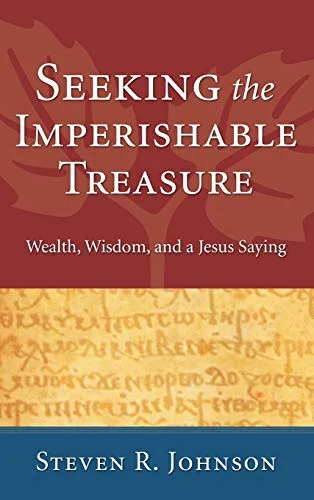
Seeking the Imperishable Treasure
 71
71

Seeking the Imperishable Treasure
Steven R. Johnson's Seeking the Imperishable Treasure offers a refreshing antidote to the ephemeral nature of much contemporary spiritual discourse. Johnson’s strength lies in his unvarnished presentation of challenging concepts, particularly his treatment of the ego as a primary obstacle to true attainment. The work is not without its limitations; at times, the dense prose can obscure the very clarity it seeks to impart. A passage discussing the "subtle body" and its energetic pathways, while conceptually sound, could benefit from more illustrative examples for readers unfamiliar with advanced yogic or Hermetic anatomy. Nevertheless, Johnson provides a robust framework for those committed to a disciplined spiritual path. It is a demanding but ultimately rewarding examination of enduring spiritual principles.
📝 Description
71
Steven R. Johnson's 2008 book, Seeking the Imperishable Treasure, addresses the quest for spiritual permanence.
Seeking the Imperishable Treasure, published in 2008, examines various philosophical and mystical traditions not as historical objects, but as active systems for cultivating a stable inner reality. The book prioritizes practical application over theoretical discussion. It offers methods and viewpoints designed to promote genuine spiritual development. This text is for serious students of esoteric philosophy who have moved beyond introductory ideas and want concrete direction. Readers who value strong intellectual investigation alongside practical spiritual practices will find considerable benefit. It speaks to those unhappy with fleeting spiritual moments and who seek a firm basis for their inner endeavors.
Johnson's work appeared during a time of renewed interest in perennial philosophy and comparative mysticism. The early 21st century saw a rise in esoteric writing that often tried to combine ancient knowledge with modern psychology. Johnson's method stands out for its direct engagement with specific practices and its critique of superficial spiritual trends common in the digital age.
This book emerged in 2008, a period marked by a resurgence of interest in perennial philosophy and comparative mysticism, building on earlier influences from thinkers like René Guénon and Ananda Coomaraswamy. The early 21st century witnessed a significant output of esoteric literature, often attempting to bridge ancient wisdom with contemporary psychological insights. Johnson's contribution is notable for its direct focus on specific practices and its critical stance toward the shallow spiritual trends prevalent in the digital era.
💡 Why Read This Book?
• Gain practical methods for cultivating inner stability, directly applicable to daily life, by examining Johnson's detailed approach to the concept of the "Imperishable Treasure. • Understand the limitations of ego-driven pursuits and learn techniques for detachment, as detailed in the book's exploration of the self in the context of spiritual realization. • Discover how to integrate esoteric philosophy into concrete action, moving beyond theory to achieve a more permanent spiritual foundation, as exemplified by the work’s focus on practical application and discipline.
⭐ Reader Reviews
Honest opinions from readers who have explored this book.
❓ Frequently Asked Questions
What is the 'Imperishable Treasure' as described by Steven R. Johnson?
The 'Imperishable Treasure' refers to a stable, unshakeable inner state of being, representing ultimate spiritual realization. Johnson's 2008 book explores methods to attain this enduring core, transcending the transient nature of ordinary consciousness and the limitations of the ego.
Is Steven R. Johnson's book suitable for beginners in esoteric philosophy?
While the book discusses fundamental concepts, its rigorous approach and practical focus are best suited for those with some prior exposure to esoteric disciplines. It challenges readers to move beyond introductory ideas toward deeper, applied understanding.
When was Seeking the Imperishable Treasure first published and what was the intellectual climate?
The book was first published in 2008, a period marked by a resurgence of interest in perennial philosophy and comparative mysticism, influenced by earlier scholars like René Guénon.
What are the primary philosophical traditions referenced in the book?
Johnson draws from various traditions, including contemplative prayer, philosophical detachment, and integrated spiritual disciplines. The specific lineages are explored for their methods in achieving spiritual permanence.
Does the book offer specific exercises or practices?
Yes, the work emphasizes practical application. It details methods and perspectives designed to foster genuine spiritual growth, focusing on actionable guidance rather than solely theoretical discussion.
What makes this book different from other esoteric guides published around 2008?
Johnson's direct engagement with specific practices and his critique of superficial spiritual trends stand out. The book prioritizes rigorous inquiry and the attainment of a stable inner reality over fleeting spiritual experiences.
🔮 Key Themes & Symbolism
The Nature of Impermanence
Johnson tackles the fundamental human experience of flux and decay, arguing that attachment to the transient is a primary source of suffering. He contrasts this with the potential for an 'Imperishable Treasure' – a stable, unchanging core of being. The book examines how various spiritual traditions recognize this illusion of impermanence and offer pathways to a more enduring reality, moving beyond mere philosophical acknowledgment to practical methods for experiencing this stability.
Ego as Obstacle
A central pillar of Johnson's argument is the identification and dismantling of the ego's illusory sovereignty. The work explores how the self, as commonly understood, is a construct that binds individuals to the cycle of desire and dissatisfaction. Johnson presents techniques, rooted in contemplative and philosophical practices, to gain objective awareness of the ego's mechanisms, thereby loosening its grip and clearing the path toward genuine spiritual realization.
Practical Spiritual Discipline
Seeking the Imperishable Treasure distinguishes itself by its emphasis on actionable spiritual work. It moves beyond abstract theorizing to present concrete methods for personal transformation. These include contemplative exercises, philosophical analysis applied to daily life, and the cultivation of inner stillness. The book serves as a manual for those committed to disciplined practice aimed at achieving lasting spiritual insight and stability.
Attaining the Unshakeable Core
The ultimate aim presented is the discovery and integration of one's true, unshakeable spiritual core. This is the 'Imperishable Treasure' that remains constant amidst life's changes. Johnson guides the reader through the process of recognizing this inherent stability, often obscured by psychological conditioning and worldly distractions. The work provides a framework for this profound inner discovery and its embodiment in everyday existence.
💬 Memorable Quotes
Direct passages from the work, attributed to the author.
“The greatest illusion is the belief in the finality of change.”
— This statement challenges the common perception that constant flux is the ultimate reality. Johnson suggests that beneath the surface of constant transformation lies a more permanent essence waiting to be discovered.
“The ego constructs its fortress of permanence from the bricks of transience.”
— This highlights the paradoxical nature of the ego. It attempts to create a sense of enduring selfhood by clinging to fleeting experiences and possessions, thus perpetuating a cycle of attachment and anxiety.
“True spiritual work is less about accumulation and more about discerning what is essential.”
— This points to the core of Johnson's practical philosophy. It advocates for a process of simplification and purification, distinguishing genuine spiritual attainment from the accumulation of knowledge or experiences.
“Stillness is not an absence of activity, but the presence of an unmoving center.”
— This definition reframes the concept of inner peace. It suggests that true stillness is not passive emptiness but an active, stable awareness that remains unaffected by external disturbances.
“The path to the imperishable requires relentless attention to the perishable.”
— This paradoxical instruction suggests that understanding and engaging with the transient world, rather than escaping it, is crucial. By observing the impermanent, one can better recognize the eternal principles that underpin it.
🌙 Esoteric Significance
Tradition
The work draws heavily from the perennialist school, echoing the concerns of René Guénon and Frithjof Schuon regarding the 'dissolution' of spiritual traditions in the modern West. Johnson's emphasis on an 'Imperishable Treasure' aligns with concepts of divine essence or the true Self found in various mystical paths, including Hermeticism, Advaita Vedanta, and certain Gnostic traditions. It departs by focusing on a direct, non-denominational approach to rediscovering this core, often bypassing specific ritualistic or dogmatic frameworks in favor of universal principles of awareness and detachment.
Symbolism
The central motif of the 'Imperishable Treasure' itself functions symbolically, representing the unassailable spiritual core within each individual, often obscured by the transient ego. The book also implicitly engages with the symbolism of the 'path' or 'journey' towards this treasure, a common trope in spiritual literature, suggesting a process of purification and focused effort. Furthermore, the concept of 'stillness' serves as a potent symbol for the unmoving center of consciousness that remains unaffected by the external world's ceaseless activity.
Modern Relevance
Johnson's work finds relevance today among practitioners of contemplative disciplines, Stoic philosophers seeking inner resilience, and those engaged with modern Hermetic or esoteric orders looking for rigorous, principle-based guidance. His critique of superficial spiritual consumerism and emphasis on enduring inner stability speak directly to contemporary anxieties about meaning and authenticity in a fast-paced, information-saturated world. Thinkers and practitioners interested in the intersection of ancient wisdom and practical psychology often reference his direct approach.
👥 Who Should Read This Book
• Serious students of esoteric philosophy seeking practical methods for inner stability, who are willing to engage with challenging concepts beyond introductory levels. • Individuals disillusioned with transient spiritual trends and looking for a grounded approach to cultivating an unshakeable inner core, drawing from perennial wisdom. • Practitioners of contemplative practices or philosophical disciplines who wish to refine their understanding of the ego and its role in spiritual development.
📜 Historical Context
Steven R. Johnson's Seeking the Imperishable Treasure, published in 2008, arrived during a dynamic period for esoteric thought. The early 21st century witnessed a significant resurgence of interest in perennial philosophy, building upon the foundations laid by scholars like René Guénon in the mid-20th century and later by figures such as Huston Smith. The intellectual landscape was marked by an attempt to synthesize ancient wisdom traditions with contemporary psychological theories and a growing disillusionment with purely materialistic worldviews. Contemporary authors like John Michael Greer were also exploring modern applications of occult traditions. Johnson's work distinguished itself by its direct, often severe, focus on practical application and its critique of what he perceived as superficial spiritual trends prevalent in an increasingly digital and consumerist society. Unlike more academic treatises, his approach aimed at providing actionable methods for achieving a stable inner reality, a concept that resonated with readers seeking depth amidst ephemeral trends.
📔 Journal Prompts
The ego's construction of permanence from transience: identify one instance in your life.
Reflecting on the 'unmoving center' of consciousness: when did you last experience it?
Distinguishing accumulation from discernment: what 'spiritual' pursuits are merely accumulation?
The illusion of change: how does your perception of impermanence shape your daily actions?
Identifying the 'perishable' elements that obscure your 'Imperishable Treasure'.
🗂️ Glossary
Imperishable Treasure
The central concept in Johnson's work, representing the stable, unchanging spiritual core or ultimate realization within an individual, distinct from the transient ego and the fluctuating external world.
Ego
In this context, the self as commonly perceived—a construct of thoughts, emotions, and memories that creates a sense of separate identity, often acting as the primary obstacle to spiritual realization.
Transience
The state or quality of being temporary; fleetingness. Johnson contrasts the inherent transience of the external world and the ego with the potential for an enduring, 'imperishable' inner reality.
Spiritual Discipline
Conscious, systematic practices undertaken to foster spiritual growth and attain higher states of awareness. This can include meditation, prayer, philosophical inquiry, and ethical conduct.
Stillness
Not merely the absence of external noise or movement, but a state of profound inner quietude and stable awareness, representing the unmoving center of consciousness.
Perennial Philosophy
The philosophical and theological perspective that posits a common source or underlying truth shared by all religions and esoteric traditions, emphasizing universal spiritual principles.
Subtle Body
A concept found in various esoteric traditions referring to non-physical aspects of a being, often comprising energetic centers (chakras) and pathways (nadis), which are explored in relation to spiritual development.
🔮 Readers Also Liked
Browse all →









More by Steven R. Johnson
All books →
More Free Occult Philosophy Books
View all →