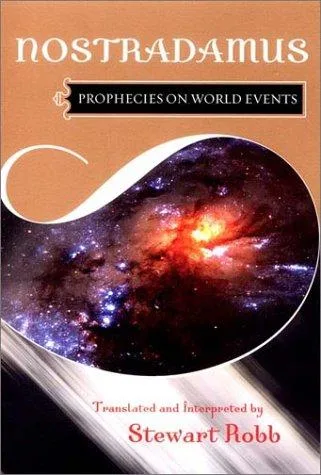
Prophecies on World Events
 72
72

Prophecies on World Events
The 1992 compilation of Michel de Nostredame's *Prophecies on World Events* presents a formidable challenge to the contemporary reader. Unlike works that offer comfort or direct guidance, this text demands active participation, a willingness to wrestle with obscure language and potentially unsettling visions. Its enduring appeal, even centuries after its initial composition, lies in its persistent ambiguity. A notable strength is the sheer density of symbolic material; passages alluding to "the eagle and the crow" or the "great king born in Europe" invite endless analysis, reflecting a deep engagement with archetypal imagery. However, the primary limitation remains the inherent subjectivity of interpretation. Without Nostredame's original intent or a definitive interpretive key (which likely never existed), much of the text functions as a Rorschach test for historical events. The quatrain mentioning "the city of God will fall" and its alignment with various calamities serves as a prime example of how the text can be retrofitted to fit any significant disaster. Ultimately, *Prophecies on World Events* is less a predictive manual and more a historical artifact of prophetic ambition, a mirror reflecting both the anxieties of its time and the interpretive biases of its readers.
📝 Description
72
Michel de Nostredame's quatrains, first published in 1555, predict historical events through cryptic verses.
Michel de Nostredame's *Prophecies* is a collection of quatrains attributed to the 16th-century French apothecary and seer. First compiled in a collected edition in 1992, the text contains verses that purportedly foretell significant historical and future occurrences. These poetic predictions are often allegorical and subject to varied interpretations, a characteristic that has fueled their study and debate for centuries.
The work offers insight into divination practices through symbolic language and numerological patterns. Its dense, coded narratives invite readers to engage actively in deciphering their meaning. This volume is suited for serious students of esoteric traditions, historical prophecy, and comparative mythology. It will appeal to those interested in Nostradamus's lasting impact on Western occult thought and popular culture, as well as readers who enjoy analyzing complex symbolic systems and the intersection of history with foreknowledge.
Nostredame's work emerged during the French Renaissance, a period where astrological and occult arts held sway alongside burgeoning scientific inquiry. His prophecies exist within a tradition of Western esotericism that views history as potentially guided or foreshadowed by divine or hidden insight. The quatrains are a prime example of visionary literature, where symbolic language is used to convey perceived future events, a practice common in various mystical traditions seeking to understand cosmic order or divine will.
💡 Why Read This Book?
• Gain insight into the 16th-century European worldview by examining Nostredame's prophetic quatrains, which were composed during the French Renaissance, a period of significant intellectual and religious ferment. • Explore the enduring practice of symbolic divination through the lens of Nostredame's cryptic verses, understanding how allegorical language has been used to record and predict future occurrences. • Engage with a text that has influenced Western esoteric thought for centuries, specifically analyzing interpretations of recurring figures like the "Great King" and "Hister" that continue to spark debate.
⭐ Reader Reviews
Honest opinions from readers who have explored this book.
❓ Frequently Asked Questions
When was the original *Les Propheties* by Nostradamus first published?
The initial collection of Nostradamus's prophecies, titled *Les Propheties*, was first published in 1555. This 1992 edition is a later compilation of these enduring verses.
What is the primary language used in Nostredame's prophecies?
Nostredame's quatrains are written in a mix of languages, primarily French, but also incorporating elements of Greek, Latin, and Occitan, often with astrological and historical allusions.
How are Nostradamus's prophecies typically interpreted?
Interpretations vary widely, often involving matching cryptic verses to specific historical events, individuals, or timelines. Astrological calculations and numerology are frequently employed in these analyses.
Is there a definitive key to understanding Nostradamus's predictions?
No definitive key exists. The cryptic and allegorical nature of the quatrains allows for multiple interpretations, which have evolved over centuries as historical events unfolded.
What historical periods do Nostradamus's prophecies supposedly cover?
The prophecies are believed to cover events from Nostredame's own time in the 16th century through to the year 3797, extending far into the future.
What was Nostredame's profession?
Michel de Nostredame was trained as an apothecary, a profession that involved compounding medicines and often included knowledge of herbalism and early chemistry.
🔮 Key Themes & Symbolism
Cryptic Verse and Symbolism
The central theme revolves around Nostredame's unique method of prophecy: short, four-line verses (quatrains) encoded with allegorical language, historical references, and astrological symbols. These verses are not straightforward narratives but dense puzzles designed to be deciphered. The work explores how such symbolic language, often deliberately ambiguous, can be applied to a vast sweep of future events, from political upheavals to natural disasters. The interpretation of symbols like "the eagle," "the lion," or celestial alignments forms the bedrock of understanding these predictions.
Historical Determinism vs. Free Will
While not explicitly debated, the text implicitly raises questions about fate and human agency. The seemingly predetermined nature of the events foretold in the quatrains suggests a deterministic worldview. However, the very act of interpretation and the varied historical alignments made by scholars imply that human understanding and choice play a role in how these prophecies are perceived and enacted. This tension between a fixed future and the human capacity to influence or react to it is a subtle but pervasive undercurrent.
The Art of Interpretation
More than just a collection of prophecies, the work is a case study in the art and science of interpretation itself. Nostredame's use of multiple languages, historical allusions, and obscure metaphors necessitates a scholarly and intuitive approach. The enduring legacy of his work is as much about the centuries of analysis and debate it has generated as it is about the predictions themselves. This theme highlights how texts, particularly those dealing with the esoteric, gain meaning through the continuous engagement and interpretive efforts of their readers.
Archetypal Figures and Events
Nostredame's quatrains frequently reference archetypal figures and events that transcend specific historical moments. Names like "Hister" (often linked to Hitler) or recurring motifs of "great kings," "wars," and "plagues" tap into universal human experiences and anxieties. These archetypes allow the prophecies to remain relevant across different eras, as new figures and conflicts can be seen as reflections or repetitions of these timeless patterns. The work thus functions as a repository of symbolic representations for major human dramas.
💬 Memorable Quotes
“The great king will be born in Italy, who will be sent down, from the sky, to earth, and will be one of the blood.”
— This quatrain is often interpreted as referring to a significant religious or political leader emerging from Italy, potentially with divine or noble lineage. Its ambiguity allows for diverse applications to figures throughout history and into the future.
“When the great king is born, and the Pope is of French origin, he will be elected in Rome.”
— This verse suggests a period of significant papal influence originating from France, pointing to a specific historical or future conjunction of French leadership within the Vatican. It highlights Nostredame's interest in the interplay of political and religious powers.
“The city of God will be besieged by enemies.”
— This prediction is frequently associated with Jerusalem or Rome, symbolizing a major spiritual or religious center facing profound conflict or invasion. Its broad application makes it a focal point for discussions on apocalyptic scenarios.
“From the Orient, the great mover will be seen, who will cause the nations to tremble.”
— This quatrain is often interpreted as foretelling a powerful figure or movement arising from the East that will significantly impact global politics and cause widespread disruption or fear.
“The empire will be given to another who will value the birds and the beasts more than the people.”
— This verse can be interpreted as a commentary on leadership that prioritizes nature or animal welfare over human concerns, or perhaps a symbolic reference to rulers associated with specific animal totems or heraldry.
🌙 Esoteric Significance
Tradition
Nostredame's work is rooted in the Western Esoteric Tradition, drawing from Hermeticism, Neoplatonism, and Renaissance magical thought. His use of astrological symbolism aligns with traditional Hermetic practices that view celestial bodies as influencing earthly events. While not strictly Kabbalistic, the interpretive process often mirrors the Gematria or numerological analyses found in Jewish mysticism, seeking hidden meanings within text. His prophecies represent a form of divinatory practice that attempts to map cosmic influences and historical cycles onto human events, fitting within a long lineage of seers and astrologers.
Symbolism
Central symbols include celestial bodies (planets, stars, eclipses) representing divine or cosmic influences, and animals (eagles, lions, crows) often standing for nations, leaders, or forces. Geographical locations, particularly Italy and specific cities, serve as anchors for predicted events. The "Great King" and "Hister" are archetypal figures representing powerful leaders or destructive forces, whose identities are debated and reassigned based on historical context. The very structure of the quatrain itself can be seen as a symbolic container for future unfolding.
Modern Relevance
Contemporary thinkers and practitioners in occult studies, historical prophecy analysis, and comparative religion continue to engage with Nostredame's work. While often viewed critically by mainstream academia, his prophecies are studied by those interested in the history of divination and the psychology of prediction. Modern esoteric authors and astrologers sometimes reference his quatrains when analyzing current global events or exploring archetypal patterns. The enduring fascination with *Prophecies on World Events* highlights a persistent human desire to find order and meaning in historical trajectories, often through symbolic interpretation.
👥 Who Should Read This Book
• Students of Western Esotericism: Those seeking to understand the historical development of divination and prophecy within traditions like Hermeticism and Renaissance magic will find rich material. • Comparative Mythology Enthusiasts: Readers interested in archetypal figures, symbolic language, and how ancient texts are applied to contemporary events will appreciate the interpretive challenges. • History Buffs with an Esoteric Bent: Individuals fascinated by the intersection of historical events and purported foresight, particularly concerning major European and global occurrences, will find ample material for study.
📜 Historical Context
Michel de Nostredame's *Prophecies*, first published in installments starting in 1555, emerged during the vibrant and tumultuous French Renaissance. This era was characterized by a burgeoning interest in humanism, astrology, and occult sciences, coexisting with profound religious shifts like the Protestant Reformation. Nostredame, an apothecary and physician, operated within a cultural milieu where prophecy and divine inspiration were taken seriously, even by learned individuals. His work gained immediate attention, unlike many contemporary esoteric texts. He was, however, part of a broader tradition of prophetic literature, yet his quatrain format and perceived scope set his work apart. While figures like Paracelsus were exploring alchemy and medicine, Nostredame focused on codified foresight. The work faced scrutiny but also garnered patronage, notably from Catherine de' Medici. Its enduring appeal lies in its ability to be reinterpreted against successive historical crises, a phenomenon not unique to Nostradamus but amplified by his cryptic style.
📔 Journal Prompts
The "great king" motif: How might this archetype manifest in contemporary leadership dynamics?
Analyze a specific quatrain's symbolism (e.g., "the eagle and the crow") in relation to a current geopolitical situation.
Reflect on the enduring human fascination with predicting the future, as exemplified by Nostredame's work.
Consider the role of ambiguity in prophetic texts: How does it enable or hinder understanding?
Map a historical event you are familiar with onto a Nostredame quatrain, exploring potential symbolic connections.
🗂️ Glossary
Quatrain
A stanza or poem containing four lines. Nostredame's prophecies are primarily structured in this format, typically with an ABAB or AABB rhyme scheme, though often irregular.
Hister
A name appearing in Nostredame's prophecies, often interpreted by some as a reference to Adolf Hitler due to phonetic similarities and the context of predicted conflict.
Great King
A recurring figure in Nostredame's prophecies, often interpreted as a powerful monarch or world leader who will play a significant role in future events, particularly in Europe.
Apothecary
A historical term for a person who prepared and sold medicines and drugs. Nostredame was trained as an apothecary and physician.
Renaissance
The period in European history, roughly from the 14th to the 17th century, marked by a revival of classical learning, artistic innovation, and a shift in intellectual thought.
Allegory
The use of symbols and metaphorical language to represent abstract ideas or historical events. Nostredame's prophecies are heavily reliant on allegorical interpretation.
Divination
The practice of seeking knowledge of the future or the unknown by supernatural means. Nostredame's work is a form of textual divination.