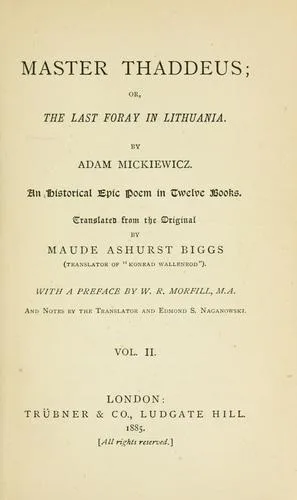
Master Thaddeus
 75
75

Master Thaddeus
Adam Mickiewicz's Master Thaddeus offers a uniquely allegorical approach to spiritual seeking, distinguishing itself from more didactic esoteric texts. The strength lies in its narrative subtlety; rather than expounding doctrines, it embodies them within the character's journey. A passage describing Thaddeus's encounter with the "Mirror of Self-Knowledge" vividly illustrates the challenges of confronting one's own limitations, a moment that feels both personal and universally applicable. However, the allegorical nature, while a strength, can also be a stumbling block. At times, the symbolism feels dense, requiring a dedicated reader to unpack its layers. The narrative's pace, particularly in the middle sections, might test those accustomed to more direct exposition. Nevertheless, Master Thaddeus provides a compelling fictional exploration of inner transformation, rewarding patient engagement with its carefully constructed philosophical landscape.
📝 Description
75
Adam Mickiewicz's Master Thaddeus was published in 1928, a novel about a spiritual quest.
Master Thaddeus follows its main character's spiritual and philosophical path. Adam Mickiewicz published this story in 1928, using allegorical events and character interactions to examine self-discovery, the nature of reality, and the search for hidden knowledge. The book uses fiction to address deep questions about existence. Its structure allows complex ideas to develop slowly, encouraging readers to consider their own life's direction. This book is for readers interested in philosophical fiction that includes spiritual and mystical elements. Those who enjoy stories that combine allegory with reflections on consciousness and secret truths will find it valuable. It suits readers looking for literary works that prompt introspection and a closer look at life's enigmas, moving past ordinary narratives to engage with deeper thought.
The interwar period, when Master Thaddeus appeared, was a time of significant interest in spiritualism and the occult across Europe and North America. The early 20th century saw a revival of Hermeticism, Gnosticism, and Theosophy, movements influenced by figures like Helena Blavatsky and Rudolf Steiner. Mickiewicz's work, released in 1928, engaged with this intellectual climate. It offered its own viewpoint amid a thriving scene of esoteric literature and related movements. This era was characterized by a questioning of traditional beliefs and a search for meaning beyond purely material explanations.
Published in the interwar period, Master Thaddeus emerged during a time of significant interest in spiritualism, the occult, and alternative philosophies across Europe and North America. The early 20th century saw a resurgence of interest in Hermeticism, Gnosticism, and Theosophy, fueled by figures like Helena Blavatsky and Rudolf Steiner. Mickiewicz's work, appearing in 1928, would have engaged with this intellectual milieu, offering its unique perspective alongside a flourishing of esoteric literature and movements. The era was marked by a questioning of established norms and a search for meaning beyond materialist perspectives.
💡 Why Read This Book?
• Learn about the concept of the "inner master" as depicted in Mickiewicz's allegorical narrative, understanding its role in guiding spiritual development. • Explore the symbolic representation of the "Mirror of Self-Knowledge" and its function in challenging the seeker's perception of reality and self. • Gain insight into the philosophical underpinnings of the interwar esoteric revival, specifically how literature from 1928 engaged with concepts of consciousness and spiritual evolution.
⭐ Reader Reviews
Honest opinions from readers who have explored this book.
❓ Frequently Asked Questions
What is the primary theme of Master Thaddeus?
The primary theme of Master Thaddeus is the spiritual journey of self-discovery and the pursuit of esoteric knowledge, guided by an "inner master" or higher consciousness.
When was Master Thaddeus first published?
Master Thaddeus was first published in 1928, placing it within the broader intellectual and spiritual currents of the interwar period.
Who is the author of Master Thaddeus?
The author of Master Thaddeus is Adam Mickiewicz, a significant figure whose work was published in the early 20th century.
What kind of esoteric concepts does the book explore?
The book explores concepts such as the nature of reality, the illusion of the material world, spiritual evolution, and the pursuit of gnosis through allegorical narrative.
Is Master Thaddeus a factual account or fiction?
Master Thaddeus is a work of allegorical fiction, using narrative to explore philosophical and esoteric themes rather than presenting a historical account.
What makes Master Thaddeus significant in the context of 1928 literature?
Its significance lies in its engagement with the esoteric and spiritual interests prevalent in 1928, offering a literary interpretation of inner transformation amidst a period of questioning established norms.
🔮 Key Themes & Symbolism
The Inner Master
The concept of the 'inner master' is central to Master Thaddeus, representing a divine spark or higher self within each individual. This internal guide is depicted not as a physical person but as an intuitive force or wisdom that leads the protagonist, Thaddeus, through trials and revelations. The narrative suggests that true spiritual progress comes from attuning to this inner voice, transcending external influences and egoic desires. It posits that this master is the ultimate source of gnosis and the key to working through the complexities of existence toward enlightenment.
Illusion vs. Reality
Master Thaddeus critically examines the perceived reality of the material world, portraying it as an illusion or a veil obscuring a deeper, spiritual truth. The book uses symbolic encounters, such as the "Mirror of Self-Knowledge," to illustrate how ordinary perceptions are often misleading. Thaddeus’s journey involves shedding these illusions, learning to discern the ephemeral from the eternal. This theme aligns with various mystical traditions that emphasize the deceptive nature of the senses and the need for inner vision to perceive the true nature of the cosmos and the divine.
Spiritual Evolution
The narrative implicitly follows a path of spiritual evolution, portraying Thaddeus's development from a state of relative ignorance to one of greater understanding and self-awareness. This journey is not linear but involves cycles of challenge, insight, and transformation. The book suggests that human existence is a process of unfolding consciousness, where each experience serves as a lesson. This perspective echoes ideas found in Gnostic and Theosophical thought, where the soul progresses through various stages to achieve spiritual liberation or reunification with the divine.
The Pursuit of Gnosis
Fundamentally, Master Thaddeus is a narrative about the pursuit of gnosis – direct, experiential knowledge of the divine and the spiritual realms. Thaddeus's quest is driven by an innate longing for this higher understanding. The book illustrates that gnosis is not acquired through intellectual study alone but through inner transformation, self-realization, and direct communion with spiritual principles. This pursuit is depicted as the ultimate aim of the spiritual aspirant, leading to liberation from the cycle of ignorance and suffering.
💬 Memorable Quotes
Direct passages from the work, attributed to the author.
“The path to truth is often obscured by the very clarity we seek.”
— This statement suggests that our conscious efforts to understand can sometimes create more confusion than clarity. True insight may arise from stillness and inner receptivity rather than forceful intellectual pursuit.
“Within the mirror, not the reflection, lies the self.”
— This highlights the difference between superficial appearance and true essence. The 'reflection' represents outward form or perceived self, while the 'mirror' symbolizes the deeper, underlying consciousness or spiritual nature.
“Each shadow cast is but a teacher in disguise.”
— This interpretation frames challenges and negative experiences not as obstacles but as opportunities for learning. Difficulties are presented as disguised lessons essential for spiritual growth and understanding.
“To find the source, one must first embrace the current.”
— This suggests that understanding ultimate origins requires engaging with the present flow of life and consciousness. One must participate in the journey ('the current') to comprehend its ultimate destination or beginning ('the source').
“The world is but a whisper of the true design.”
— This conveys the idea that the physical, observable universe is a limited manifestation of a vaster, more profound spiritual or cosmic blueprint. The tangible reality we experience is only a faint echo of a greater, underlying order.
🌙 Esoteric Significance
Tradition
Master Thaddeus can be situated within the broader Western Esoteric Tradition, drawing parallels with Hermeticism and Gnosticism. Its emphasis on inner knowledge (gnosis), the illusory nature of the material world, and the guidance of an inner principle aligns with these lineages. The work departs from purely philosophical treatises by employing allegorical fiction, making its esoteric teachings accessible through narrative. It reflects a mid-20th-century trend of synthesizing various esoteric streams into personal spiritual narratives, rather than strictly adhering to a single historical tradition.
Symbolism
Key symbols include the 'Mirror of Self-Knowledge,' representing the challenge of confronting one's true self and egoic limitations. The 'inner master' functions as a symbol of the divine spark or higher consciousness within, a guiding archetype. The 'shadows' encountered by the protagonist symbolize obstacles, karmic lessons, or aspects of the self that must be integrated or understood for spiritual growth. These symbols serve as narrative devices to illustrate abstract esoteric principles.
Modern Relevance
Contemporary thinkers and practitioners in fields like Jungian psychology, transpersonal psychology, and various modern spiritual movements find resonance in Master Thaddeus. Its exploration of the inner journey, archetypal symbolism, and the quest for self-realization connects with modern inquiries into consciousness and personal transformation. Authors and teachers who focus on mindfulness, shadow work, and the development of intuition can draw upon the book's allegorical framework for illustrative purposes.
👥 Who Should Read This Book
• Aspiring practitioners of Western Esotericism seeking allegorical narratives that illustrate core principles of spiritual development and self-realization. • Readers interested in philosophical fiction from the early 20th century that engages with themes of consciousness, reality, and the inner life. • Students of comparative religion and mysticism who wish to understand how esoteric ideas were expressed through literary forms during the interwar period.
📜 Historical Context
Published in 1928, Adam Mickiewicz's Master Thaddeus emerged during a vibrant period for esoteric thought and literature. The interwar years witnessed a widespread fascination with spiritualism, the occult, and alternative philosophies, partly as a reaction to the perceived materialism of the age and the trauma of World War I. Movements like Theosophy, championed by figures such as Helena Blavatsky, had already laid significant groundwork, influencing a generation of thinkers and artists. Mickiewicz's work would have been in dialogue with this milieu, offering a fictional exploration of inner transformation. Contemporaries like G.I. Gurdjieff were also developing complex systems of spiritual training and cosmology during this era. The reception of such works often varied, with some finding validation and others dismissing them as fanciful, yet their presence indicates a significant cultural undercurrent seeking meaning beyond conventional scientific and religious frameworks.
📔 Journal Prompts
Thaddeus's encounter with the "Mirror of Self-Knowledge": What aspect of yourself does this mirror reveal?
The concept of the "inner master": How have you intuitively recognized or ignored this guidance?
Reflecting on the "whisper of the true design": What subtle truths does your everyday life hint at?
The function of "shadows" as teachers: Identify a past challenge and its disguised lesson.
Embracing the "current" to find the "source": How can you engage more fully with your present path?
🗂️ Glossary
Inner Master
The internal spiritual guide or higher consciousness within an individual, believed to offer wisdom and direction on the path to enlightenment.
Gnosis
Direct, intuitive, and experiential knowledge of spiritual truths, often considered a higher form of understanding than intellectual comprehension.
Allegory
A narrative in which characters, events, and settings represent abstract ideas or principles, used here to convey esoteric concepts.
Mirror of Self-Knowledge
A symbolic device within the narrative representing a tool or experience that forces the protagonist to confront their true nature and limitations.
Spiritual Evolution
The process of growth and development of consciousness towards higher states of awareness and spiritual understanding.
Material World Illusion
The concept that the physical reality perceived by the senses is not the ultimate or true reality, but rather a deceptive or limited manifestation.
Interwar Period
The historical era between the end of World War I (1918) and the beginning of World War II (1939), characterized by significant social, political, and cultural shifts.
🔮 Readers Also Liked
Browse all →









More by Adam Mickiewicz
All books →
More Free Occult Philosophy Books
View all →