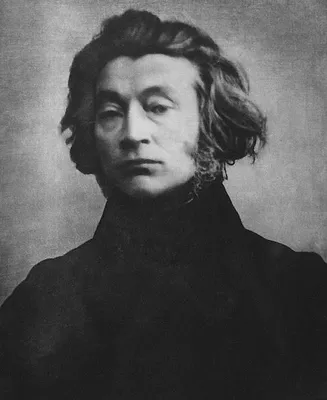
Adam Mickiewicz
Adam Mickiewicz was a renowned Polish Romantic poet, political activist, and influential figure in Slavic literature.
Adam Mickiewicz (1798–1855) was a pivotal figure in Polish Romanticism, celebrated as a national poet in Poland, Lithuania, and Belarus, with significant influence on Ukrainian and Russian literature. He is best known for his poetic drama "Dziady" (Forefathers' Eve) and the epic "Pan Tadeusz," both of which served as inspiration for national independence movements.
Born in the Russian-partitioned territories of the former Polish-Lithuanian Commonwealth, Mickiewicz actively pursued independence for his homeland. His political activities led to his exile in Russia for five years. He later lived abroad in Western Europe, settling in Paris where he lectured on Slavic literature at the Collège de France. His involvement with the mystical teachings of Andrzej Towiański led to conflict with authorities. He also founded a newspaper advocating for democracy and national liberation. Mickiewicz died in Istanbul while organizing forces to fight Russia in the Crimean War. His remains were eventually returned to Poland and interred in Kraków's Wawel Cathedral. His life and work remain central to the cultural and political identity of several Eastern European nations.
Literary and National Significance
Adam Mickiewicz is widely acclaimed as Poland's greatest poet and a "Slavic bard," holding national poet status in Poland, Lithuania, and Belarus. His work significantly shaped Ukrainian literature and impacted Russian literary traditions. As a central figure of Polish Romanticism, he is counted among Poland's "Three Bards." His most famous works, the poetic drama "Dziady" (Forefathers' Eve) and the national epic "Pan Tadeusz," were instrumental in fostering a spirit of resistance and national revival against the imperial powers that had partitioned the Polish-Lithuanian Commonwealth. The influence of "Pan Tadeusz" is even evident in the opening lines of Lithuania's national anthem.
Activism and Exile
Mickiewicz's life was deeply intertwined with the struggle for his homeland's independence. Born in territory under Russian partition, he was involved in secret student organizations like the Philomaths, which promoted self-education and Polish independence. These activities led to his arrest and subsequent exile to central Russia for five years, beginning in 1824. During his exile, he traveled within Russia, including a significant period in Odessa and Crimea, which inspired his "Crimean Sonnets." He integrated into the literary circles of Saint Petersburg and Moscow, befriending prominent figures like Alexander Pushkin. Ultimately, he secured permission to leave the Russian Empire in 1829, embarking on a life in exile across Western Europe.
Later Life and Mysticism
After leaving Russia, Mickiewicz traveled through Germany and Italy, experiencing intellectual and artistic circles, and meeting figures like Goethe. He settled in Paris, where he became a prominent member of the Polish émigré community and lectured on Slavic literature at the Collège de France. However, his later years were marked by increasing involvement with the religious mysticism of Andrzej Towiański. This association led to friction with French authorities and the Catholic Church, resulting in the loss of his professorship. In 1849, he founded "La Tribune des Peuples," a newspaper championing democracy, socialism, and national liberation. He died in Istanbul in 1855, having gone to assist in organizing Polish and Jewish forces against Russia during the Crimean War.
Books by Adam Mickiewicz
2 free public domain books · Read online or download