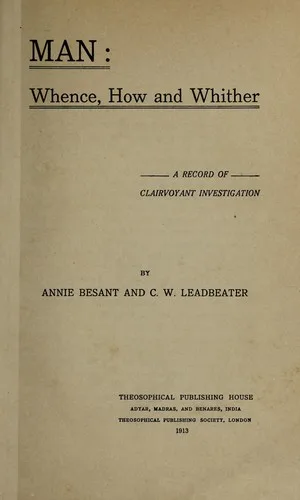
Man

 73
73

Man
The meticulous dissection of human nature presented in Man by Besant and Leadbeater offers a detailed, if sometimes dense, exposition of Theosophical doctrine. The authors’ strength lies in their systematic approach, mapping out the subtle bodies and their functions with a clarity that can be illuminating for initiates. However, the prose, while informative, occasionally veers into highly technical jargon that may present a barrier to entry for newcomers. A particularly striking concept is the detailed description of the etheric body, presented not as a mere metaphor but as a tangible, energetic structure influencing physical health. While the vision is grand, the lack of direct engagement with the materialist scientific paradigm of its time, which was then ascendant, marks a significant limitation. Ultimately, Man serves as a foundational text for understanding the Theosophical anthropology of its era.
📝 Description
73
Published in 2018, Man examines the human constitution through a Theosophical lens.
Man, written by Annie Wood Besant and Charles Webster Leadbeater, examines the human being from a Theosophical viewpoint. The book details a view of humanity that goes beyond the physical body to include subtle bodies and spiritual progression. It describes distinct levels of existence, starting with the physical organism and moving to the etheric, astral, and mental planes. These are all presented as connected to human experience and development.
This work is for students of Theosophy and comparative spirituality who want to grasp the Theosophical model of human evolution. It will appeal to those interested in subtle anatomy and the idea of humans as spiritual beings progressing through many lives. Readers already familiar with core Theosophical ideas, such as karma, reincarnation, and consciousness evolution, will find the content most accessible.
Man originates from the Theosophical movement of the late 19th and early 20th centuries. Besant and Leadbeater were key figures in the Theosophical Society, continuing the work of Helena Blavatsky. This period saw growing interest in spiritualism, Eastern religions, and esoteric philosophies as an alternative way of understanding the world. Their writings aimed to clarify Blavatsky's complex teachings on human evolution and consciousness, often interacting with contemporary scientific and philosophical thought.
💡 Why Read This Book?
• Gain a comprehensive understanding of the Theosophical model of the human constitution, detailing the subtle bodies (etheric, astral, mental) as presented by Besant and Leadbeater, which offers a unique framework for self-study beyond the physical. • Explore the concept of the causal body as described in the text, learning how it functions as a repository of karmic experience and guides spiritual evolution across lifetimes, providing a deeper perspective on personal growth. • Grasp the intricate workings of the chakras as explained within the book, understanding their role as energy centers within the subtle anatomy and their connection to psychological and spiritual development.
⭐ Reader Reviews
Honest opinions from readers who have explored this book.
❓ Frequently Asked Questions
What is the primary focus of Annie Wood Besant and Charles Webster Leadbeater's book 'Man'?
The book 'Man' focuses on the esoteric and Theosophical understanding of the human constitution. It details the multi-layered nature of human beings, including physical, etheric, astral, and mental bodies, and their role in spiritual evolution.
When was 'Man' by Besant and Leadbeater first published?
While Besant and Leadbeater were active much earlier, the edition referenced was first published in 2018, making this specific printing a modern release of their foundational Theosophical work.
What are the subtle bodies discussed in 'Man'?
The book details several subtle bodies, including the etheric body (vital energy), the astral body (emotions and desires), and the mental body (thought and intellect), in addition to the physical form and higher spiritual principles.
How does 'Man' relate to the broader Theosophical movement?
As prominent figures in the Theosophical Society, Besant and Leadbeater’s 'Man' is a key text that expounds upon Helena Blavatsky's teachings, offering a structured view of human evolution within the Theosophical cosmology.
What is the concept of the 'causal body' in this book?
The causal body, as explored in 'Man', is considered the spiritual ego or the higher mental body that carries the essence of an individual's experiences and karmic lessons through successive reincarnations.
Who would benefit most from reading 'Man'?
Students of Theosophy, comparative religion, esoteric philosophy, and those interested in subtle anatomy and the concept of reincarnation will find this book particularly valuable for its detailed Theosophical perspective.
🔮 Key Themes & Symbolism
The Sevenfold Man
The work systematically breaks down the human being into seven distinct principles or bodies, extending far beyond the physical. These include the physical body, the etheric double, the astral body, the mental body, the buddhi or intuitional body, and the atma or spiritual self, culminating in the Monad. Each level is presented as a vehicle for consciousness at different stages of evolution, intricately linked and interacting to form the complete human entity. This framework is central to understanding the Theosophical view of incarnation and spiritual development.
Subtle Anatomy and Energy Centers
A significant portion of 'Man' is dedicated to the description of the human subtle anatomy, focusing on the etheric and astral bodies. It details the network of nadis and the major chakras (energy centers) located within these bodies. The authors explain how these centers are vital for the flow of life force (prana) and how their development or blockage affects physical health, emotions, and mental faculties. The concept of the etheric body as the blueprint for the physical is a cornerstone of this analysis.
Evolutionary Process
The book posits human existence as part of a vast evolutionary scheme governed by universal laws, primarily karma and reincarnation. It describes the journey of the Monad through successive incarnations, learning lessons and developing consciousness through experiences on various planes. The concept of involution (descent into matter) and evolution (ascent back to spirit) is explored, with the 'Man' of the title representing a stage in this ongoing cosmic process of unfoldment.
The Role of Thought and Desire
Besant and Leadbeater emphasize the power of thought and desire, attributing them to the mental and astral bodies respectively. They explain how these faculties shape an individual's experiences, both in the current life and in subsequent ones, through the mechanism of karma. The book details how the quality of one's thoughts and desires influences the nature of their astral and mental bodies and impacts their journey through the afterlife and rebirth.
💬 Memorable Quotes
“The physical body is but the dense outer garment of the man.”
— This interpretation highlights the core Theosophical idea that our physical form is merely the most visible aspect of a more complex, multi-layered being, suggesting a hidden reality beneath the surface.
“The astral body is the vehicle of desire and emotion.”
— This paraphrased concept points to the function of the astral body as the seat of feelings and urges, explaining how these non-physical elements influence our actions and perceptions.
“Thought is a force, and the mental body is its instrument.”
— This interpretation underscores the active nature of thought in the Theosophical model, portraying the mental body not just as a receptacle but as an energetic tool capable of shaping reality.
“Karma is the law of causation governing all evolution.”
— This paraphrased concept defines karma as the fundamental principle of cause and effect that directs the entire evolutionary path of consciousness, linking actions to consequences across lifetimes.
“The Monad is the divine spark within, the eternal pilgrim.”
— This interpretation identifies the Monad as the ultimate spiritual source within each individual, a timeless essence that embarks on the long journey of reincarnation and spiritual growth.
🌙 Esoteric Significance
Tradition
Man is firmly rooted in the Theosophical tradition, which itself synthesizes elements from various esoteric lineages, including Hermeticism, Neoplatonism, Hinduism, and Buddhism. Besant and Leadbeater sought to present a coherent, universal doctrine of evolution based on these syntheses. This work departs from some earlier traditions by offering a highly detailed, almost anatomical, description of subtle bodies and their functions, aiming to provide a scientific-like structure to occult knowledge.
Symbolism
The book frequently employs the symbolism of the lotus flower, representing the unfolding of consciousness and the spiritual principles within the human constitution, particularly the higher bodies. Another key symbol is the Monad, often depicted as a divine spark or ray, signifying the eternal, unchanging spiritual core of an individual that journeys through the cycles of reincarnation. The chakras are also symbolic, representing focal points of spiritual energy and consciousness within the subtle anatomy.
Modern Relevance
Contemporary New Age spirituality, holistic health movements, and various forms of energy healing often draw implicitly or explicitly on the concepts popularized by Besant and Leadbeater, such as subtle bodies, chakras, and the energetic blueprint of the physical form. Thinkers in consciousness studies and comparative mysticism continue to engage with their detailed models of human evolution and consciousness, even as they critique or adapt them for modern contexts.
👥 Who Should Read This Book
• Students of Theosophy: Those seeking to deepen their understanding of Annie Besant's and Charles Webster Leadbeater's foundational teachings on human evolution and the structure of consciousness. • Comparative Religion Scholars: Researchers interested in esoteric interpretations of human nature and spiritual development within a specific historical and philosophical context (early 20th-century Theosophy). • Individuals exploring subtle anatomy and energy work: Those curious about concepts like etheric bodies, astral planes, and chakras as described in classical Theosophical literature.
📜 Historical Context
Man emerged from the fervent Theosophical milieu of the late 19th and early 20th centuries, a period marked by widespread interest in spiritualism and Eastern philosophies in the West. Annie Wood Besant and Charles Webster Leadbeater, key figures in the Theosophical Society after Helena Blavatsky, sought to systematize and elaborate upon her complex teachings. Their work aimed to provide a coherent esoteric framework for understanding human existence, consciousness, and evolution, often presented as a counterpoint to the prevailing materialistic scientific worldview. This era saw intense debate within esoteric circles, with various interpretations of occult doctrines vying for prominence. For instance, figures like Rudolf Steiner, initially a member of the Theosophical Society, later diverged to found Anthroposophy, offering a different approach to spiritual science. Besant and Leadbeater's detailed exposition of subtle bodies and reincarnation significantly shaped the Theosophical understanding of anthropology, influencing generations of students.
📔 Journal Prompts
The etheric body's role in health as described in 'Man'.
The causal body's function in guiding karmic progression.
How the astral body's desires shape experiences.
The Monad's journey through reincarnation.
The evolution of consciousness across the seven planes.
🗂️ Glossary
Monad
The ultimate spiritual principle or divine spark within each individual, considered eternal and unchanging, which guides the soul's evolutionary journey through multiple lifetimes.
Etheric Body
The vital or energetic body that interpenetrates the physical body, considered the blueprint and sustainer of physical form, and the channel for life force (prana).
Astral Body
The vehicle of emotions, desires, and feelings, which functions on the astral plane. It is considered the seat of personality and the source of the body's magnetism.
Mental Body
The vehicle of thought and intellect, functioning on the mental plane. It is responsible for cognitive processes, reasoning, and the formation of ideas.
Causal Body
The higher mental body or spiritual ego, which carries the essence of an individual's experiences, karmic patterns, and spiritual lessons across successive incarnations.
Chakras
Energy centers located within the subtle bodies (primarily etheric and astral), which act as focal points for the distribution of life force and are associated with different psychological and spiritual functions.
Theosophy
A spiritual philosophy founded in the late 19th century by Helena Blavatsky, aiming to synthesize Eastern and Western esoteric traditions and present a unified view of universal wisdom.