Echoes of the Ancient Skies
 80
80

Echoes of the Ancient Skies
E. C. Krupp's 'Echoes of the Ancient Skies' offers a remarkably clear exposition of archaeoastronomy, a field often mired in speculation. Krupp, with his characteristic authority, avoids the pitfalls of sensationalism, instead presenting a grounded, evidence-based survey of how ancient peoples perceived the cosmos. The sheer breadth of cultures examined, from the Anasazi to the Egyptians, is impressive, and the integration of over 200 illustrations significantly enhances comprehension, particularly when detailing complex site alignments. A particular strength lies in Krupp's ability to connect celestial observations to tangible cultural outcomes, such as the development of calendars or the justification of political power. If there's a limitation, it's that the book’s comprehensive nature sometimes leads to a rapid pace through certain topics, leaving the reader wishing for deeper dives into specific cultures. However, the clarity of the writing and the wealth of information make it an indispensable resource for understanding humanity's ancient skyward gaze. It is an essential primer on celestial influence in human history.
📝 Description
80
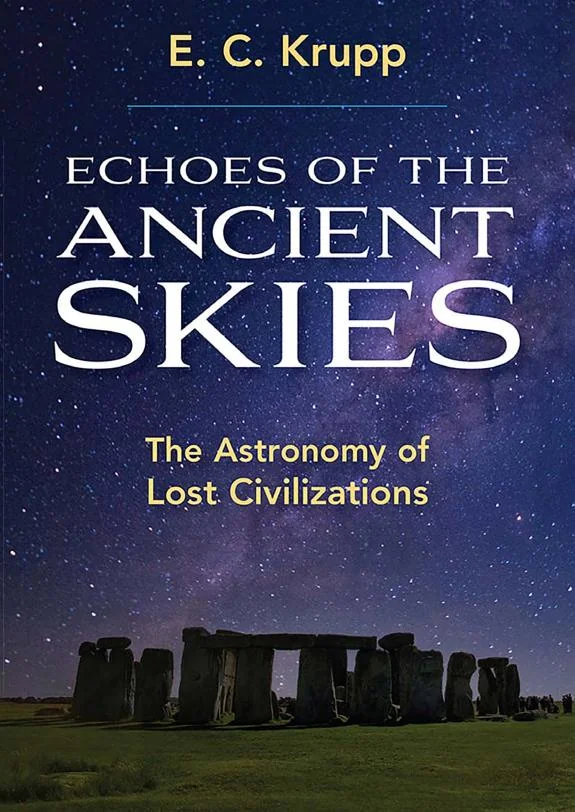
E. C. Krupp's 2003 book, Echoes of the Ancient Skies, examines how ancient peoples understood the cosmos.
Echoes of the Ancient Skies investigates archaeoastronomy, the study of how past cultures observed and made sense of the stars. E. C. Krupp traces the links between the sky and human societies, showing how astronomical awareness influenced myths, rituals, and social organization worldwide. The book describes the sky watching of various groups, from European megalith builders to Mesoamerican astronomers. It covers how these societies used celestial observations to mark time, orient buildings, and understand their place in the universe.
The book is for anyone interested in the connections between astronomy, history, and culture. Amateur astronomers will find historical context for their hobby. Students of anthropology and religious studies can learn about the role of the heavens in ancient beliefs. General readers curious about the intellectual achievements of past civilizations will also find it rewarding. It serves as an approachable introduction to archaeoastronomy for newcomers.
This book sits within a tradition of connecting celestial cycles to human affairs, a practice seen across many cultures. While Krupp approaches the subject from an academic, historical perspective, the material itself touches upon the ancient human impulse to find meaning and order in the cosmos. The study of archaeoastronomy, in its focus on how ancient peoples interpreted the sky, echoes older esoteric concerns with astrology, divination, and the perceived influence of celestial bodies on earthly events and human destiny. Krupp's work provides the historical and anthropological background for understanding these ancient worldviews.
💡 Why Read This Book?
• Learn about the precise astronomical alignments of ancient sites like Stonehenge, understanding how early cultures used celestial events to structure their societies and rituals. • Discover the methods ancient civilizations, such as those in Mesoamerica, employed to track the movements of celestial bodies, leading to the development of sophisticated calendars. • Gain insight into how astronomical knowledge was interwoven with mythology and religious practices, revealing the profound impact of the sky on ancient worldviews.
⭐ Reader Reviews
Honest opinions from readers who have explored this book.
❓ Frequently Asked Questions
What is archaeoastronomy and how does 'Echoes of the Ancient Skies' explain it?
Archaeoastronomy is the study of how ancient people observed and used celestial phenomena. Krupp's book explains it by examining astronomical alignments in ancient structures, the development of ancient calendars, and the role of the sky in mythologies and rituals across various cultures.
Which ancient cultures are discussed in 'Echoes of the Ancient Skies'?
The book covers a wide range of cultures, including those in Mesoamerica (like the Maya and Aztecs), ancient Egypt, Europe (with examples like Stonehenge), and the Anasazi of North America, among others.
What role did celestial observation play in ancient societies according to Krupp?
According to Krupp, celestial observation was crucial for developing calendars for agriculture and ceremonies, orienting sacred and monumental architecture, and forming the basis of religious beliefs and cosmological systems.
How does the book use illustrations to explain complex concepts?
With over 200 illustrations, the book visually represents celestial alignments, architectural designs, and astronomical diagrams. These visuals clarify how ancient peoples tracked stars, the sun, and the moon, and how structures like temples and observatories were designed.
Is 'Echoes of the Ancient Skies' suitable for beginners in archaeoastronomy?
Yes, the book is highly suitable for beginners. Krupp's accessible writing style and clear explanations, supported by ample illustrations, make complex topics in archaeoastronomy understandable without prior specialized knowledge.
What is the significance of Stonehenge as discussed in the book?
Stonehenge is discussed as a prime example of archaeoastronomical significance, particularly its alignment with the summer solstice sunrise. The book explores how such megalithic sites demonstrate sophisticated understanding of celestial cycles.
🔮 Key Themes & Symbolism
Celestial Alignments and Architecture
The book meticulously details how ancient structures were aligned with astronomical events. From the solstitial markers at Stonehenge to the precise orientation of Mesoamerican pyramids, Krupp demonstrates that these were not random constructions but sophisticated observatories. This theme highlights the practical and sacred integration of celestial cycles into the built environment, revealing a deep understanding of cosmic rhythms that guided societal planning and ritual practices.
Ancient Calendars and Timekeeping
A central theme is the development of calendars by ancient civilizations, driven by the need to track celestial phenomena. Krupp explores how observations of the sun, moon, and stars enabled the creation of complex timekeeping systems, essential for agriculture, religious festivals, and governance. The evolution from lunar cycles to solar and Venusian counts, as seen in Mayan and Egyptian systems, illustrates the intellectual leaps made in understanding cosmic periodicity.
Cosmology and Mythology
Elements of the Ancient Skies examines how astronomical observations profoundly shaped ancient cosmologies and mythologies. Krupp shows how celestial bodies were often personified as deities and how their movements were interpreted as divine actions or omens. This theme illustrates the human impulse to find meaning in the heavens, combining narratives that explained the origins of the world, human destiny, and the order of the universe.
Cross-Cultural Astronomical Knowledge
Krupp presents a comparative view of astronomical knowledge across diverse cultures, from ancient Egypt and Greece to the Americas. This theme emphasizes that while specific expressions varied, the fundamental human drive to observe, understand, and integrate celestial patterns into life was universal. By juxtaposing different traditions, the book reveals commonalities in human intellectual and spiritual responses to the cosmos.
💬 Memorable Quotes
Direct passages from the work, attributed to the author.
“The sky was not just a backdrop; it was a calendar, a clock, a map, and a divine revelation.”
— This interpretation captures the essence of archaeoastronomy, suggesting that for ancient peoples, the celestial sphere was an active and integral part of their daily lives, providing essential information for survival and spiritual understanding.
“Ancient observatories were often built at sites of immense cultural or religious importance.”
— This statement emphasizes the sacred nature of astronomical observation in antiquity, suggesting that the alignment of structures with celestial events was not merely scientific but deeply intertwined with ritual, power, and belief systems.
“Understanding ancient skywatching helps us appreciate the intellectual achievements of our ancestors.”
— This interpretation frames the study of archaeoastronomy as a means of recognizing and valuing the scientific and philosophical contributions of past civilizations, underscoring their ingenuity in interpreting the universe.
💡 Key Ideas
Editorial paraphrase of the work's core concepts — not direct quotes.
Archaeoastronomy reveals the profound connection between human culture and the predictable cycles of the cosmos.
This paraphrased concept highlights the core pursuit of the field: demonstrating how the study of ancient sites and artifacts can illuminate the deep, often spiritual, relationship humanity has historically held with astronomical phenomena.
The Maya developed intricate calendars based on sophisticated observations of Venus and the Sun.
This quote points to the advanced astronomical capabilities of specific ancient cultures, illustrating how detailed celestial tracking informed complex calendrical systems that governed Mayan society.
🌙 Esoteric Significance
Tradition
While not strictly belonging to a single esoteric lineage, 'Elements of the Ancient Skies' resonates deeply with Hermetic and Theosophical traditions that emphasize the correspondence between the macrocosm (universe) and the microcosm (humanity). It aligns with the Hermetic principle 'As above, so below' by illustrating how celestial patterns were believed to influence earthly events and human destiny. The work serves as a bridge, connecting empirical observation with the ancient impulse to find spiritual meaning and order in the cosmos, a common thread in many esoteric philosophies.
Symbolism
Key symbols explored include the Sun and Moon, which represent fundamental dualities (masculine/feminine, light/dark, conscious/unconscious) and are central to creation myths and calendrical systems across cultures. The alignment of structures like Stonehenge with solstices and equinoxes symbolizes the cyclical nature of existence and the passage of time, reflecting cosmic order. The stars themselves function as symbols of eternity, divine guidance, and the unchanging celestial laws that ancient peoples sought to understand and emulate.
Modern Relevance
Contemporary thinkers in fields like consciousness studies, comparative mythology, and even modern paganism draw upon the insights presented in 'Elements of the Ancient Skies'. The book's emphasis on the universal human drive to connect with celestial rhythms informs modern explorations of animism and deep ecology. It provides a historical and cultural framework for understanding practices that seek harmony with natural cycles, influencing contemporary spiritual seekers and researchers investigating the ancient roots of human spirituality and cosmology.
👥 Who Should Read This Book
• Students of comparative religion and mythology seeking to understand the celestial origins of ancient belief systems and deities. • Amateur astronomers interested in the historical context of sky observation and the development of early astronomical tools and theories. • Archaeologists and historians looking for comprehensive research on the cultural significance of ancient sites and their relationship with astronomical phenomena.
📜 Historical Context
Published in 2003, 'Elements of the Ancient Skies' emerged as a significant contribution to the field of archaeoastronomy, which had been gaining academic momentum since the mid-20th century. This era saw a surge in interdisciplinary studies, combining archaeology, astronomy, anthropology, and history. Krupp's work built upon the foundational research of scholars like Alexander Thom, known for his studies of megalithic structures, and Gerald Hawkins, who controversially proposed astronomical alignments at Stonehenge in his 1973 book 'Beyond Stonehenge'. While competing schools of thought debated the precision and intent behind ancient alignments, Krupp's approach offered a balanced and accessible synthesis. His extensive research and clear prose distinguished the book from more specialized academic papers, making complex theories about celestial observation and its cultural impact understandable to a wider audience. The book arrived at a time when the public's fascination with ancient mysteries was high, solidifying its place as a key text for both scholars and enthusiasts.
📔 Journal Prompts
Reflect on the concept of celestial alignments as a form of ancient communication with the divine.
Consider how the Maya's intricate calendars, as described in the text, might have influenced their daily lives and worldview.
Explore the symbolic meaning of the Sun and Moon in the context of the cultures discussed.
Analyze the relationship between monumental architecture and astronomical observation in ancient societies.
How might the ancient understanding of cosmic cycles, as detailed in the book, inform contemporary perspectives on time and existence?
🗂️ Glossary
Archaeoastronomy
The interdisciplinary study of how ancient peoples understood the phenomena in the skies, how they used the observations of the sun, moon, and stars to create calendars, and how these celestial bodies influenced their cultures and religions.
Solstice
The two times of the year, around June 20 or 21 and December 21 or 22, when the sun appears to reach its most northerly or southerly excursion relative to the celestial equator. These mark the longest and shortest days of the year.
Equinox
The two times of the year, around March 20 or 21 and September 22 or 23, when the sun is directly above the Earth's equator. Day and night are of approximately equal length everywhere on Earth.
Megalithic
Relating to or denoting prehistoric structures, especially in ancient Britain and France, built of large undressed stones, such as Stonehenge or Stonehenge-like structures.
Cosmology
The branch of astronomy that deals with the origin, evolution, and eventual fate of the universe, as well as the large-scale properties of space and time. In ancient contexts, it refers to their understanding of the structure and order of the universe.
Alignment
In archaeoastronomy, the intentional orientation of a structure or feature towards a specific celestial event, such as a sunrise, sunset, or star rising/setting at a particular time of year.
Anthropology
The study of human societies and cultures and their development. In this context, it helps understand how astronomical observations were integrated into social structures and belief systems.