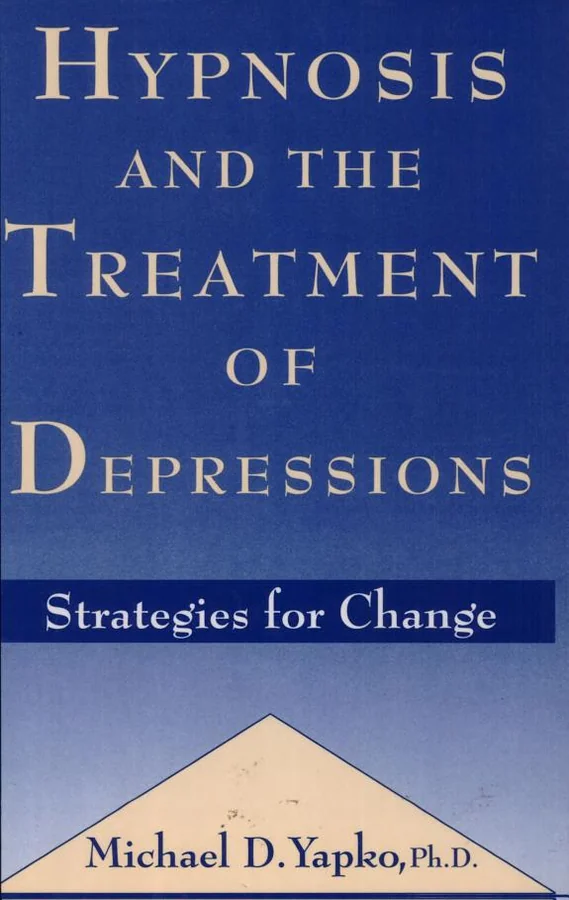
Hypnosis and the treatment of depressions
 82
82

Hypnosis and the treatment of depressions
Yapko's 1992 text offers a pragmatic, clinically oriented perspective on using hypnosis for depression, a subject often clouded by misinformation. The work effectively demystifies the process, presenting it as a focused therapeutic intervention rather than a mystical art. A notable strength lies in its detailed exploration of specific hypnotic protocols for addressing negative cognitions and improving self-esteem, moving beyond generalized suggestions. However, the text's 1992 publication date means some of its cited research and theoretical frameworks may feel dated to contemporary practitioners. For instance, its discussion on the neurobiological underpinnings of depression, while relevant for its time, has been significantly expanded by subsequent research. Despite this, the core principles of hypnotic suggestion and its role in cognitive reframing remain pertinent. The section detailing how to utilize hypnotic metaphors to challenge catastrophic thinking offers a concrete example of its practical value. Ultimately, "Hypnosis and the Treatment of Depressions" serves as a valuable historical and practical reference for understanding hypnotherapy's application in mental health.
📝 Description
82
### What It Is Michael D. Yapko's "Hypnosis and the Treatment of Depressions," first published in 1992, examines the therapeutic application of hypnotic techniques for individuals experiencing depressive states. The work details specific methodologies and theoretical underpinnings that link hypnotic states to psychological healing. It is not a general overview of hypnosis but a focused exploration of its role in addressing a particular mental health challenge.
### Who It's For This book is geared towards mental health professionals, including psychotherapists, clinical psychologists, and psychiatrists, who are interested in expanding their treatment modalities. It is also relevant for researchers in psychopathology and hypnosis, and for individuals undergoing hypnotherapy who wish to understand the process more deeply. It assumes a foundational knowledge of psychological principles.
### Historical Context The 1990s marked a period of increasing integration of alternative and complementary therapies into mainstream psychology. While hypnosis had a complex history, often associated with stage performances, works like Yapko's aimed to re-establish its credibility as a clinical tool. This book emerged as hypnotherapy began to be more seriously considered for a wider range of conditions beyond simple habit control.
### Key Concepts Central to Yapko's thesis is the idea that hypnosis can facilitate access to unconscious material relevant to depression, alter negative self-perceptions, and enhance coping mechanisms. The book discusses trance induction, suggestion, and post-hypnotic suggestion as tools for reframing depressive thought patterns. It also touches on the importance of the therapeutic relationship in facilitating these interventions.
💡 Why Read This Book?
• Understand specific hypnotic protocols for depression, such as direct and indirect suggestion techniques, to reframe negative self-perceptions, a method detailed in Yapko's clinical examples. • Gain insight into the historical positioning of hypnotherapy in mental health treatment during the early 1990s, a period where its clinical utility was being re-evaluated. • Learn about the role of trance induction and metaphor in therapeutic hypnosis, as explored in the book's chapters on accessing unconscious resources for mood regulation.
⭐ Reader Reviews
Honest opinions from readers who have explored this book.
❓ Frequently Asked Questions
What is the primary goal of using hypnosis for depression according to Michael D. Yapko?
The primary goal is to utilize hypnotic states to facilitate access to unconscious material, alter negative self-perceptions, and enhance coping mechanisms, thereby addressing the root causes and symptoms of depression.
When was "Hypnosis and the Treatment of Depressions" first published?
The book was first published in 1992, marking a period of renewed interest in the clinical applications of hypnosis.
Is this book suitable for individuals seeking self-hypnosis techniques for depression?
While it provides insights into hypnotic principles, the book is primarily aimed at mental health professionals. It details clinical applications rather than providing a direct guide for self-treatment.
What kind of historical context does the book provide regarding hypnotherapy?
It situates hypnotherapy within the early 1990s, a time when efforts were underway to re-establish its credibility as a clinical tool against a backdrop of stage-performance associations.
What are some key concepts discussed in relation to hypnosis and depression?
Key concepts include trance induction, suggestion (direct and indirect), post-hypnotic suggestion, and the use of metaphors to reframe depressive thought patterns and enhance self-esteem.
Does the book cover the neurobiological aspects of depression?
The book touches upon the theoretical underpinnings relevant to its 1992 publication. While it discusses psychological mechanisms, it does not extensively cover the extensive neurobiological research that has emerged since then.
🔮 Key Themes & Symbolism
Hypnotic State Utility
The work posits that the hypnotic state is not merely relaxation but a distinct psychological condition amenable to therapeutic intervention. Yapko details how this state allows for increased suggestibility and access to subconscious processes that contribute to depressive states. The book explores how specific induction techniques can facilitate a focused state where individuals are more receptive to reframing negative cognitions and emotional responses, moving beyond mere symptom management to address underlying psychological patterns.
Cognitive Reframing via Suggestion
A central theme is the application of hypnotic suggestion to challenge and modify the distorted thinking patterns characteristic of depression. Yapko elaborates on the use of both direct and indirect suggestions, as well as metaphorical language, to help patients develop more positive self-views and adaptive coping strategies. This involves subtly altering the patient's internal dialogue and perception of their circumstances, leveraging the focused attention of the hypnotic state to implant new, healthier perspectives.
Therapeutic Alliance Dynamics
While focusing on techniques, the book implicitly and explicitly underscores the importance of the therapeutic relationship. The efficacy of hypnotic interventions is presented as being significantly influenced by the trust and rapport between therapist and client. Yapko suggests that a strong alliance facilitates the client's openness to hypnotic suggestion and their willingness to engage with the therapeutic process, making the collaborative aspect crucial for successful outcomes.
Historical Clinical Application
Published in 1992, the book serves as a historical document illustrating the state of clinical hypnotherapy for depression at that time. It reflects a movement to professionalize and legitimize hypnosis within psychotherapy, differentiating it from entertainment. The text showcases how practitioners were integrating hypnotic methods into established therapeutic frameworks, contributing to the ongoing discourse on evidence-based psychological treatments.
💬 Memorable Quotes
“Hypnotic suggestion can be used to reframe negative self-perceptions.”
— This interpretation highlights Yapko's emphasis on the power of suggestion within hypnosis to alter an individual's core beliefs about themselves, particularly when those beliefs contribute to depression.
“The therapeutic relationship is key to effective hypnotherapy.”
— This paraphrased concept underscores the book's acknowledgment that technical skill in hypnosis must be supported by a strong, trusting bond between therapist and client for optimal results.
“Accessing unconscious material can illuminate depressive patterns.”
— This interpretation points to Yapko's exploration of how hypnosis allows for a deeper understanding of subconscious factors that fuel depression, enabling more targeted therapeutic work.
“Metaphorical language in hypnosis aids in cognitive restructuring.”
— This paraphrase captures Yapko's technique of using symbolic narratives within hypnosis to help patients challenge and change their habitual, often negative, ways of thinking.
“Trance induction creates a state receptive to therapeutic change.”
— This interpretation emphasizes Yapko's view of hypnosis not just as relaxation, but as a specific mental state that enhances a person's capacity for positive psychological transformation.
🌙 Esoteric Significance
Tradition
While primarily a clinical psychology text, "Hypnosis and the Treatment of Depressions" touches upon themes resonant with esoteric traditions that explore the mind's latent powers and the subconscious. It aligns with schools of thought that view the human psyche as having deeper, often untapped, layers accessible through altered states of consciousness. This connects to Hermetic principles of mentalism ('The All is Mind') and traditions focusing on the power of focused intention and visualization, albeit framed within a modern therapeutic context.
Symbolism
The book implicitly utilizes symbolic language through the use of therapeutic metaphors. These metaphors, such as a 'light' breaking through 'darkness' or 'burdens' being lifted, act as symbolic representations of psychological states and transitions. In an esoteric context, these can be seen as modern iterations of archetypal symbols used in myth and ritual to represent healing, transformation, and the overcoming of internal obstacles, mirroring ancient shamanic or mystical practices.
Modern Relevance
Yapko's work continues to inform contemporary practitioners interested in the intersection of hypnosis and mental health. Modern psychotherapists, particularly those in integrative or humanistic modalities, may draw upon his techniques. Thinkers exploring embodied cognition and the power of narrative in healing also find relevance in his approach to reframing depressive thought patterns through hypnotic suggestion and metaphor, linking it to current research on the mind-body connection.
👥 Who Should Read This Book
• Mental health professionals (psychologists, therapists, counselors) seeking to integrate evidence-based hypnotic techniques into their practice for treating depression. • Graduate students in psychology or counseling programs studying advanced therapeutic modalities and historical approaches to mental health treatment. • Researchers interested in the evolution of hypnotherapy and its application in specific clinical contexts during the late 20th century.
📜 Historical Context
Michael D. Yapko’s "Hypnosis and the Treatment of Depressions" emerged in 1992, a period when psychotherapy was actively seeking to integrate a wider array of techniques into its practice. While psychoanalysis and cognitive-behavioral therapy (CBT) were dominant, there was a growing openness to complementary approaches. Hypnosis, previously often relegated to stage shows or fringe practices, was undergoing a resurgence in clinical legitimacy, partly due to the efforts of figures like Yapko. This era saw researchers and practitioners like David Spiegel at Stanford exploring hypnosis for pain management and psychological distress. Yapko's work aimed to provide a structured, evidence-informed approach to using hypnosis for depression, differentiating it from earlier, less empirical applications. It contributed to the ongoing dialogue about the efficacy of psychotherapeutic interventions, positioning hypnotherapy as a viable tool within a broader mental health landscape, even as behaviorism and cognitive models continued to hold significant sway.
📔 Journal Prompts
The function of hypnotic suggestion in reframing negative self-perceptions.
Your understanding of the therapeutic alliance in the context of hypnotherapy.
The role of trance induction in accessing unconscious material.
How metaphorical language, as discussed by Yapko, can symbolize psychological change.
The historical development of hypnotherapy as a clinical tool.
🗂️ Glossary
Trance Induction
The process by which a therapist guides a client into a hypnotic state, characterized by focused attention, heightened suggestibility, and often a sense of altered perception.
Suggestibility
The degree to which an individual is receptive to suggestions offered by a hypnotist. In therapy, this is leveraged to introduce therapeutic ideas and changes.
Cognitive Reframing
A therapeutic technique involving identifying and challenging distorted or unhelpful thought patterns and replacing them with more realistic and adaptive ones.
Post-Hypnotic Suggestion
A suggestion given during hypnosis that is intended to be acted upon after the hypnotic session has concluded, influencing behavior or mood.
Metaphor in Therapy
The use of symbolic stories or images within a therapeutic context to communicate complex ideas, bypass resistance, and facilitate emotional understanding or change.
Depressive States
A range of conditions characterized by persistent low mood, loss of interest, and other emotional and physical problems that interfere with daily life.
Unconscious Material
Psychological content (thoughts, feelings, memories) that is not currently in conscious awareness but can influence behavior and emotions.