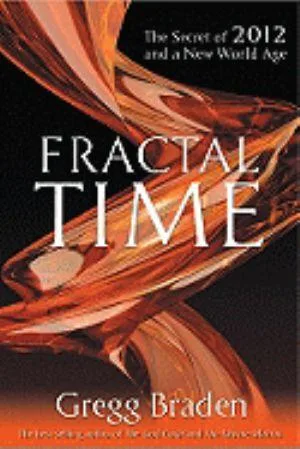
Fractal Time
 71
71

Fractal Time
Gregg Braden’s "Fractal Time" challenges the conventional, linear perception of history with a compelling argument for cyclical, fractal patterns. Braden adeptly synthesizes scientific concepts, such as fractal geometry, with interpretations of ancient prophecies and historical events, creating a unique lens through which to view human experience. His exploration of "time gates" – moments where past and future cycles intersect – is particularly intriguing, offering a framework for understanding recurring challenges and opportunities. However, the book's reliance on interpreting ancient texts and historical parallels can sometimes feel speculative, lacking the rigorous empirical backing one might expect from purely scientific discourse. A strength lies in its ability to reframe personal struggles within a grander, historical context, making individual lives feel connected to larger cosmic rhythms. The limitation appears when the interpretive leaps become too vast without sufficient evidential bridging. "Fractal Time" offers a stimulating, albeit sometimes speculative, perspective on the nature of existence and history.
📝 Description
71
Gregg Braden's 2009 book posits time is not linear but fractal, with patterns repeating across scales.
Published in 2009, Gregg Braden's "Fractal Time" argues against a linear view of history and personal experience. Braden proposes that time exhibits fractal properties, meaning patterns and events repeat at various scales, from geological eras to individual lives. This cyclical understanding offers a framework for interpreting the past and potentially influencing the future by recognizing these recurring structures. The book synthesizes scientific observations with elements drawn from ancient wisdom traditions to support its assertion of a non-linear temporal reality. Braden suggests that understanding these temporal patterns can provide deeper insight into our present circumstances and the broader sweep of history. The work encourages readers to look for connections between personal challenges and larger historical movements, moving beyond conventional models of progress. It examines moments, termed "time gates," where past cycles may directly impact present realities.
This work fits within occult philosophy by challenging mainstream scientific and historical narratives. Braden’s exploration of cyclical time and recurring patterns echoes traditions that view history not as a straight line but as a series of repeating ages or cycles. His synthesis of scientific concepts with ancient wisdom points to a perennialist current in esoteric thought, which seeks universal truths across diverse cultural and historical sources. The book engages with ideas about consciousness and the potential for human agency in shaping future events based on an understanding of these deeper temporal structures.
💡 Why Read This Book?
• Understand the concept of "time gates" to recognize how past patterns might be influencing your present decisions and future potential, offering a new perspective on personal challenges. • Gain insight into Gregg Braden's interpretation of ancient prophecies and historical cycles, allowing you to see recurring themes in human civilization beyond a simple chronological progression. • Explore the fractal nature of time as proposed by Braden, providing a unique framework for analyzing historical events and personal experiences that differs significantly from linear historical models.
⭐ Reader Reviews
Honest opinions from readers who have explored this book.
❓ Frequently Asked Questions
What is the core concept of Gregg Braden's 'Fractal Time'?
The central idea is that time is not linear but fractal, meaning patterns repeat across different scales, from historical epochs to individual lives, suggesting history echoes itself.
When was 'Fractal Time' first published?
'Fractal Time' by Gregg Braden was first published in 2009, reflecting a period of growing interest in alternative historical and consciousness models.
What kind of ancient wisdom does 'Fractal Time' reference?
The book references various ancient calendars, prophecies, and indigenous traditions, interpreting them as maps of recurring temporal patterns rather than literal predictions.
How does 'Fractal Time' relate to scientific concepts?
It draws parallels between fractal geometry and the proposed cyclical nature of time, suggesting that mathematical principles of self-similarity apply to historical and personal experiences.
What does Braden mean by 'time gates'?
Time gates are specific moments or periods where past historical cycles strongly influence present realities, and where future patterns may begin to manifest, offering opportunities for conscious choice.
Is 'Fractal Time' a historical analysis or a spiritual guide?
It functions as a blend, offering an unconventional analysis of history and time through a spiritual and consciousness-oriented lens, aiming to provide practical wisdom for living.
🔮 Key Themes & Symbolism
Cyclical History
The work proposes that history does not progress in a straight line but repeats in cycles, much like fractals exhibit self-similarity across different scales. Braden analyzes historical events and societal shifts to identify recurring patterns. This theme challenges the linear, progressive view of history prevalent in Western thought, suggesting that understanding these cycles can provide crucial insights into present circumstances and future possibilities, drawing parallels between ancient civilizations and contemporary challenges.
Time Gates and Choice
Central to Braden's thesis are 'time gates,' specific temporal junctures where past patterns converge with present realities, influencing future outcomes. These moments are presented not as deterministic points, but as critical opportunities for conscious awareness and choice. The book suggests that by recognizing these gates, individuals and societies can make informed decisions that either perpetuate negative cycles or initiate more beneficial ones, shifting the trajectory of personal and collective destiny.
Consciousness and Reality
The book posits a strong connection between human consciousness and the fabric of reality, particularly concerning the perception and experience of time. Braden implies that our collective awareness plays a role in manifesting or interacting with these temporal cycles. By understanding the fractal nature of time and the significance of time gates, individuals can potentially alter their personal experiences and contribute to a more positive unfolding of future events, highlighting the active role of the observer.
Ancient Wisdom and Modern Science
Braden seeks to bridge ancient traditions, including prophecies and cosmologies, with modern scientific concepts like fractal geometry and quantum physics. He interprets ancient texts not as literal predictions but as sophisticated understandings of temporal patterns. This theme aims to demonstrate that seemingly disparate fields of knowledge can converge to offer a more holistic view of existence, validating age-old wisdom through contemporary scientific frameworks and suggesting a unified understanding of reality.
💬 Memorable Quotes
“The future is not a destination we arrive at, but a choice we make.”
— This statement emphasizes agency and free will within Braden's framework of cyclical time. It suggests that despite recurring patterns, the outcome is not predetermined, highlighting the power of conscious decision-making in shaping personal and collective futures.
“History does not repeat itself, but it rhymes.”
— This is a paraphrased concept often attributed to Mark Twain, but it encapsulates Braden's idea of fractal time. It means that while exact events may not recur, the underlying patterns, themes, and emotional resonances of past eras reappear in new contexts.
“We are living in a time of accelerated cycles.”
— This interpretation suggests that the fractal patterns Braden describes are not only present but are becoming more pronounced or faster-acting in contemporary times. It implies a sense of urgency and heightened significance for the present era.
“The greatest discoveries are not new worlds, but new ways of seeing.”
— This quote, attributed to various thinkers, underscores Braden's core message: the transformative power lies not in external events but in shifting our perception. Understanding time as fractal offers such a new way of seeing, impacting how we interpret our lives and history.
“Ancient peoples understood the rhythms of time in ways we have forgotten.”
— This highlights Braden's respect for ancient wisdom traditions. It suggests that contemporary society has lost a vital connection to natural temporal cycles, which the book aims to help readers rediscover through the lens of fractal patterns.
🌙 Esoteric Significance
Tradition
Braden's work draws heavily from a syncretic esoteric tradition that blends elements of Hermeticism, Gnosticism, and indigenous cosmologies. It aligns with esoteric philosophies that posit a hidden order or intelligence underlying manifest reality. Unlike purely Kabbalistic or Theosophical systems, "Fractal Time" emphasizes the cyclical, pattern-based nature of time and consciousness, suggesting a dynamic, unfolding universe rather than a static, divinely ordained structure. It departs from strict linear interpretations found in some Western esoteric lineages by focusing on recurring archetypes and temporal echoes.
Symbolism
A key symbol is the **fractal** itself, representing self-similarity across scales – the idea that patterns in the grand sweep of history mirror those in personal lives. The **serpent** or **ouroboros** (snake eating its tail) is often implicitly invoked, symbolizing cyclicality, eternity, and the interconnectedness of beginnings and endings. Another motif is the **spiral**, visually representing both outward growth and inward return, common in ancient mandalas and cosmological diagrams, signifying the journey through recurring cycles.
Modern Relevance
Contemporary thinkers in fields like complexity science, systems theory, and integral psychology find resonance in Braden's fractal model. His ideas influence contemporary spirituality focused on consciousness, personal empowerment, and the search for meaning in a rapidly changing world. Practices in mindfulness and intentional living often draw on the concept of recognizing and consciously navigating recurring patterns, a core tenet of "Fractal Time." The work continues to inform discussions about predictive modeling and societal resilience by offering a non-linear perspective.
👥 Who Should Read This Book
• Individuals interested in alternative historical frameworks and cyclical theories of time, seeking to understand recurring patterns in human civilization beyond linear progression. • Seekers of personal growth and meaning who question conventional timelines and wish to explore how historical cycles might inform their own life experiences and choices. • Readers intrigued by the intersection of science and spirituality, particularly those who appreciate syntheses of fractal geometry, ancient prophecies, and consciousness studies.
📜 Historical Context
Published in 2009, Gregg Braden’s "Fractal Time" emerged within a cultural landscape increasingly receptive to non-linear thinking and the integration of ancient wisdom with modern science. This period saw a surge in popular interest in quantum physics, consciousness studies, and alternative historical narratives, partly fueled by earlier works like Zecharia Sitchin's "The 12th Planet" (1976) and Michael D. Coe's archaeological studies. Braden's work tapped into a zeitgeist that questioned established paradigms, offering a perspective that contrasted sharply with the prevailing linear, materialistic worldview. While not directly engaging with mainstream academic debates, his ideas resonated with a growing audience seeking meaning beyond conventional explanations, aligning with thinkers exploring cyclical theories of civilization and history, such as those influenced by Carl Sagan’s "Cosmos" (1980) which explored cosmic cycles. The book’s reception was largely within the self-help and New Age communities, bypassing traditional academic or critical literary circles.
📔 Journal Prompts
The concept of "time gates" and their potential influence on your present.
Identifying recurring patterns in your personal history that mirror broader historical cycles.
How the idea of fractal time challenges your linear perception of personal progress.
Reflecting on ancient wisdom traditions and their understanding of temporal rhythms.
The role of consciousness in shaping future possibilities within a cyclical framework.
🗂️ Glossary
Fractal Time
The concept that time is not linear but exhibits self-similar patterns across different scales, meaning historical and personal events can echo each other in recurring cycles.
Time Gates
Specific junctures in time where past historical cycles strongly influence present realities and future patterns begin to emerge, presenting critical moments for conscious choice.
Cycles
Recurring patterns or sequences of events that repeat over time, from geological ages to societal trends and individual life experiences, as described in the fractal model.
Self-Similarity
A characteristic of fractals where patterns appear the same regardless of the scale at which they are viewed, applied in this context to the recurrence of historical themes across different epochs.
Consciousness
In the context of "Fractal Time," consciousness refers to the awareness and perception that interacts with, and potentially influences, the unfolding of temporal patterns and cycles.
Ancient Prophecies
Interpretations of ancient texts and predictions, viewed not as literal foretellings but as sophisticated understandings of recurring temporal rhythms and human behavioral patterns.
Linear Time
The conventional, sequential perception of time as a straight line moving from past to present to future, which "Fractal Time" challenges with its cyclical model.