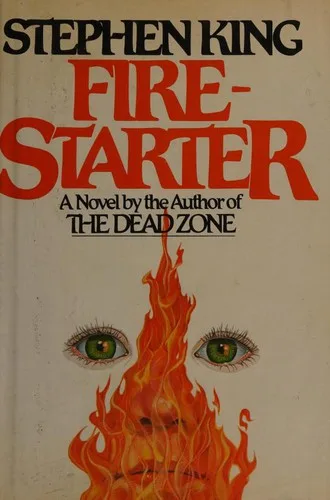
Firestarter
 81
81

Firestarter
Stephen King’s "Firestarter" is a stark depiction of an ordinary family thrust into extraordinary peril. The novel excels in its portrayal of Charlie McGee, a child burdened with terrifying power, and her parents' desperate attempts to shield her from a predatory government agency. King’s strength here lies in rendering the mundane terror of being hunted, transforming the familiar landscape of suburban America into a battleground. The weakness, however, is the somewhat predictable trajectory of Charlie's escalating abilities and "The Shop's" relentless pursuit, which can feel formulaic by the novel’s midpoint. A particularly memorable sequence involves Charlie’s early, uncontrolled bursts of power, illustrating the raw, dangerous potential that both fascinates and terrifies her. The narrative’s ultimate verdict hinges on whether the exploration of parental love against overwhelming odds can fully compensate for a plot that occasionally treads familiar King territory.
📝 Description
81
### What It Is Stephen King's 1980 novel, "Firestarter," chronicles the harrowing experiences of the McGee family, particularly young Charlie, who possesses pyrokinesis. The story unfolds as Charlie's latent psychic abilities, triggered by an experimental drug called Lot Six, draw the attention of a clandestine government agency known only as The Shop. This organization seeks to weaponize her powers, leading to a desperate flight for survival.
### Who It's For Readers interested in the intersection of supernatural abilities and government conspiracies will find "Firestarter" compelling. It appeals to those who appreciate character-driven narratives set against a backdrop of suspense and psychological tension. Fans of King's earlier works, particularly those exploring extraordinary human capabilities and their consequences, will recognize familiar thematic territory.
### Historical Context Published in 1980, "Firestarter" emerged during a period of heightened public fascination with parapsychology and psychic phenomena, fueled partly by Cold War anxieties and a general interest in the unexplained. King's work tapped into this zeitgeist, presenting a grounded, albeit terrifying, exploration of what might happen if such powers were real and controllable by shadowy entities.
### Key Concepts The narrative revolves around the nature of innate power, the ethics of its exploitation, and the lengths to which individuals will go to protect their loved ones. It examines the corrupting influence of unchecked institutional power and the primal instinct for self-preservation when faced with overwhelming threats. The concept of "The Shop" represents a faceless, amoral bureaucracy wielding immense resources to achieve its objectives.
💡 Why Read This Book?
• Gain insight into the psychological toll of extraordinary abilities, as seen in Charlie McGee's struggle to control her pyrokinesis, a central element explored from its initial manifestations. • Understand the dangers of unchecked institutional power through "The Shop's" relentless pursuit of Charlie, mirroring anxieties from the post-Watergate era. • Experience a visceral depiction of familial protection, exemplified by Andy and Vicky McGee's extreme measures to safeguard their daughter, a theme amplified by their shared experience with Lot Six.
⭐ Reader Reviews
Honest opinions from readers who have explored this book.
❓ Frequently Asked Questions
What is the significance of Lot Six in Stephen King's "Firestarter"?
Lot Six is an experimental drug administered to parents in the 1960s, including Charlie McGee's. It's the catalyst for latent psychic abilities, such as pyrokinesis, manifesting in their offspring, forming the central premise of "Firestarter".
Who is "The Shop" in "Firestarter"?
"The Shop" is a clandestine government agency in "Firestarter" dedicated to exploiting and weaponizing individuals with psychic powers, like Charlie McGee, for nationalistic or nefarious purposes.
What are Charlie McGee's powers in "Firestarter"?
Charlie McGee's primary ability is pyrokinesis, the power to generate and control fire with her mind. As the story progresses, her powers escalate, demonstrating a terrifying potential for destruction.
When was "Firestarter" by Stephen King first published?
"Firestarter" was first published in 1980, marking a significant entry in Stephen King's early career, exploring themes of psychic phenomena and government conspiracy.
Are there any real-world inspirations for "The Shop" in "Firestarter"?
While fictional, "The Shop" draws on real-world anxieties surrounding covert government experiments and intelligence agencies during the Cold War era, reflecting a societal distrust explored in literature of the period.
What makes "Firestarter" unique compared to other Stephen King novels?
"Firestarter" distinguishes itself with its intense focus on a child protagonist possessing overwhelming power and the direct, high-stakes conflict with a shadowy organization, moving beyond supernatural horror to a more direct thriller narrative.
🔮 Key Themes & Symbolism
The Burden of Power
Charlie McGee's pyrokinesis represents an overwhelming, innate force that is both a part of her identity and a source of immense danger. The narrative explores the profound psychological weight of possessing such abilities, especially when they are uncontrollable and attract malevolent attention. Her struggle is not just to wield the fire, but to contain it, reflecting a deep-seated fear of one's own destructive potential and the isolation that accompanies being fundamentally different.
Primal Protection
The driving force behind Andy and Vicky McGee's actions is an unyielding instinct to protect their daughter. Their flight from "The Shop" is a desperate act of parental love, pushing them to extreme measures. This theme highlights the raw, animalistic need to shield one's offspring from perceived threats, even at the cost of their own safety and freedom. The narrative elevates this primal drive to the story's emotional core.
Institutional Corruption
"The Shop" embodies a faceless, amoral bureaucracy that views human beings as resources to be exploited. Its pursuit of Charlie is devoid of ethical consideration, driven solely by the desire for power and control. This theme serves as a critique of unchecked governmental or organizational authority, illustrating how systems can dehumanize individuals in their quest for advancement or security, a prevalent anxiety in the late 20th century.
The Price of Progress
The experimental drug Lot Six, intended to unlock human potential, instead unleashes uncontrollable and dangerous forces. This concept probes the ethical boundaries of scientific advancement, questioning whether certain discoveries are too dangerous to pursue. The tragic consequences faced by the McGee family and others exposed to Lot Six serve as a cautionary tale about the unforeseen repercussions of tampering with natural or psychic human capabilities.
💬 Memorable Quotes
“Her name was Charlene McGee, and she was eight years old. She had a mother and a father and a dog. She had a bicycle and a treehouse and a favorite sweater. She had powers.”
— This early description establishes Charlie's normalcy before introducing her extraordinary abilities, emphasizing the stark contrast and the disruption these powers bring to an otherwise ordinary childhood.
“The Shop was a thing of the mind, a shadow. It was wherever the money was, wherever the power was, wherever the fear was.”
— This passage defines "The Shop" not as a physical place but as a pervasive, insidious force rooted in corruption and control. It highlights its intangible yet omnipresent threat.
“Fire was his mother’s name. Fire was his father’s name. Fire was his name.”
— This repetition underscores the pervasive nature of pyrokinesis within the McGee family, linking it directly to their identities and suggesting it's an inherited or deeply ingrained trait.
“If you were a kid and you had a superpower, you’d be scared too.”
— This interpretation directly addresses the psychological burden of extraordinary abilities, framing Charlie's fear not as weakness but as a rational response to her unique and dangerous circumstances.
“It’s not the fire you fear, it’s the hand that lights the match.”
— This aphorism suggests that the true danger lies not in the power itself, but in the intent and agency of those who control or manipulate it, pointing towards "The Shop" as the primary antagonist.
🌙 Esoteric Significance
Tradition
While "Firestarter" is primarily a thriller, its exploration of innate psychic abilities like pyrokinesis touches upon themes common in esoteric traditions that posit hidden human potentials. It departs from established Western esoteric lineages like Hermeticism or Kabbalah by focusing on raw, almost biological manifestations of power rather than structured magical systems or spiritual attainment. The narrative positions these powers as a force of nature within the individual, rather than a learned or divinely granted faculty.
Symbolism
Fire is the central symbol, representing both destructive potential and primal energy. Charlie's pyrokinesis embodies this duality: it can annihilate but also signifies an inner light or force. "The Shop" symbolizes the corrupting influence of mundane power structures attempting to control or exploit esoteric forces for material or political gain. The experimental drug Lot Six can be seen as a flawed alchemical agent, meant to unlock potential but instead creating dangerous imbalance.
Modern Relevance
Contemporary discussions around latent human abilities, particularly those explored in neuroplasticity or fringe psychology, echo "Firestarter's" premise. Thinkers and practitioners interested in the practical application or control of mental energy, often drawing from Eastern contemplative practices or modern biofeedback techniques, might find resonance in the novel's depiction of extraordinary human capabilities and the challenges they present. The book's depiction of a clandestine organization seeking to weaponize such abilities also remains relevant in an age of advanced surveillance and information control.
👥 Who Should Read This Book
• Thriller enthusiasts seeking a gripping narrative with supernatural elements will appreciate the high-stakes chase and the moral quandaries presented. • Readers interested in the psychological impact of extraordinary abilities on individuals and families will find Charlie McGee's journey particularly compelling. • Fans of Stephen King's early work, especially novels like "Carrie," will enjoy this exploration of psychic powers within a suspenseful framework.
📜 Historical Context
Published in 1980, Stephen King's "Firestarter" arrived during a cultural moment marked by a surge of interest in parapsychology and psychic phenomena, partly fueled by the Cold War's pervasive atmosphere of espionage and covert operations. The novel tapped into anxieties about government overreach and the potential for scientific advancements to be weaponized, themes also explored by contemporaries like Dean Koontz. King's work presented a more visceral, character-driven take on these concepts compared to the more abstract explorations found in some fringe scientific or New Age publications of the era. Reception was generally strong, with the book becoming a bestseller and solidifying King's status as a master of suspenseful narrative. While not directly engaging with specific intellectual movements, it reflected a broader societal fascination with the unexplained and a distrust of shadowy institutions, a sentiment amplified by events like the Watergate scandal.
📔 Journal Prompts
Charlie McGee's pyrokinesis as a manifestation of repressed emotion.
The ethical implications of "The Shop's" pursuit of psychic subjects.
Parental protection versus the exploitation of innate power.
The symbolic representation of fire in the narrative.
Andy McGee's use of his own psychic abilities for manipulation.
🗂️ Glossary
Pyrokinesis
The purported psychic ability to create and control fire using only the mind. In "Firestarter," this is Charlie McGee's primary and most dangerous power.
The Shop
A clandestine government agency in "Firestarter" dedicated to identifying, capturing, and weaponizing individuals with psychic abilities, driven by ruthless ambition.
Lot Six
An experimental drug administered to parents in the 1960s, which caused latent psychic abilities to manifest in their children, serving as the catalyst for "Firestarter's" plot.
The Burned Man
A dangerous, unpredictable psychic individual created by "The Shop's" experiments, representing the extreme and often uncontrollable consequences of their work.
Psychic
Referring to individuals possessing extraordinary mental abilities beyond the normal scope of human perception, such as telekinesis, precognition, or pyrokinesis.
Mandatory Euthanasia
A procedure "The Shop" enforces on their failed experiments or uncontrollable subjects, reflecting their cold, utilitarian approach to human life.
The Ponderosa
A remote facility used by "The Shop" for experimentation and containment of psychic individuals, symbolizing their hidden and ethically dubious operations.