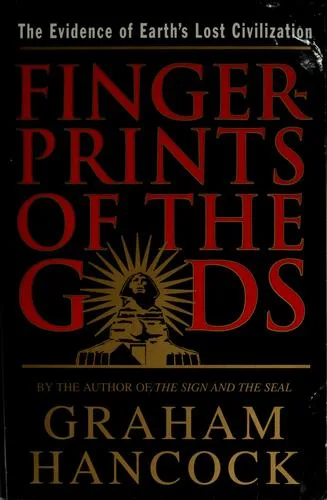
Fingerprints of the gods
 74
74

Fingerprints of the gods
Graham Hancock’s Fingerprints of the Gods (2011 edition) is less a scholarly treatise and more a compelling polemic. Hancock excels at weaving disparate threads of evidence—from geological data on the Younger Dryas to astronomical alignments in ancient structures—into a grand, albeit speculative, narrative. His exploration of the Great Pyramid of Giza's alleged astronomical connections, for instance, is particularly evocative. However, the book’s weakness lies in its tendency to present hypotheses as established fact, often sidestepping rigorous peer review in favor of persuasive storytelling. The author’s reliance on interpreting myths as literal historical accounts, while engaging, strains credulity for many. Ultimately, Fingerprints of the Gods serves as a provocative challenge to conventional history, urging readers to reconsider the accepted timeline of human civilization, but it demands a critical eye and a willingness to accept conjecture.
📝 Description
74
### What It Is
Fingerprints of the Gods, first published in 2011 by Graham Hancock, presents a controversial theory regarding a global civilization that predates known history. Hancock posits that a sophisticated society, advanced in astronomy and engineering, existed approximately 12,500 years ago, before being catastrophically wiped out by a comet impact. The work explores evidence from ancient sites and myths worldwide, suggesting a common origin and shared knowledge base for these advanced cultures.
### Who It's For
This book is intended for readers interested in alternative histories and pre-history, those who question mainstream archaeological timelines, and individuals drawn to theories of lost civilizations and ancient wisdom. It appeals to those who enjoy synthesizing evidence from diverse fields, including archaeology, mythology, and geology, to construct a cohesive, albeit speculative, narrative about humanity's deep past.
### Historical Context
Hancock's work emerges from a lineage of inquiry into ancient mysteries, building upon and challenging established archaeological paradigms. The early 2000s saw a growing public interest in fringe historical theories, fueled by the internet and a general skepticism towards academic consensus. This book entered a landscape where scholars like John Anthony West and Robert Bauval had already proposed unconventional interpretations of ancient sites. Its reception was marked by significant debate, with many academics dismissing its conclusions while popular audiences found its arguments compelling.
### Key Concepts
The central thesis revolves around the Younger Dryas impact hypothesis, a geological event proposed to have occurred around 10,800 BCE. Hancock connects this cataclysm to widespread destruction and the subsequent decline of advanced cultures. He identifies recurring patterns in global myths and monumental architecture, such as the pyramids of Giza and the ruins of Tiahuanaco, as remnants of this forgotten epoch. The book also examines evidence of advanced astronomical knowledge possessed by ancient peoples, suggesting a level of sophistication not typically attributed to them by mainstream archaeology.
💡 Why Read This Book?
• You will learn about the Younger Dryas impact hypothesis, a specific geological event around 10,800 BCE, and how Hancock links it to the destruction of an advanced prehistoric civilization, offering a unique perspective on global cataclysms. • You will explore Hancock's examination of ancient sites like Tiahuanaco, understanding his interpretation of their advanced engineering and astronomical knowledge as evidence of a forgotten global culture. • You will gain an alternative perspective on world mythology, seeing how Hancock proposes recurring motifs across different cultures, such as flood myths, as potential collective memories of a lost epoch.
⭐ Reader Reviews
Honest opinions from readers who have explored this book.
❓ Frequently Asked Questions
What is Graham Hancock's main theory in Fingerprints of the Gods?
Hancock proposes that a highly advanced global civilization existed around 12,500 years ago, predating currently accepted timelines. This civilization was destroyed by a catastrophic comet impact during the Younger Dryas period, leaving behind scattered remnants and influencing global myths.
What evidence does Hancock cite for a lost advanced civilization?
He points to monumental architecture with sophisticated engineering (e.g., the pyramids), evidence of advanced astronomical knowledge in ancient cultures, and recurring patterns in global myths and flood legends, suggesting a common origin.
When was Fingerprints of the Gods first published?
The book was first published in 2011, though its initial release was in 1995. The 2011 edition likely includes updated research and arguments.
What is the Younger Dryas period?
The Younger Dryas is a period of significant global cooling that occurred roughly between 12,900 and 11,700 years ago. Hancock links a hypothesized comet impact during this time to widespread destruction and societal collapse.
How does Fingerprints of the Gods differ from mainstream archaeology?
It challenges the standard timeline of human civilization, suggesting advanced cultures existed far earlier than conventionally believed. It also interprets archaeological and mythological evidence in ways that diverge from academic consensus.
Is Graham Hancock's work accepted by academics?
Hancock's theories are generally considered fringe by mainstream archaeologists and historians. While his work sparks debate and public interest, it is often criticized for speculative interpretations and a lack of rigorous peer-reviewed evidence.
🔮 Key Themes & Symbolism
The Younger Dryas Cataclysm
The book centers on the hypothesis that a comet impact around 10,800 BCE, during the Younger Dryas cold period, caused widespread devastation. Hancock argues this event wiped out a sophisticated global civilization, forcing survivors to rebuild from scratch and leading to the creation of many myths about a great flood or destruction. He examines geological evidence suggesting such an impact, presenting it as the catalyst for humanity's 'reset' and the genesis of our current historical epoch.
Evidence of a Prehistoric Global Civilization
Hancock posits that remnants of this advanced civilization can be found worldwide in megalithic structures exhibiting uncanny engineering precision and astronomical alignment. He highlights sites like the Giza pyramids, Göbekli Tepe (dating to around 9600 BCE), and structures in South America, suggesting a common, highly developed culture with shared knowledge of mathematics and cosmology that predates established historical records.
Mythology as Historical Record
A significant aspect of Hancock's argument is the interpretation of global myths, particularly flood narratives and stories of a 'golden age' followed by destruction. He suggests these are not mere allegories but fragmented collective memories of a real, advanced civilization and the cataclysm that ended it. By comparing myths from diverse cultures, he seeks to find echoes of this forgotten past and its sophisticated knowledge.
Forgotten Astronomical Knowledge
The book emphasizes the sophisticated astronomical understanding possessed by ancient peoples. Hancock proposes that the orientation and design of ancient monuments were not arbitrary but deliberately encoded with celestial data, reflecting advanced knowledge of cycles, precession, and cosmic events. This suggests a continuity of sophisticated scientific observation stretching back to the end of the last Ice Age.
💬 Memorable Quotes
“The Earth was struck by a swarm of comet fragments.”
— This refers to Hancock's central thesis regarding the Younger Dryas impact event. He uses this as the primary explanation for the destruction of a hypothesized advanced civilization and the subsequent reset of human history.
“The myths of the flood are never of one time, but of all times.”
— This paraphrase highlights Hancock's view that global flood myths are not isolated legends but recurring historical memories. He sees them as evidence of a widespread, ancient catastrophe that impacted humanity's collective consciousness.
“The Great Pyramid of Giza is a map of the stars.”
— This interpretation points to Hancock's argument about the astronomical significance of ancient structures. He suggests the alignment and dimensions of the pyramids encode celestial information, reflecting advanced knowledge of cosmic cycles.
“We are the inheritors of a lost golden age.”
— This captures the essence of Hancock's belief in a superior precursor civilization. He posits that humanity today is living with the diminished legacy of a far more advanced society that existed in remote antiquity.
“The evidence for a lost civilization is written in stone and myth.”
— This paraphrase encapsulates Hancock's methodology. He draws upon both physical evidence from ancient sites and the symbolic language of global myths to support his controversial theory of prehistoric advanced cultures.
🌙 Esoteric Significance
Tradition
Hancock's work draws implicitly from traditions that posit ancient, advanced root races or lost continents (like Atlantis) possessing advanced spiritual and technological knowledge. While not strictly adhering to a single lineage like Theosophy or Hermeticism, it echoes their theme of a cyclical history where humanity has fallen from a prior state of enlightenment. It taps into a modern esoteric current that seeks hidden knowledge in ancient sites and myths, suggesting humanity's true origins are far more complex and mystical than secular history allows.
Symbolism
The book frequently engages with the symbolism of the pyramid, representing not just construction but also a connection between the earthly and the celestial, a map of cosmic order. Water and flood symbolism are pervasive, representing not only natural disaster but also purification and the cyclical destruction and rebirth of ages. The motif of the 'serpent' or 'dragon' also appears, often symbolizing ancient wisdom, chaos, or the destructive cosmic forces linked to the comet impact.
Modern Relevance
Hancock's ideas continue to influence contemporary esoteric thought, particularly within communities interested in ancient astronaut theories, earth mysteries, and alternative archaeology. Thinkers exploring consciousness studies and the potential for collective memory often cite his work as a compelling, albeit controversial, framework. Modern proponents of the Younger Dryas impact hypothesis, some of whom collaborate with Hancock, continue to research and promote his core ideas, finding resonance in contemporary discussions about planetary defense and humanity's vulnerability to cosmic events.
👥 Who Should Read This Book
• Readers interested in ancient mysteries and alternative historical timelines will find Hancock's synthesis of geological, archaeological, and mythological evidence compelling. • Individuals questioning the accepted narrative of human development and seeking explanations for anomalous ancient structures will gain a provocative alternative perspective. • Those fascinated by theories of lost civilizations and global cataclysms will appreciate the detailed exploration of the Younger Dryas impact hypothesis and its proposed consequences.
📜 Historical Context
Published in 2011, Fingerprints of the Gods by Graham Hancock arrived during a period of burgeoning interest in alternative history and ancient mysteries, amplified by internet dissemination. It built upon the groundwork laid by authors like Erich von Däniken and, more recently, Robert Bauval and John Anthony West, who had already challenged conventional timelines for the construction and purpose of ancient megaliths. Hancock’s work entered a discourse already polarized between mainstream archaeology, which largely dismissed such theories as pseudo-science, and a popular audience fascinated by the possibility of lost civilizations. The book’s reception was typical of Hancock's career: widely read and debated, but often criticized by academics for its speculative leaps and selective use of evidence, particularly in contrast to the rigorous, evidence-based methodology championed by figures like Zahi Hawass, then Secretary-General of Egypt's Supreme Council of Antiquities.
📔 Journal Prompts
The Younger Dryas impact hypothesis and its implications for human civilization.
Recurring motifs in global flood myths and their possible historical basis.
The astronomical alignments in ancient structures like the Giza pyramids.
Interpreting the symbolism of the pyramid as a cosmic map.
Evidence for sophisticated engineering in sites like Tiahuanaco.
🗂️ Glossary
Younger Dryas
A period of significant global cooling that occurred roughly between 12,900 and 11,700 years ago. Hancock proposes a comet impact during this period as the cause of a catastrophic event.
Megalithic Structures
Large structures built from massive stones, often found in ancient sites worldwide. Hancock uses their sophisticated construction and alignment as evidence of advanced prehistoric cultures.
Precession of the Equinoxes
A slow wobble in Earth's axis that causes the position of the stars at the time of the spring equinox to shift over thousands of years. Hancock argues ancient sites reflect knowledge of this cycle.
Göbekli Tepe
An archaeological site in Turkey featuring massive stone pillars dating back to approximately 9600 BCE. Hancock cites it as evidence of advanced early civilization predating agriculture.
Tiahuanaco
An ancient archaeological site in Bolivia known for its impressive stonework and monumental architecture, which Hancock suggests is evidence of a sophisticated prehistoric culture.
Atlantis
A legendary island civilization mentioned by Plato, often associated with advanced technology and a sudden cataclysmic end. Hancock's theories echo some aspects of the Atlantis myth.
Global Flood Myths
Narratives found in cultures worldwide describing a great flood that destroyed civilization. Hancock interprets these as fragmented memories of a real cataclysm.