Farmer Giles of Ham
 76
76

Farmer Giles of Ham
Tolkien’s "Farmer Giles of Ham" functions less as a profound myth and more as a highly skilled pastiche. The narrative’s strength lies in its linguistic execution; Tolkien’s command of Old English phrasing and tone creates an authentic-feeling, albeit invented, historical document. The story of Giles, a simple farmer who uses cleverness rather than brute force to defeat a dragon, is charming and anticlimactic in the best way. Its primary limitation is its brevity and lack of deeper thematic exploration, which might leave some readers wanting more substance beyond the stylistic accomplishment. The passage detailing Giles’s initial reluctance and eventual, almost accidental, rise to fame perfectly encapsulates the story’s understated humor. Ultimately, it is a delightful, meticulously crafted piece of literary antiquarianism.
📝 Description
76
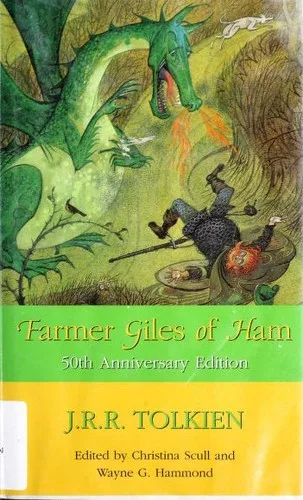
J.R.R. Tolkien's 1949 story, Farmer Giles of Ham, recounts a farmer's unlikely rise to hero.
Published in 1949, J.R.R. Tolkien's "Farmer Giles of Ham" unfolds as a medieval-style chronicle. It details the transformation of a simple farmer into a celebrated dragon-slayer. The story is presented as if it were a newly discovered manuscript, lending a sense of historical authenticity to its fantastical events. This approach allows Tolkien to play with narrative conventions and the construction of legend.
The work appeals to those who enjoy linguistic games and the traditions of folklore. It offers a look at Tolkien's storytelling outside his more extensive Middle-earth mythology. Readers looking for a brief, engaging tale with a mythic quality will find it particularly rewarding. The narrative is deliberately crafted with an archaic style, echoing the rhythms and structures of Old English poetry and medieval romances.
Tolkien, a scholar of Old English and medieval literature, crafted "Farmer Giles of Ham" with deep awareness of ancient heroic traditions. The story mimics the style and thematic concerns of early medieval romances and heroic poetry. Its presentation as a found manuscript connects to a historical fascination with uncovering and authenticating older texts. The narrative’s engagement with the creation of legends and the public perception of heroism touches on themes present in folklore studies and the anthropology of myth.
💡 Why Read This Book?
• You will experience Tolkien’s mastery of Old English stylistic imitation, understanding how he crafts a narrative voice that evokes medieval chronicles, a skill distinct from his Middle-earth epics. • You will encounter the concept of the 'accidental hero' through Giles, a character whose fame is built on circumstance and wit rather than inherent martial prowess, offering a unique perspective on heroism. • You will appreciate the subtle satire present in the story's depiction of societal expectations and the creation of legend, understanding how Tolkien subverted traditional heroic tropes with a wry, scholarly touch.
⭐ Reader Reviews
Honest opinions from readers who have explored this book.
❓ Frequently Asked Questions
What is the publication history of J.R.R. Tolkien's Farmer Giles of Ham?
Farmer Giles of Ham was first published in 1949. It appeared as a supplement to the Autumn 1949 issue of the Bodleian Library Record and was also issued as a separate booklet.
Who illustrated Farmer Giles of Ham?
The original and most notable illustrations for Farmer Giles of Ham were created by Pauline Baynes, who also illustrated Tolkien's The Adventures of Tom Bombadil and Smith of Wootton Major.
What is the primary language style of Farmer Giles of Ham?
The story deliberately mimics the style and linguistic conventions of Old English heroic poetry and medieval romances, reflecting Tolkien's deep academic expertise in philology and ancient literature.
Does Farmer Giles of Ham connect to the legendarium of Middle-earth?
No, Farmer Giles of Ham is a standalone story and is not directly connected to the mythology and history of Middle-earth, though it showcases Tolkien's characteristic narrative style.
What is the core narrative of Farmer Giles of Ham?
The story follows Giles, a humble farmer who, through a series of fortunate events and clever stratagems, becomes known as a dragon-slayer and gains fame and fortune.
What is the significance of the Bodleian Library in its publication?
Its initial publication by the Bodleian Library in 1949 lent it an air of academic legitimacy and presented it as a unique literary artifact rather than a typical commercial release.
🔮 Key Themes & Symbolism
Accidental Heroism
The narrative centers on Giles, a farmer whose rise to heroic status is more a product of circumstance and cleverness than inherent bravery or martial skill. He is not a knight or warrior but a common man thrust into extraordinary situations. His primary weapon against the dragon Criseyde is not a sword but a strategically deployed 'black air' and later, a clever negotiation. This theme subverts traditional heroic archetypes, suggesting that reputation and societal perception can be as powerful as actual deeds, a concept explored through Giles's reluctant journey from obscurity to fame.
Linguistic Pastische
Tolkien, a distinguished philologist, imbues "Farmer Giles of Ham" with the style and cadence of Old English heroic poetry and medieval chronicles. The language is deliberately archaic, complete with invented place names and titles, creating a convincing illusion of historical authenticity. This stylistic pastiche is not merely decorative; it shapes the reader's perception of the events and characters, framing the story as a discovered artifact. The work is a evidence of Tolkien's deep engagement with the linguistic structures of early medieval literature.
Reputation vs. Reality
A significant theme is the dichotomy between how Giles is perceived and his actual nature. He is hailed as a dragon-slayer, a hero of the realm, yet his motivations are primarily driven by self-preservation and the desire for material gain (the king's reward). The story highlights how quickly a legend can be constructed, often with little regard for the nuanced reality of the individual. This commentary on the creation and manipulation of public image is subtly woven through the narrative, particularly in the king's eager acceptance of Giles's 'exploits'.
The Mundane and the Mythic
The story brilliantly juxtaposes the ordinary life of a farmer with the extraordinary threat of a dragon and the subsequent emergence of mythic status. Giles’s farm, his dog, and his simple life are the starting point, providing a stark contrast to the dragon Criseyde's lair and the king's court. This grounding in the mundane makes the fantastical elements more impactful and Giles's transformation more striking. It explores how mythic narratives can arise from the most unexpected corners of everyday existence.
💡 Key Ideas
Editorial paraphrase of the work's core concepts — not direct quotes.
He was a stout man, and as he was well-to-do, he took his ease and was not given to adventure.
This line immediately establishes Giles not as a typical hero, but as a comfortable, ordinary man. It sets up the central irony of the story: how such a person becomes entangled in heroic deeds and legendary status, subverting common expectations of protagonists.
‘I have been an enemy of yours,’ said Giles, ‘and I have done you great harm.’
This quote, spoken by Giles to the dragon Criseyde, is a masterful understatement. It refers to Giles having driven the dragon away from his village and farm, framing it as a personal offense to the beast. It highlights Giles's pragmatic, almost business-like approach to a legendary conflict.
‘A dragon is a dragon,’ said Criseyde. ‘He is a great menace.’
This is a paraphrase of the king’s reasoning for demanding Giles deal with the dragon. It represents the societal pressure and the perceived necessity of confronting a threat, regardless of who is best equipped to do so. It underscores the king's reliance on Giles, the supposed dragon-slayer.
‘The king rewarded him and gave him the title of ‘The Dragon-Slayer’.’
This paraphrased conclusion signifies the formal establishment of Giles's legendary status. It demonstrates how official recognition solidifies a reputation, regardless of the underlying complexities or the individual's true nature, cementing his place in the story's chronicle.
‘The dragon was at his last gasp.’
This quote describes the state of the dragon Criseyde after Giles has supposedly defeated him. It emphasizes that the dragon was already weakened or defeated by others (implied by context), and Giles merely arrives to claim the 'victory,' highlighting the opportunistic nature of his heroism.
🌙 Esoteric Significance
Tradition
While not explicitly occult, "Farmer Giles of Ham" draws from the deep wellspring of Western European folklore and pre-Christian mythic narrative, which are foundational to many esoteric traditions. Its archaic style and focus on a seemingly mundane hero confronting a primal force like a dragon aligns with archetypal psychology and Jungian interpretations of myth. The story can be viewed as a secularized myth, stripped of overt religious dogma but retaining the symbolic power found in Gnostic tales of overcoming primordial chaos or Hermetic narratives of transformation.
Symbolism
The dragon, Criseyde, represents primal chaos, ancient power, and the untamed forces of nature that threaten civilization. Giles, the farmer, symbolizes the grounded, ordinary human being who, through wit and circumstance, can tame or overcome these forces. The king's reward and the title 'Dragon-Slayer' symbolize societal recognition and the transformation of the individual into a figure of legend. The 'black air' Giles uses can be interpreted as a symbolic representation of cunning or perhaps even a primitive form of magical deception used to control a more overt, destructive power.
Modern Relevance
Modern readers interested in folklore, comparative mythology, and the psychology of heroism find resonance in "Farmer Giles of Ham." Its exploration of archetypes—the humble hero, the monstrous adversary, the powerful ruler—connects to contemporary discussions in Jungian psychology and the study of narrative structure. Thinkers who explore the power of storytelling to shape identity and societal understanding can analyze Tolkien's deliberate crafting of a legend, making it relevant to fields like cultural studies and narrative therapy.
👥 Who Should Read This Book
• Aspiring writers and scholars of medieval literature interested in Tolkien’s combination of philology and narrative invention, gaining insight into his stylistic methods beyond Middle-earth. • Folklore enthusiasts seeking a concise, engaging tale that playfully engages with dragon-slaying myths and the archetype of the accidental hero, understanding how classic tropes can be subverted. • Readers appreciating linguistic artistry and historical pastiche, who enjoy stories that meticulously recreate the feel and voice of a bygone era through careful language choice and narrative structure.
📜 Historical Context
Published in 1949, "Farmer Giles of Ham" emerged in a post-war Britain grappling with national identity and cultural heritage. Tolkien, a distinguished Oxford professor, was deeply immersed in Old English and medieval literature, movements that saw scholars and writers reviving interest in Anglo-Saxon sagas and heroic poetry. His work at this time, including the scholarly "Beowulf: The Monsters and the Critics" (1936), fundamentally reshaped the study of these texts. "Farmer Giles" itself was published by the Bodleian Library, lending it an air of scholarly artifact rather than commercial fiction, differentiating it from more mainstream fantasy emerging at the time. While not directly engaging with contemporaries like C.S. Lewis’s Narnia series, which began in 1950, Tolkien's story offered a distinct, philologically grounded approach to myth-making, drawing on a tradition Lewis less directly referenced.
📔 Journal Prompts
Giles's transformation from farmer to 'Dragon-Slayer' suggests the power of narrative. How might a chosen title or reputation reshape an individual's perceived reality?
The dragon Criseyde represents a primal threat. Reflect on a modern-day 'dragon'—a societal problem or personal fear—and consider what 'cleverness' might be needed to face it.
Consider the king's eagerness to accept Giles's 'victory.' How do societal expectations influence the acceptance of heroic narratives, even when the reality might be different?
The story's archaic style is crucial. How does the deliberate imitation of Old English prose affect your perception of Giles and his world compared to a modern retelling?
Giles’s motivation is largely practical (reward, peace). Explore the tension between self-interest and the demands of public heroism as depicted in the story.
🗂️ Glossary
Philology
The study of language in oral and written historical sources; it is the intersection of textual criticism, literary criticism, history, and linguistics. Tolkien was a renowned philologist.
Pastiche
An artistic work in a style that imitates that of another work, artist, or period. Tolkien's "Farmer Giles of Ham" is a pastiche of medieval chronicles and Old English heroic poetry.
Chronicle
A historical account of events in the order in which they happened. The story is presented as if it were such a historical record.
Dragon-slayer
A common heroic archetype in folklore and mythology, representing the vanquishing of chaos or evil. Giles is given this title, though his methods are unconventional.
Old English
The earliest recorded form of the English language, spoken in England from the 5th to the 11th century. Tolkien's expertise in this language heavily influenced his writing style.
Archetype
A very typical example of a certain person or thing; in literature, a recurring symbol or motif that represents universal patterns of human nature.
Criseyde
The name of the dragon in "Farmer Giles of Ham." The name itself has literary associations, notably from Chaucer's "Troilus and Criseyde."
🔮 Readers Also Liked
Browse all →









More by J.R.R. Tolkien
All books →





More Free Occult Philosophy Books
View all →




![Evocation [sic] deorum](/img/thumb/evocation-sic-deorum-gabriella-gustafsson-447656.webp)