Etruscan Roman remains in popular tradition

 78
78

Etruscan Roman remains in popular tradition
Charles Godfrey Leland's "Etruscan Roman Remains in Popular Tradition" presents a formidable collection of Italian folk magic and belief systems, a considerable achievement for its time. The sheer volume of documented spells, charms, and folkloric narratives is impressive, offering a direct window into practices often overlooked by mainstream historical accounts. Leland's dedication to recording these traditions firsthand, particularly those he encountered in regions like Tuscany, lends the work an undeniable authenticity. However, the book's strength in exhaustive cataloging is also its primary limitation; it often lacks deeper analytical interpretation or theoretical framework, presenting the material in a somewhat undigested manner. A particularly striking section details the various invocations and ritualistic uses of herbs, demonstrating a practical magical knowledge that persisted into the modern era. While invaluable for its raw data, the reader must often construct the broader significance themselves. It serves best as a foundational text for further scholarly inquiry.
📝 Description
78
Charles Godfrey Leland published 'Etruscan Roman Remains in Popular Tradition' in 1907, documenting Italian witchcraft.
Charles Godfrey Leland’s 1907 book gathers folklore, magical practices, and beliefs from Italy that survived Christianity's establishment. He meticulously recorded oral traditions, superstitions, and enduring pagan customs, blending ancient Etruscan and Roman elements with later folk magic. This work functions as an ethnographic survey, preserving fragments of a worldview that persisted in popular culture.
The book targets students of folklore, comparative religion, and Western esotericism. It appeals to those interested in historical research on ancient belief systems within everyday life. Readers seeking practical folk magic, witchcraft traditions, and pre-Christian religious thought will find extensive material. It is a scholarly resource rather than a casual read.
Leland conducted his fieldwork in the late 19th century, a time of growing interest in anthropology and oral tradition collection. His research tapped into scholarly efforts to understand the persistence of pre-Christian beliefs. Unlike speculative metaphysics, his approach favored direct ethnographic observation. His cataloging of rituals and beliefs offered a vital perspective against purely classical interpretations of Roman religion.
This book sits within the late 19th-century surge of interest in comparative mythology and the hidden currents of folk belief. Leland’s work documents traditions that scholars often overlooked, focusing on the lived experience of magic and pre-Christian practices rather than abstract theology. It contributes to the study of Western esotericism by showing the continuity of ancient magical systems within popular culture, a counterpoint to more formalized occult movements of the era.
💡 Why Read This Book?
• Gain insight into surviving 'Stregoneria' practices, including specific incantations and amuletic uses detailed by Leland, revealing the persistence of pre-Christian magical frameworks. • Understand the syncretic fusion of ancient Etruscan and Roman beliefs with later Christian elements, as documented through recorded folk festivals and rituals from the Italian countryside. • Explore the practical applications of folk magic, such as healing remedies and protective charms, as cataloged from oral traditions collected by Leland in the late 19th century.
⭐ Reader Reviews
Honest opinions from readers who have explored this book.
❓ Frequently Asked Questions
What is 'Stregoneria' as described by Leland?
'Stregoneria' refers to the folk witchcraft traditions of Italy documented extensively by Charles Godfrey Leland. His work details its practices, beliefs, and practitioners, often showing a blend of ancient pagan elements and later Christian influences.
When was Charles Godfrey Leland's research on Etruscan Roman remains conducted?
Leland conducted much of his extensive fieldwork and compilation for "Etruscan Roman Remains in Popular Tradition" during the latter half of the 19th century, with the book first published in 1977.
Does the book focus on historical Roman religion or folk traditions?
The book primarily focuses on the survival and transformation of ancient Etruscan and Roman beliefs within popular Italian folk traditions and magic, rather than academic or state-sanctioned Roman religion.
What regions of Italy does Leland's work primarily cover?
Leland's research heavily features traditions from Tuscany, where he spent considerable time, but also incorporates material from other regions of Italy, reflecting a broader spectrum of folk beliefs.
Are there specific examples of magical spells or rituals in the book?
Yes, the book is rich with examples of magical spells, incantations, charms, and folk remedies used for protection, healing, love, and other purposes, meticulously recorded from oral sources.
Is this book suitable for beginners in occult studies?
While fascinating, the book is a scholarly compilation rather than an introductory guide. Beginners might find its dense ethnographic detail challenging without prior context in folklore or comparative religion.
🔮 Key Themes & Symbolism
Survival of Ancient Beliefs
Leland meticulously documents how ancient Etruscan and Roman magical practices, deities, and worldviews persisted in Italian popular tradition long after official conversion to Christianity. He highlights the continuity of certain rituals and superstitions, demonstrating that the 'death' of paganism was not absolute but a process of adaptation and syncretism within folk culture. This theme underscores the resilience of ancient spiritual currents.
Italian Folk Witchcraft (Stregoneria)
A central focus is the detailed examination of 'Stregoneria,' the indigenous witchcraft traditions of Italy. Leland records specific spells, incantations, charms, and the use of symbolic objects and herbs for various purposes—healing, protection, love, and curse-breaking. He presents these not as isolated curiosities but as integral parts of a living, albeit often hidden, magical system.
Syncretism and Adaptation
The work illustrates how ancient beliefs and practices were absorbed, reinterpreted, or blended with Christian elements over centuries. Saints often assumed the roles of older deities, and Christian prayers were sometimes incorporated into magical formulas. This theme reveals the dynamic process by which folk religion adapts to changing socio-religious landscapes while retaining core magical functions.
Ethnographic Documentation
Leland's approach is fundamentally ethnographic; he sought to record the lore directly from the people, collecting oral traditions, superstitions, and firsthand accounts. This emphasis on primary source material gathered from common folk provides invaluable, often unvarnished, insights into the popular imagination and the practical application of magic in daily life during his research period.
💬 Memorable Quotes
Direct passages from the work, attributed to the author.
“The vulgar believe that witches can bring about the rain, the hail, the drought, and the sunshine.”
— This observation by Leland points to the perceived power of folk magic practitioners to influence natural phenomena, a common belief in many pre-modern cultures and a key aspect of 'Stregoneria' he documents.
“Many charms are used to detect thieves or to recover stolen property.”
— This highlights the practical, everyday concerns that folk magic addressed. The desire for security and the restitution of property were potent drivers for magical practices recorded by Leland.
“The witch is often represented as a woman who has made a pact with the devil.”
— This reflects the common demonological interpretation of witchcraft prevalent in European folklore and Christianity, which influenced how practitioners of 'Stregoneria' were often perceived by the wider society.
“Amulets are employed for protection against evil spirits and the evil eye.”
— This succinctly captures the defensive function of magical artifacts in folk belief. The fear of malevolent forces, both spiritual and psychological, spurred the creation and use of protective talismans.
“The old gods and goddesses were often transformed into Christian saints.”
— Leland notes the process of religious syncretism, where remnants of pagan worship were assimilated into Christianity by mapping ancient divine roles onto Christian figures, thus preserving older magical associations.
🌙 Esoteric Significance
Tradition
This work sits within the broader tradition of Western Esotericism, specifically concerning the study of folk magic and surviving pagan elements. It contributes to understanding the practical, often unwritten, magical traditions that persisted outside of formal Hermetic, Kabbalistic, or Alchemical lineages. Leland's documentation provides raw material for scholars examining the continuity of shamanic and earth-based magical practices.
Symbolism
Key symbols include the 'Mano Pantea' (all-powerful hand), often used as a protective amulet, embodying divine power and warding off evil. The book also details the symbolic use of herbs like rue and rosemary in spells for purification, protection, and love, connecting them to ancient agrarian and chthonic deities. The frequent appearance of the Evil Eye motif highlights a pervasive fear of envious or malevolent glances, addressed through specific counter-charms.
Modern Relevance
Contemporary practitioners of witchcraft and neo-paganism, particularly those interested in Italian Stregheria or broader Mediterranean traditions, draw heavily on Leland's research. His documentation of spells and beliefs informs modern magical practices seeking to reclaim and understand ancient folk roots. Thinkers exploring the phenomenology of magic and the persistence of indigenous spiritual systems find his work a foundational ethnographic resource.
👥 Who Should Read This Book
• Students of comparative folklore and religious studies seeking primary source material on the persistence of pre-Christian beliefs in Italy. • Practitioners of folk magic and witchcraft interested in historical 'Stregoneria' traditions and specific incantations recorded by Leland. • Researchers of Western Esotericism looking to understand the unwritten magical currents that influenced later occult developments.
📜 Historical Context
Charles Godfrey Leland conducted his extensive fieldwork for "Etruscan Roman Remains in Popular Tradition" primarily in the latter half of the 19th century, a period rife with burgeoning anthropological interest and a desire to catalog vanishing folk traditions. This era saw scholars like Andrew Lang exploring fairy tales and folklore across Europe. Leland's work focused on the tenacious survival of pre-Christian beliefs and magical practices in Italy, particularly in Tuscany. His research tapped into a vein of occult and esoteric inquiry that ran parallel to, but distinct from, the more formalized spiritualist movements and the rising Theosophy of figures like Helena Blavatsky. While not directly engaging with specific philosophical schools like Neoplatonism in a theoretical sense, Leland's empirical approach to recording folk magic provided a crucial counter-narrative to purely classical or theological interpretations of Roman and Etruscan heritage. His detailed documentation offered a glimpse into the 'underground' spiritual life of the Italian peasantry.
📔 Journal Prompts
The documented use of amulets for protection against the Evil Eye.
Leland's accounts of 'Stregoneria' and its practitioners.
The transformation of ancient gods into Christian saints within folk belief.
Specific herbs and their ritualistic purposes as recorded by Leland.
The concept of witches influencing natural phenomena.
🗂️ Glossary
Stregoneria
The Italian term for folk witchcraft, encompassing a wide range of magical practices, beliefs, and traditions documented by Leland, often blending ancient pagan elements with later Christian influences.
Mano Pantea
An amulet, often depicted as a hand, believed to possess all-powerful protective qualities. It is frequently used in Italian folk magic to ward off evil influences and the Evil Eye.
Janare
A term sometimes used, particularly in Southern Italy, for witches or sorceresses, often associated with specific folk magical traditions and beliefs documented in the book.
Beneath the Moon
A phrase used by Leland to describe secret or nocturnal magical gatherings and practices, often associated with traditional witchcraft rituals and ceremonies.
Evil Eye
A malevolent glare believed to cause misfortune or injury. Leland records numerous charms and amulets specifically designed to protect individuals from its effects.
Incantation
A series of words used as a magical spell or charm. The book contains many examples of incantations used in folk rituals for various purposes, such as healing or protection.
Syncretism
The merging or attempted merging of different religions, cultures, or schools of thought. In this context, it refers to the blending of ancient pagan beliefs with Christianity in Italian folk traditions.
🔮 Readers Also Liked
Browse all →









More by Charles Godfrey Leland
All books →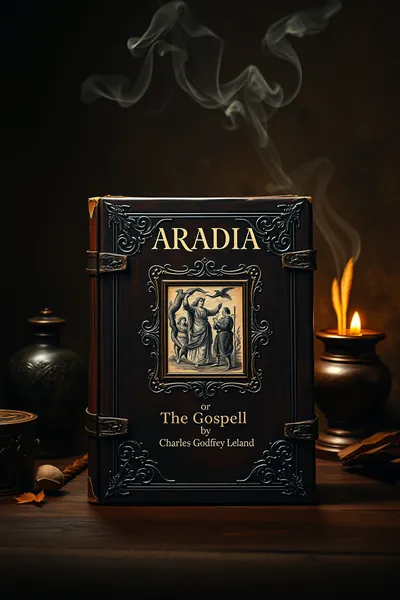





More Free Occult Philosophy Books
View all →