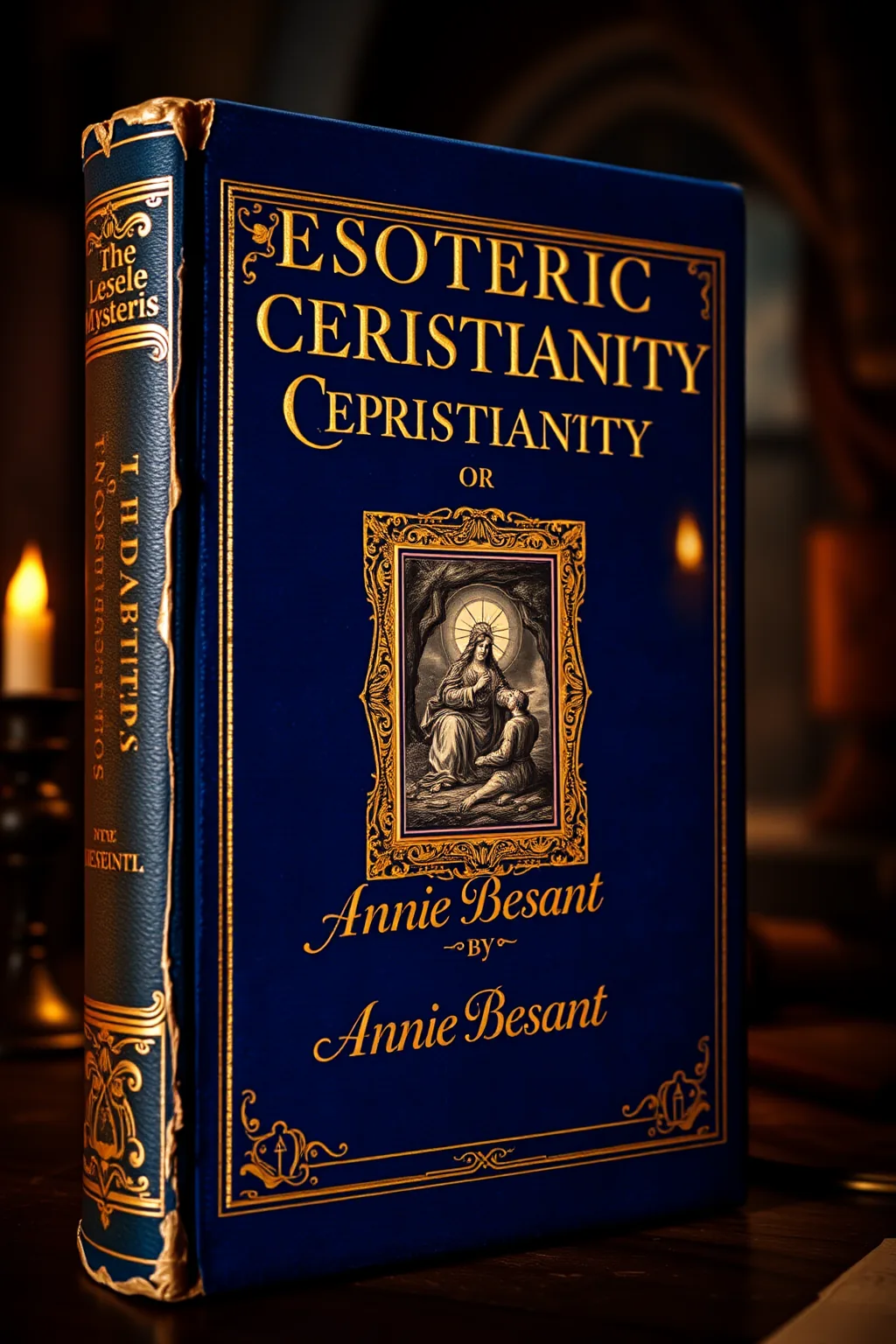
Esoteric Christianity Or the Lesser Mysteries
 76
76

Esoteric Christianity Or the Lesser Mysteries
Annie Besant’s Esoteric Christianity Or the Lesser Mysteries attempts to excavate a forgotten layer of Christian meaning, arguing that the popular version has diluted profound spiritual truths. She focuses on the Christ as an archetypal force and the Gospels as a blueprint for inner transformation, rather than a purely historical account. The strength lies in its systematic approach to symbolism, particularly in reinterpreting the life of Jesus as a map for the aspirant’s journey. However, the work occasionally suffers from an anachronistic application of Theosophical concepts, which can feel imposed upon the original texts. The discussion on the 'Seven Wills' as applied to Christ's sacrifice is particularly striking, offering a unique, albeit dense, perspective. Ultimately, Besant presents a compelling case for a more symbolic and inwardly focused understanding of Christianity, though readers must be prepared for a distinctly Theosophical framework.
📝 Description
76
### What It Is Esoteric Christianity Or the Lesser Mysteries by Annie Besant offers a profound exploration of the hidden doctrines and symbolic meanings embedded within Christian scripture and tradition. It posits that the exoteric, or outward, presentation of Christianity often obscures a deeper, spiritual reality accessible through mystical interpretation. The work aims to illuminate these veiled truths, suggesting that the original teachings of Christ were intended for initiates, a select few capable of grasping their more profound implications.
### Who It's For This book is intended for individuals seeking to understand the mystical underpinnings of Christianity beyond its conventional dogma. It will appeal to students of comparative religion, seekers of spiritual knowledge, and those interested in the esoteric interpretations of Western religious history. Readers who approach theological texts with a desire for symbolic understanding and a questioning of literal interpretations will find particular value in Besant's approach.
### Historical Context Published during a period of intense spiritual and intellectual ferment, Esoteric Christianity Or the Lesser Mysteries emerged from the late 19th and early 20th-century Theosophical movement. Annie Besant, a prominent figure in Theosophy, sought to synthesize Eastern and Western mystical traditions, presenting a universalist view of religion. This era saw a resurgence of interest in ancient wisdom, Gnosticism, and Hermeticism, often in contrast to the prevailing materialism and rigid orthodoxy of the time. Besant's work engaged with these currents by reinterpreting Christian narratives through a Theosophical lens.
### Key Concepts The book delves into the concept of the Christ as a divine principle rather than solely a historical figure, emphasizing the potential for this principle to manifest in individuals who undergo spiritual evolution. It examines key biblical stories and figures, such as the Nativity, the Crucifixion, and the disciples, as allegories for inner spiritual processes. The 'Lesser Mysteries' refers to the initial stages of spiritual awakening and understanding, distinct from the 'Greater Mysteries' of full enlightenment.
💡 Why Read This Book?
• Gain a unique perspective on the life and teachings of Jesus, understanding them as symbolic allegories for spiritual development, directly drawing from Besant's reinterpretation of the Nativity and Crucifixion narratives. • Explore the concept of the 'Lesser Mysteries,' learning how the book frames initial stages of spiritual awakening within a Christian context, as outlined in the foundational chapters. • Understand the Christ not just as a historical figure but as an archetypal divine principle, a core idea discussed throughout the book that offers a different lens on Christian theology.
⭐ Reader Reviews
Honest opinions from readers who have explored this book.
❓ Frequently Asked Questions
What is the main argument of Annie Besant's Esoteric Christianity?
Besant argues that the exoteric, or outward, teachings of Christianity obscure deeper, esoteric truths intended for initiates. She presents the life and teachings of Jesus as a symbolic guide for spiritual evolution and inner transformation.
Who was Annie Besant and what was her background?
Annie Besant (1847-1933) was a prominent British socialist, theosophist, and women's rights advocate. She became a leading figure in the Theosophical Society, promoting its universalist spiritual teachings and advocating for Indian independence.
What does 'Lesser Mysteries' refer to in the book's title?
The 'Lesser Mysteries' denotes the initial stages of spiritual understanding and awakening within the Christian tradition, as interpreted by Besant. These are contrasted with the more profound, advanced teachings of the 'Greater Mysteries'.
How does Besant interpret the life of Jesus?
Besant views Jesus' life, including his birth, death, and resurrection, as allegorical accounts of the spiritual journey of the individual soul. She emphasizes the Christ principle as an inner divine potential.
What is the relationship between this book and Theosophy?
This book is a product of the Theosophical movement, authored by a key leader, Annie Besant. It interprets Christian doctrine through the lens of Theosophical principles, such as reincarnation, karma, and the evolution of consciousness.
When was Esoteric Christianity Or the Lesser Mysteries first published?
The book was first published in 1901, though the edition referenced here has a more recent publication date of 2016-02-24.
🔮 Key Themes & Symbolism
The Christ as Archetypal Principle
Besant reframes the figure of Christ not merely as a historical individual but as the embodiment of the divine potential within humanity. This interpretation moves beyond literalism, suggesting that the 'Christ consciousness' is an attainable state for all aspirants who undergo inner purification and spiritual evolution. The book examines the narratives surrounding Jesus as symbolic representations of this universal spiritual path, emphasizing the inner awakening that mirrors the external events described in the Gospels.
Symbolic Interpretation of Scripture
A core tenet of the work is the belief that biblical narratives and doctrines hold profound symbolic meanings often overlooked by conventional theology. Besant applies a Theosophical lens to reinterpret events like the Nativity, the Baptism, the Crucifixion, and the Resurrection not as literal occurrences but as allegories for the soul's journey through stages of spiritual development and overcoming lower nature.
The Lesser Mysteries
The title itself points to a key theme: the distinction between exoteric (outward, public) religion and esoteric (inner, hidden) knowledge. The 'Lesser Mysteries' represent the initial phases of spiritual understanding, accessible to those prepared to look beyond the surface. Besant suggests that Christ's teachings were originally intended for this inner circle, a concept rooted in ancient mystery traditions, and that rediscovering these veiled truths is essential for true spiritual insight.
Spiritual Evolution and the Aspirant's Path
The book presents a model of human spiritual evolution, with the life of Christ serving as a blueprint for the individual aspirant. It details the challenges and stages involved in transcending the ego, mastering the lower self, and attaining union with the divine. This perspective aligns with Theosophical ideas of reincarnation and karma, portraying the spiritual journey as a progressive unfolding of consciousness over many lifetimes.
💬 Memorable Quotes
“The object of this book is to suggest certain lines of thought as to the deep truths underlying Christianity, truths generally overlooked, and only too often denied.”
— This opening statement clearly defines the author's intent: to reveal hidden, esoteric meanings within Christianity that are frequently missed or dismissed by mainstream interpretation, setting the stage for a deeper, symbolic analysis.
“The generous wish to share with all what is precious, to spread broadcast priceless truths, to shut out none from the illumination of true knowledge, has resulted in a zeal without discretion that has vulgarised Christianity...”
— Besant critiques how the desire to democratize religious knowledge has inadvertently diluted its profound spiritual essence. This oversimplification, she suggests, has made Christianity less potent and accessible to those seeking genuine mystical insight.
“The comma”
— This appears to be an incomplete quote or placeholder. Its inclusion suggests an intention to reference specific punctuation or grammatical points within the text, possibly related to the interpretation of scripture, but the full context is missing.
“The Christ is not a man, but the man made divine.”
— This statement encapsulates Besant's view of Jesus as an exemplar of human potential. It suggests Christ represents the divine nature that can be realized by any individual through spiritual discipline and evolution.
“Jesus, the Christ, is the highest ideal of humanity, and the Christ principle is the divine spark within every soul.”
— This interpretation emphasizes the universal aspect of the Christ. It posits that the divine essence within Jesus is also present in all human beings, offering a path toward spiritual realization for everyone.
🌙 Esoteric Significance
Tradition
This work is firmly rooted in the Theosophical tradition, which sought to establish a 'universal brotherhood' by drawing parallels between Eastern and Western esoteric philosophies. Besant interprets Christianity through the Theosophical framework of reincarnation, karma, and the evolution of consciousness, presenting Jesus as the highest human exemplar and the Christ as a universal divine principle accessible through inner development.
Symbolism
Key symbols explored include the Nativity, representing the birth of the divine spark within the aspirant; the Crucifixion, symbolizing the overcoming of the lower self and the sacrifice of personal desires for a higher purpose; and the Resurrection, signifying spiritual rebirth and the attainment of higher consciousness. These are presented not as historical events but as allegories for the inner spiritual journey.
Modern Relevance
Contemporary New Age spirituality, modern Gnostic studies, and various esoteric Christian movements continue to draw upon Besant's work. Thinkers and practitioners exploring the archetype of the Christ, seeking symbolic interpretations of scripture, or investigating the potential for human spiritual evolution often reference her foundational ideas on the 'Lesser Mysteries' and the inner Christ.
👥 Who Should Read This Book
• Students of comparative religion and esoteric traditions seeking to understand Theosophical interpretations of Western faiths. • Individuals interested in symbolic readings of the Bible and the life of Jesus, moving beyond literal historical accounts. • Seekers of spiritual growth who are drawn to concepts of inner transformation and the development of higher consciousness within a Christian framework.
📜 Historical Context
Annie Besant's *Esoteric Christianity Or the Lesser Mysteries*, first published in 1901, emerged from the vibrant intellectual milieu of the late Victorian and Edwardian eras. This period witnessed a surge of interest in spiritualism, Theosophy, and alternative religious movements, often as a reaction against the perceived materialism and rigid orthodoxy of established churches. Besant, a leading figure in the Theosophical Society following Helena Blavatsky, aimed to synthesize Eastern esoteric traditions with Western mystical thought. Her work engaged directly with the prevailing Christian narrative, seeking to reveal its hidden, Gnostic-like dimensions. Contemporaries like Rudolf Steiner were also developing esoteric interpretations of Christianity during this time, though Steiner would later diverge from Theosophy. Besant's reinterpretation resonated with those disillusioned by literalist theology, offering a more symbolic and inwardly focused spirituality, though it was also met with skepticism from traditionalists.
📔 Journal Prompts
The Christ principle as the divine spark within every soul: how does this concept challenge or affirm your current beliefs?
Reflect on the symbolic meaning of the Crucifixion as presented in the 'Lesser Mysteries' context.
Consider Besant's critique of how Christianity has been 'vulgarised'; where do you see this occurring today?
The allegorical interpretation of biblical narratives: identify one biblical story and explore its potential esoteric meaning.
What are the 'truths generally overlooked' in contemporary religious discourse, according to Besant's approach?
🗂️ Glossary
Exoteric
Relating to or denoting that which is external or outward. In religion, it refers to the teachings and practices intended for the general public, as opposed to esoteric knowledge.
Esoteric
Intended for or likely to be understood by only a small number of people with a specialized knowledge or interest. In religion, it refers to hidden, inner, or mystical teachings.
Lesser Mysteries
In ancient traditions and esoteric thought, the initial stages of initiation or spiritual understanding, concerning the outer forms and symbolic meanings of sacred teachings.
Christ Principle
The divine consciousness or spiritual potential that Besant believed is inherent in all humanity, exemplified by Jesus, the Christ.
Aspirant
A person who seeks or desires a spiritual goal or higher level of consciousness.
Theosophy
A mystical-religious philosophy founded in the late 19th century by Helena Blavatsky, aiming to uncover the universal truths underlying all religions and philosophies.
Vulgarised
Made common, commonplace, or crude; debased. In this context, Besant uses it to mean diluted or simplified to the point of losing its profound spiritual significance.