Die Out-of-Body Experience
 79
79

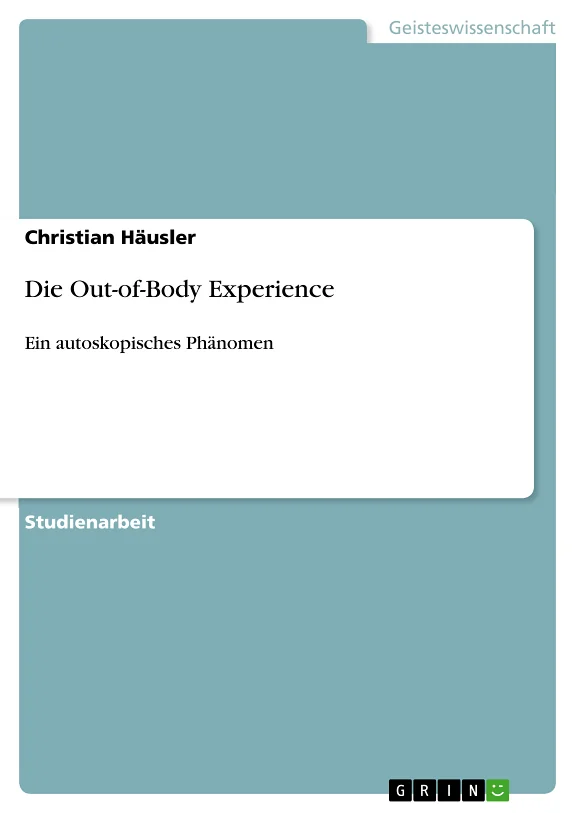
Die Out-of-Body Experience
Christian Häusler's "Die Out-of-Body Experience" offers a welcome academic rigor to a topic frequently obscured by sensationalism. The strength of this 2011 study lies in its systematic approach, attempting to define and categorize autoskopic phenomena within clinical psychology. By referencing specific historical texts and linking subjective experience to potential neuropsychological mechanisms, Häusler provides a valuable foundation for further research. However, the work's origin as a student paper means it may lack the broader synthesis found in more extensive monographs. A particular point of interest is the discussion of the etymology of "autoskopy" from ancient Greek, grounding the phenomenon in a historical linguistic context. The book serves as a solid, if narrowly focused, academic inquiry into a perennially intriguing subject.
📝 Description
79
### What It Is This academic work, originally a 2011 study by Christian Häusler from the Otto-von-Guericke University Magdeburg, examines autoskopic phenomena. These are experiences where an individual perceives their own body from an external viewpoint. The study emerges from the field of clinical psychology and neuropsychology, specifically addressing psychopathology and prevention. It grounds its exploration in psychological theory and neurological observations.
### Who It's For This text is suited for psychology students, particularly those focusing on neuropsychology and psychopathology. It will also engage researchers interested in altered states of consciousness and the phenomenology of self-perception. Individuals studying the history of psychological concepts or the scientific investigation of subjective experiences will find value here.
### Historical Context The book situates its study within the long-standing human fascination with out-of-body experiences (OBEs), noting their presence in mythology and folklore since antiquity. It references early psychological and medical literature, pointing to figures and concepts that have previously attempted to categorize or explain such subjective states. The work reflects a scientific approach to phenomena often relegated to anecdotal accounts or mystical interpretations.
### Key Concepts Central to Häusler's work is the concept of autoskopy, the visual perception of one's own body from an outside perspective. The study differentiates between various forms of these phenomena, potentially exploring their neurological underpinnings and psychological correlates. It likely discusses the subjective experience itself, its potential triggers, and its classification within clinical psychology.
💡 Why Read This Book?
• Gain a precise academic definition of autoskopic phenomena, distinguishing them from related altered states, as explored in Christian Häusler's 2011 study. • Understand the potential neuropsychological correlates discussed in the work, moving beyond anecdotal accounts to scientific inquiry. • Appreciate the historical context of studying out-of-body experiences, referencing early mythological and folklore connections mentioned in the text.
⭐ Reader Reviews
Honest opinions from readers who have explored this book.
❓ Frequently Asked Questions
What is the primary focus of Christian Häusler's "Die Out-of-Body Experience"?
The book's primary focus is the academic examination of autoskopic phenomena, which are experiences where an individual perceives their own body from an external viewpoint, studied within clinical psychology and neuropsychology.
When was "Die Out-of-Body Experience" first published?
The work was first published on October 19, 2011, as a student paper for the Otto-von-Guericke University Magdeburg.
What academic fields does this book draw from?
It draws from clinical psychology, psychopathology, prevention, and neuropsychology, reflecting its origin as a university seminar paper.
Does the book discuss historical accounts of out-of-body experiences?
Yes, the abstract mentions that autoskopic phenomena have fascinated humanity since antiquity and are found in mythology and folklore, referencing authors like Sheils and Todd & Dewhurst.
What is the meaning of the term 'autoskopy'?
The term 'autoskopy' originates from ancient Greek and refers to the phenomenon of seeing oneself from an external perspective.
Is this book a practical guide to having an out-of-body experience?
No, this is an academic study, not a practical guide. It analyzes the phenomenon from a psychological and neuropsychological perspective rather than instructing readers on how to induce such experiences.
🔮 Key Themes & Symbolism
Autoskopie Phenomenon
The central theme is autoskopy, defined as the experience of seeing one's own body from an external vantage point. Häusler's work seeks to categorize and understand the psychological and potential neurological bases of these subjective states. It moves beyond simple anecdotal accounts to examine the phenomenon through the lens of clinical psychology, considering its implications for understanding consciousness and self-perception.
Clinical Psychology & Neuropsychology
This book is firmly rooted in academic psychological research. It applies principles of clinical psychology and neuropsychology to the study of autoskopic experiences. The work likely investigates how these phenomena might manifest in relation to neurological function or dysfunction, and how they are classified within the spectrum of psychological experiences, including psychopathology.
Historical and Mythological Roots
Häusler acknowledges the long history of human fascination with experiences akin to out-of-body states. The study references their presence in ancient mythology and folklore, grounding the modern scientific inquiry in a broader cultural and historical context. This connection highlights the enduring nature of these phenomena in the human experience.
Phenomenology of Self-Perception
At its core, the book explores the subjective experience of altered self-perception. It delves into how individuals perceive their own physical presence and spatial relationship to their bodies during autoskopic episodes. This focus on the lived experience, combined with scientific analysis, is crucial for understanding the complex nature of consciousness.
💬 Memorable Quotes
“Autoskopische Phänomene haben die Menschheit seit jeher fasziniert und sind vielfältig in Mythologie und Folklore eingegangen”
— This passage highlights the deep, historical human interest in autoskopic experiences, noting their consistent presence across cultures in myths and folklore, setting the stage for academic inquiry.
“Der Begriff Autoskopie stammt aus dem Altgriechischen”
— This points to the linguistic origins of the term 'autoskopy,' grounding the scientific concept in its etymological roots and indicating a deliberate effort to define the phenomenon precisely.
“Studienarbeit aus dem Jahr 2011 im Fachbereich Psychologie”
— This factual statement firmly places the work within an academic context, specifying its nature as a student research paper from 2011 in the field of psychology.
“Otto-von-Guericke-Universität Magdeburg (Neuropsychologie)”
— This identifies the specific academic institution and department (Neuropsychology) where the research was conducted, adding institutional credibility and context.
“Veranstaltung: Seminar Klinische Psychologie und Neuropsychologie II SS 2011”
— This details the specific university course and semester under which the paper was produced, further defining its academic scope and origin.
🌙 Esoteric Significance
Tradition
While the work itself is an academic study rooted in psychology and neuropsychology, it touches upon phenomena often explored within esoteric traditions. Autoskopic experiences, or out-of-body states, have been a subject in various mystical lineages, including certain branches of Western esotericism and Eastern contemplative practices, often viewed as a form of spiritual insight or astral projection rather than a clinical symptom.
Symbolism
The primary symbol is the self observed externally, representing a dissociation of consciousness from the physical body. This can symbolize a detachment from egoic identification, an exploration of the 'subtle body,' or a crisis of self-perception. In esoteric contexts, such experiences are often interpreted as journeys of the soul or spirit, transcending physical limitations.
Modern Relevance
Contemporary research into near-death experiences (NDEs), lucid dreaming, and the neuroscience of consciousness often intersects with the phenomena Häusler examines. Thinkers and practitioners in fields like transpersonal psychology, consciousness studies, and even certain mindfulness-based practices may find value in the structured analysis of autoskopic states presented in this work.
👥 Who Should Read This Book
• Psychology students specializing in clinical psychology or neuropsychology, seeking foundational academic research on autoskopic phenomena. • Researchers investigating altered states of consciousness, who need to understand the scientific categorization and potential neurological underpinnings of out-of-body experiences. • Academics and students of the history of psychology, interested in how phenomena traditionally viewed anecdotally are approached through empirical study.
📜 Historical Context
Published in 2011, Christian Häusler's "Die Out-of-Body Experience" emerged during a period of renewed scientific interest in consciousness studies and altered states, building upon decades of psychological and neurological research. The work engages with a history of exploring subjective phenomena that stretches back to early psychoanalysis and philosophical inquiries into selfhood. It implicitly contrasts with more spiritual or parapsychological interpretations prevalent in popular culture, grounding itself in empirical study. While not explicitly engaging with contemporaries in this abstract, the research context places it within the broader discourse of neuropsychology and clinical psychology, fields actively investigating the brain-body connection and the nature of perception. The academic setting of its origin at Otto-von-Guericke University Magdeburg suggests an adherence to established scientific methodologies, distinct from earlier, less empirically rigorous explorations of similar topics.
📔 Journal Prompts
Autoskopie phenomena as described by Häusler: initial observations and questions.
The etymology of 'autoskopy' and its implications for understanding the experience.
Connecting mythological accounts of external self-perception to clinical definitions.
Potential neuropsychological correlates of autoskopic experiences: areas for further study.
The experience of self-perception outside the physical body: subjective aspects.
🗂️ Glossary
Autoskopie
The phenomenon of perceiving one's own body from an external viewpoint, as studied in psychology and neuropsychology.
Out-of-Body Experience (OBE)
A broader term for subjective experiences where an individual feels their consciousness has left their physical body, often encompassing autoskopic phenomena.
Clinical Psychology
A branch of psychology focused on assessing, diagnosing, treating, and preventing mental, emotional, and behavioral disorders.
Neuropsychology
A field that studies the relationship between brain function and behavior, often examining how brain injuries or disorders affect psychological processes.
Psychopathology
The scientific study of mental disorders, including their symptoms, causes, and treatments.
Phenomenology
The philosophical study of the structures of experience and consciousness from the first-person perspective.
Mythology
A collection of myths, especially one belonging to a particular religious or cultural tradition.