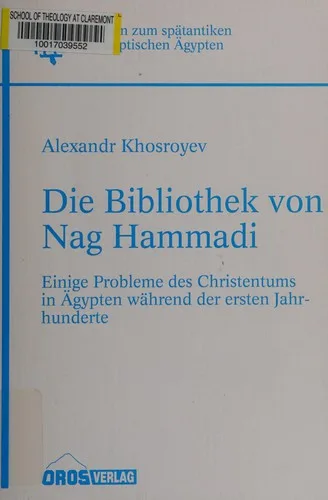
Die Bibliothek von Nag Hammadi
 83
83

Die Bibliothek von Nag Hammadi
Khosroev's study of the Nag Hammadi library is a dense but rewarding engagement with texts that reshaped our understanding of early religious thought. The work excels in its meticulous dissection of the codices' contents, particularly its detailed exposition of the theological frameworks within texts like the *Apocryphon of John*. A notable strength is the author's ability to situate these writings within their complex historical and philosophical landscape, moving beyond simplistic categorizations. However, the book's academic rigor, while a strength, can also be a barrier; the prose is often dry, and a prior familiarity with Gnostic terminology is practically assumed, making it less accessible for the uninitiated. A passage discussing the dualistic nature of the *Gospel of Truth* offers a particularly clear example of Khosroev's analytical approach. Ultimately, "Die Bibliothek von Nag Hammadi" serves as a vital scholarly resource for those committed to a deep exploration of these foundational Gnostic documents.
📝 Description
83
A. L. Khosroev's 2002 study examines the Gnostic codices found near Nag Hammadi in 1945.
This volume analyzes the collection of Gnostic texts discovered in Egypt in 1945. Khosroev focuses on their content, historical origins, and theological significance. The book addresses early Christian and Gnostic writings that were largely unknown before their discovery. It seeks to clarify the varied philosophical and religious ideas within these ancient documents. The work is written for academic researchers, students of religious studies, and those deeply interested in Gnosticism and early Christian history. It requires a prior grasp of theological concepts rather than serving as a simple introduction. Readers concerned with historical Jesus movements, comparative religion, and the growth of esoteric thought in antiquity will find extensive material. The book favors rigorous analysis over popular accounts.
The Nag Hammadi library's discovery in December 1945 provided unique access to Gnostic writings. These texts, mostly Coptic versions of Greek originals, date mainly to the 4th century CE, although composition likely occurred earlier, in the 2nd and 3rd centuries. The library's contents challenged established views of early Christianity by presenting perspectives from groups often labeled heretical. These discoveries have significantly altered scholarly understanding of early Christian diversity.
The Nag Hammadi library represents a crucial window into Gnosticism, a complex set of religious and philosophical movements prominent in the early centuries CE. These texts revealed a Gnostic worldview distinct from orthodox Christianity, emphasizing divine knowledge (gnosis) as the path to salvation. They detailed unique cosmologies, divine hierarchies, and narratives of creation that often positioned a lesser deity as the creator of the material world. Khosroev's work situates these writings within that broader esoteric tradition, showing how they offered alternative interpretations of scripture and the divine.
💡 Why Read This Book?
• Understand the historical Jesus movement beyond canonical texts, by examining the *Gospel of Thomas* and its implications for early Christian teachings as discussed in Khosroev's analysis. • Gain insight into Gnostic cosmology by exploring concepts like the Pleroma and the Demiurge, which Khosroev meticulously details, offering a counterpoint to mainstream creation narratives. • Appreciate the academic significance of the 1945 Nag Hammadi discovery, understanding how these Coptic texts, analyzed by Khosroev, fundamentally altered scholarship on early Christianity and religious pluralism.
⭐ Reader Reviews
Honest opinions from readers who have explored this book.
❓ Frequently Asked Questions
When were the Nag Hammadi texts discovered?
The Nag Hammadi library was discovered in December 1945 by local farmers near the town of Nag Hammadi in Upper Egypt, providing a wealth of Gnostic and early Christian writings.
What is the primary language of the Nag Hammadi texts?
Most of the surviving texts are Coptic translations of earlier Greek originals, dating primarily from the 4th century CE, though composed earlier.
What is Gnosticism as presented in these texts?
Gnosticism, as explored in the Nag Hammadi library, is a diverse set of religious beliefs emphasizing gnosis (spiritual knowledge) for salvation, often featuring complex cosmologies and a dualistic worldview.
Who was A. L. Khosroev?
A. L. Khosroev is the author of "Die Bibliothek von Nag Hammadi," a scholarly work analyzing the Gnostic texts discovered at Nag Hammadi, Egypt.
How did the Nag Hammadi library impact religious studies?
The library's discovery significantly broadened the understanding of early Christianity, revealing a wider spectrum of beliefs and practices beyond what was previously known from canonical and patristic sources.
Are the Nag Hammadi texts considered canonical scripture?
No, the texts found at Nag Hammadi are generally considered apocryphal and Gnostic, not part of the established canon of the major Christian traditions.
🔮 Key Themes & Symbolism
Gnostic Cosmology
The book meticulously details the intricate cosmologies found within the Nag Hammadi codices. Central to this is the concept of the Pleroma, the spiritual fullness of the divine realm, and the subsequent emanation of various divine beings. Khosroev explains the role of Sophia, often depicted as falling from this divine state, leading to the creation of the material world by the imperfect Demiurge. This framework offers a radical departure from the creation narratives found in Genesis, positing a flawed creator and a material existence seen as an error or imprisonment.
The Nature of Gnosis
A core theme is the Gnostic emphasis on gnosis, or direct spiritual knowledge, as the path to salvation. Khosroev explores how this knowledge is not intellectual assent but an experiential awakening to one's true divine origin and nature. Texts like the *Gospel of Thomas* are analyzed for their teachings on unlocking this inner knowledge through enigmatic sayings attributed to Jesus. The book illustrates that for Gnostics, liberation comes from understanding one's place within the divine order and escaping the illusion of the material world.
Dualism and Materiality
The work highlights the pervasive dualism present in many Nag Hammadi texts, contrasting the spiritual, incorruptible realm with the material, corruptible world. Khosroev examines how this dualism shapes the Gnostic worldview, often viewing the material creation as a prison or a flawed byproduct of divine error. This perspective influences their understanding of the human condition, the role of the redeemer figure, and the ultimate goal of returning the divine spark trapped within humanity back to its source.
Alternative Christianities
Khosroev positions the Nag Hammadi library as crucial evidence for the diversity of early Christian thought. The book analyzes texts that present Christological interpretations and ethical teachings diverging significantly from what became orthodox Christianity. By examining these writings, the work sheds light on movements and ideas that were eventually marginalized or suppressed, offering a more nuanced picture of the religious range of the 1st to 4th centuries CE.
💬 Memorable Quotes
Direct passages from the work, attributed to the author.
“The discovery of the Nag Hammadi library fundamentally altered our perception of early Christian diversity.”
— This highlights the seismic impact of the 1945 find. Before this, understanding of early Christian sects, especially Gnostics, was largely filtered through their opponents, offering a biased view. Khosroev points to the direct access these texts provide.
“The Demiurge represents a flawed creator, distinct from the true, transcendent God.”
— This defines a central Gnostic concept. Khosroev explains how this figure, often identified with the God of the Old Testament, is seen as ignorant or malevolent, responsible for the imperfect material world.
“The *Gospel of Thomas* offers esoteric sayings, bypassing traditional narrative structures.”
— This points to the unique literary and theological character of the *Gospel of Thomas*. Khosroev likely analyzes its aphoristic style and its focus on hidden spiritual insights accessible to the initiated.
“Dualism permeates the Gnostic worldview, separating spirit from matter.”
— This statement captures a fundamental tenet of Gnosticism as presented in the library. Khosroev likely explores the implications of this sharp division for Gnostic ethics, cosmology, and soteriology.
💡 Key Ideas
Editorial paraphrase of the work's core concepts — not direct quotes.
Gnosis is not merely intellectual understanding but a salvific illumination.
This paraphrased concept emphasizes the experiential and transformative nature of Gnostic knowledge. It suggests that true salvation comes from an inner awakening and direct apprehension of divine truth, not just doctrinal agreement.
🌙 Esoteric Significance
Tradition
The Nag Hammadi library is a reference for understanding Gnosticism, a complex religious phenomenon that flourished in the early centuries CE, often intertwined with nascent Christianity and Hellenistic philosophical traditions. While distinct from mainstream Christianity, its esoteric teachings on divine knowledge (gnosis), dualism, and salvation through inner realization place it within a broader lineage of esoteric thought. Khosroev's work helps situate Gnosticism not as a fringe heresy but as a significant spiritual current with its own sophisticated theological systems and practices.
Symbolism
Key symbols analyzed include the Pleroma, representing the totality of divine being and the spiritual realm from which emanations occur. Sophia, often depicted as a divine feminine figure whose fall precipitates the creation of the material world, is another crucial symbol, representing wisdom and often associated with error or compassion. The Serpent, frequently a positive figure in Gnostic mythos, symbolizes gnosis and liberation, contrasting sharply with its traditional negative portrayal.
Modern Relevance
Contemporary esoteric traditions, particularly those drawing from Hermeticism, Kabbalah, and Jungian psychology, find fertile ground in the Nag Hammadi texts. Carl Jung's work on archetypes and the collective unconscious was significantly influenced by his study of Gnostic symbolism. Modern spiritual seekers and alternative religious movements often engage with Gnostic ideas of self-divinization, the critique of oppressive societal structures, and the pursuit of direct spiritual experience, finding resonance with the themes Khosroev explores.
👥 Who Should Read This Book
• Students of comparative religion and early Christianity, seeking direct textual evidence beyond canonical sources to understand the pluralism of the 1st-4th centuries CE. • Scholars and practitioners of esoteric traditions interested in the origins of Gnostic thought and its influence on later mystical movements. • Readers with a background in theology or philosophy who wish to engage with complex cosmological and soteriological systems distinct from orthodox doctrines.
📜 Historical Context
The discovery of the Nag Hammadi library in December 1945, just after World War II, occurred during a period of intense academic interest in the origins of Christianity and Hellenistic religions. For centuries, knowledge of Gnosticism was primarily derived from the polemical writings of Church Fathers like Irenaeus of Lyons, who wrote in the late 2nd century. These condemnations presented Gnostic groups as heretical deviants. The Nag Hammadi texts, however, offered direct access to Gnostic writings themselves, revealing a far more complex and nuanced theological landscape. This included diverse interpretations of Jesus' teachings, elaborate cosmologies, and different paths to salvation. The emergence of these texts challenged the monolithic view of early Christian development and stimulated comparative religious studies, prompting scholars like Gilles Quispel to re-evaluate existing theories about the transmission of early Christian ideas.
📔 Journal Prompts
The concept of the Demiurge and its implications for understanding creation.
Reflections on the nature of gnosis as presented in the *Gospel of Thomas*.
The role of Sophia in Gnostic cosmology and her perceived fall.
Contrasting the Gnostic view of the material world with other creation narratives.
The significance of the Serpent symbol within the Nag Hammadi texts.
🗂️ Glossary
Gnosis
Greek for 'knowledge'; in Gnosticism, refers to intuitive, experiential, and salvific knowledge of the divine, often involving self-knowledge and understanding of one's true origin.
Demiurge
In Gnostic cosmology, the lesser creator-god, often ignorant or malevolent, responsible for fashioning the flawed material universe. Sometimes identified with the God of the Old Testament.
Pleroma
The totality of divine powers and fullness of the Godhead in Gnostic cosmology. It is the spiritual realm from which all emanations originate.
Sophia
Greek for 'wisdom'; a divine feminine figure in Gnostic cosmology whose actions, often involving a fall from the Pleroma, lead to the creation of the material world.
Coptic
The final stage of the ancient Egyptian language, written using a modified Greek alphabet. Many Nag Hammadi texts are preserved in Coptic translations.
Apocrypha
Texts, typically religious, that are not part of the accepted canon of scripture. Gnostic texts are often referred to as apocryphal.
Dualism
A philosophical or religious concept that posits two fundamental, often opposing, principles or substances, such as spirit and matter, good and evil.
🔮 Readers Also Liked
Browse all →









More by A. L. Khosroev
All books →
More Free Occult Philosophy Books
View all →