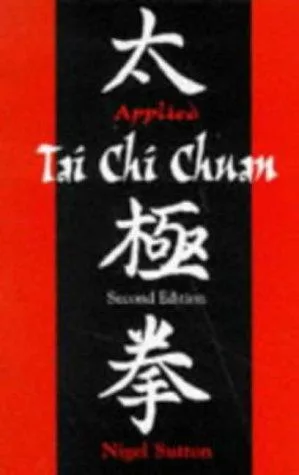
Applied Tai Chi Chuan (Martial Arts)
 80
80

Applied Tai Chi Chuan (Martial Arts)
Nigel Sutton's Applied Tai Chi Chuan (Martial Arts) provides a much-needed, grounded analysis of the fighting applications within Tai Chi forms. The strength of this 1996 work lies in its systematic deconstruction of movements, particularly its detailed examination of 'Fa Jin' generation, which is often discussed but rarely explained with such clarity. Sutton eschews flowery prose for precise biomechanical descriptions, making the martial intent of each posture tangible. A limitation, however, is that the text assumes a baseline familiarity with Tai Chi forms; newcomers might struggle without accompanying visual aids or prior instruction. The section on pushing hands, specifically demonstrating yielding and redirecting force against a stronger opponent, is particularly illuminating, showing how softness can overcome hardness. It's a valuable resource for serious martial students, albeit one that demands focused study.
📝 Description
80
Nigel Sutton's 1996 book, Applied Tai Chi Chuan, returns focus to the martial combat applications within Tai Chi forms.
Applied Tai Chi Chuan, published in 1996, analyzes the practical martial applications inherent in classical Tai Chi Chuan movements. Nigel Sutton moves beyond philosophical or health interpretations to detail the mechanics that turn graceful postures into effective self-defense. The book examines the internal dynamics of generating force, yielding to an opponent, and redirecting their energy, grounding the art in physical reality. It is written for Tai Chi practitioners who want to understand their art's martial origins. It also speaks to martial artists from other disciplines curious about Tai Chi's principles, and those interested in a systematic deconstruction of martial forms. Individuals seeking an analytical approach to combat applications, rather than a purely theoretical one, will find value here. Sutton's publication aimed to re-center the martial aspect of Tai Chi Chuan at a time when it was increasingly studied in the West, often detached from its fighting heritage. He engaged with existing interpretations, such as those from the Yang Chengfu lineage, by detailing combat applications that countered the view of Tai Chi as solely a gentle exercise.
In the esoteric tradition of martial arts, Tai Chi Chuan is often seen as a system that cultivates internal power and subtle energetic principles for combat. Sutton's work fits within this by detailing how the seemingly gentle movements and internal cultivation practices translate directly into effective self-defense strategies. It bridges the gap between the 'soft' appearance of Tai Chi and its underlying 'hard' martial efficacy, aligning with traditions that emphasize the practical, energetic, and strategic dimensions of internal martial arts.
💡 Why Read This Book?
• Understand the practical martial applications of Tai Chi Chuan, moving beyond its reputation as solely a health practice, by studying Sutton's detailed analysis of movements like 'Ward Off' (Peng) and 'Push' (Tui). • Learn the biomechanics behind generating 'Fa Jin' (explosive power) as described in the text, enabling you to train for more potent strikes and deflections. • Gain insight into the strategic use of yielding and redirecting force, as detailed in the book's martial interpretations of classical forms, to effectively counter an opponent's aggression.
⭐ Reader Reviews
Honest opinions from readers who have explored this book.
❓ Frequently Asked Questions
What is the primary focus of Nigel Sutton's Applied Tai Chi Chuan (Martial Arts)?
The book's primary focus is on the martial applications of Tai Chi Chuan, dissecting the movements of classical forms to reveal their practical combat effectiveness and underlying principles of force generation and defense.
When was Applied Tai Chi Chuan (Martial Arts) first published?
Nigel Sutton's Applied Tai Chi Chuan (Martial Arts) was first published in 1996, offering a contemporary analysis of traditional martial techniques.
Is this book suitable for beginners in Tai Chi?
While it provides valuable insights, the book is best suited for practitioners who already have some familiarity with Tai Chi Chuan forms. It assumes a basic understanding of movements and terminology.
Does the book explain how to perform Tai Chi?
No, the book does not serve as a primary instruction manual for performing Tai Chi movements. Instead, it analyzes the martial intent and application of forms that the reader is presumed to already know.
What martial concepts are explored in Applied Tai Chi Chuan (Martial Arts)?
The book explores concepts such as 'Fa Jin' (explosive power), the interplay of Yin and Yang in combat, yielding, redirection, and specific offensive and defensive strategies derived from Tai Chi's core principles.
Who is Nigel Sutton?
Nigel Sutton is an author and martial artist known for his work on Tai Chi Chuan, particularly focusing on its martial aspects and historical context.
🔮 Key Themes & Symbolism
Martial Mechanics
This work moves beyond the health and philosophical interpretations of Tai Chi Chuan to focus intently on the mechanics of combat. It deconstructs each movement, revealing how principles of leverage, structure, and coordinated body power are applied. The text examines how seemingly gentle postures can generate significant force and defensive resilience, grounded in a deep understanding of biomechanics and physics. It’s about the ‘how’ of combat application, not just the ‘what’.
Fa Jin Explained
A central theme is the generation and application of 'Fa Jin' or explosive power. Sutton provides a detailed breakdown of how this power is cultivated through correct body alignment, rootedness, and the synchronized movement of the entire body. The book illustrates the principles behind this sudden release of energy, differentiating it from mere muscular force and situating it within the context of effective martial striking and counter-offense.
Yin and Yang in Combat
The eternal principles of Yin (yielding, softness, absorbing) and Yang (asserting, hardness, striking) are explored not as abstract concepts but as dynamic, interdependent forces in martial engagement. Sutton shows how mastering the ability to yield and absorb an opponent’s force is crucial for setting up opportunities to apply Yang, or explosive, counter-attacks. This interplay is presented as the strategic core of Tai Chi combat.
Strategic Application of Forms
The book emphasizes that Tai Chi forms are not merely sequences of movements but contain sophisticated martial strategies. Each posture and transition is analyzed for its defensive capabilities, offensive potential, and transitional applications. Sutton illustrates how practitioners can understand and employ these embedded strategies, transforming the practice from rote memorization into a dynamic combat art.
💬 Memorable Quotes
Direct passages from the work, attributed to the author.
“The power of Tai Chi Chuan is not generated by the arms or legs alone, but by the coordinated action of the entire body.”
— This statement highlights the principle of whole-body integration, a core part of Tai Chi. It emphasizes that true power comes from a unified structure and intent, rather than isolated muscular effort, forming the basis for effective force generation and transmission.
“Softness does not mean weakness; it is the ability to yield and control.”
— This interpretation underscores a key paradox in Tai Chi: the strength derived from yielding. It suggests that true martial efficacy lies not in brute force, but in the skillful redirection and absorption of an opponent's energy, allowing for precise and effective counter-offense.
“Each movement in the Tai Chi form has a specific martial application.”
— This concept asserts that the seemingly fluid and graceful movements of Tai Chi are not arbitrary but are codified techniques for combat. It implies that a deeper understanding of these applications can unlock the martial potential inherent in the practice.
“The purpose of pushing hands is to develop sensitivity and learn to neutralize an opponent's force.”
— This highlights the training methodology of pushing hands, framing it as a crucial exercise for developing practical martial skills. It focuses on learning to 'listen' to an opponent's energy and neutralize their power, rather than simply meeting force with force.
“Rootedness provides stability, allowing for efficient power transfer and defense.”
— This statement defines the importance of grounding in Tai Chi practice. It explains that a stable base is essential for both generating and receiving force effectively, enabling the practitioner to maintain balance and deliver powerful techniques while resisting an opponent.
🌙 Esoteric Significance
Tradition
While Tai Chi Chuan itself has roots in Taoist philosophy and traditional Chinese medicine, Nigel Sutton's approach in this work leans towards a more empirical and mechanical interpretation of its martial applications. It departs from purely spiritual or energy-focused explanations, grounding the practice in observable physical principles. It can be seen as aligning with a practical, almost alchemical transformation of human movement and force, echoing Hermetic principles of 'as above, so below' applied to biomechanics.
Symbolism
The book implicitly engages with the Taoist concept of Yin and Yang not just as philosophical opposites but as dynamic forces in martial combat. The yielding nature of Yin is symbolized by the practitioner's ability to absorb and redirect an opponent's force, while the assertive power of Yang is represented by 'Fa Jin,' the explosive strike. The concept of 'rootedness' can be seen as symbolizing a connection to the Earth element, providing stability and grounding for effective action.
Modern Relevance
Sutton's work remains relevant for contemporary martial artists and practitioners of internal arts seeking to understand the combat applications of Tai Chi. It informs modern approaches to training that emphasize biomechanical efficiency and strategic application, influencing instructors who aim to balance the health benefits of Tai Chi with its martial heritage. Thinkers in fields like kinesiology and applied physics who study movement dynamics may also find its systematic analysis of force generation compelling.
👥 Who Should Read This Book
• Practitioners of Tai Chi Chuan seeking to understand the martial applications embedded within their forms, moving beyond health benefits to grasp self-defense principles. • Martial artists from other disciplines interested in the unique concepts of yielding, redirection, and 'Fa Jin' (explosive power) as taught in Tai Chi. • Students of traditional Chinese culture and philosophy looking for a practical, analytical exploration of how abstract principles are applied in a physical discipline.
📜 Historical Context
Published in 1996, Nigel Sutton's Applied Tai Chi Chuan (Martial Arts) arrived at a time when Western engagement with Chinese martial arts was rapidly expanding. While many texts focused on the health and philosophical aspects of Tai Chi, or offered generalized introductions to its forms, Sutton's work deliberately focused on the martial science. He engaged directly with the traditional understanding of Tai Chi as a combat system, offering a detailed, analytical approach that countered the growing perception of it as merely a gentle exercise. His work can be seen as a response to the broader trend in martial arts scholarship, which was beginning to move beyond superficial descriptions towards more technical and historical analysis. While specific reception events like reviews or citations are not widely documented, the book contributed to a growing body of literature aimed at practitioners seeking a deeper understanding of the combative principles within internal arts, offering a counterpoint to less rigorous popularizations.
📔 Journal Prompts
The concept of 'Fa Jin' and its practical application.
How the principle of yielding (Yin) can be applied to non-martial situations.
The strategic advantage of coordinated whole-body movement over isolated strength.
Analyzing a specific Tai Chi movement for its dual defensive and offensive potential.
The relationship between rootedness and effective force generation.
🗂️ Glossary
Tai Chi Chuan
A traditional Chinese martial art practiced for both its health benefits and its self-defense applications. It is characterized by slow, flowing movements, deep breathing, and a focus on internal energy and body mechanics.
Fa Jin
Literally 'explosion force,' this refers to the generation and release of explosive power in Tai Chi Chuan. It is a sudden, potent burst of energy that is coordinated through the entire body, distinct from brute muscular strength.
Yin and Yang
Fundamental Taoist concepts representing complementary opposites. In Tai Chi martial arts, Yin relates to yielding, softness, and absorbing force, while Yang relates to asserting, hardness, and striking.
Pushing Hands (Tui Shou)
A training exercise in Tai Chi Chuan designed to develop sensitivity, balance, and the ability to yield, redirect, and apply force against an opponent. It involves controlled contact and response.
Rootedness
The state of being grounded and stable in Tai Chi practice. It involves proper weight distribution and connection to the ground, providing a solid base for movement, defense, and power generation.
Ward Off (Peng)
One of the fundamental Tai Chi techniques, often translated as 'ward off' or 'peng jin.' It involves expanding and warding off an incoming force with a structure that is both yielding and resilient.
Push (Tui)
Another fundamental Tai Chi technique, 'push' or 'tui jin,' involves extending the body forward to neutralize an opponent's force and create distance or opportunity for counter-attack.
🔮 Readers Also Liked
Browse all →









More by Nigel Sutton
All books →

More Free Occult Philosophy Books
View all →