Apocalypsis revelata
 74
74

Apocalypsis revelata
Swedenborg's attempt to demystify the Book of Revelation in Apocalypsis revelata is both ambitious and, at times, overwhelmingly systematic. His allegorical method, viewing the text as a representation of spiritual states rather than historical prophecy, offers a compelling alternative to traditional eschatology. The strength lies in his consistent application of the doctrine of correspondences, providing a unified lens through which to view complex biblical imagery. For instance, his interpretation of the "beast" not as a literal entity but as a symbol of corrupted reason is particularly illuminating. However, the sheer volume of symbolic connections and the dense theological framework can prove challenging for readers unfamiliar with his extensive body of work. The text demands considerable intellectual investment to fully grasp its intricate symbolic logic. This work is best approached as a detailed case study in Swedenborgian hermeneutics, offering a unique perspective on apocalyptic literature.
📝 Description
74
Emanuel Swedenborg's Apocalypsis revelata, published posthumously in 1786, offers an allegorical reading of the Book of Revelation.
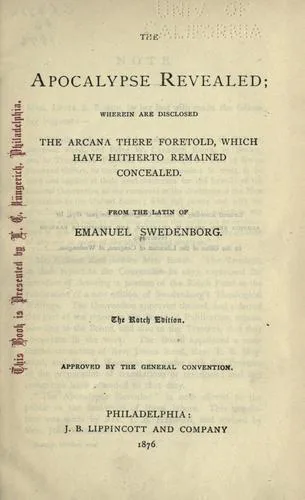
This work presents Emanuel Swedenborg's unique interpretation of the biblical Book of Revelation. First published in 1786, this edition reflects a 1921 printing, aligning with a time of renewed interest in spiritualistic thought. Swedenborg, a Swedish scientist and mystic, moves beyond literal readings of the apocalyptic visions. He instead provides a systematic, allegorical approach to uncover deeper spiritual meanings within the text.
The book emerged from Swedenborg's prolific later period, following his reported spiritual awakenings. Written in Latin, it followed his extensive spiritual experiences and theological writings. The 18th century saw a tension between Enlightenment rationalism and emerging mystical movements. Swedenborg's work, with its elaborate system of correspondences, offered an alternative to purely rationalistic theology. It would later influence movements like Spiritualism and Theosophy.
Apocalypsis revelata is a key text in understanding Swedenborg's unique mystical system. His doctrine of correspondences posits a hidden spiritual reality behind the natural world and biblical narratives. Swedenborg claimed direct experience of the spiritual world, which informed his systematic, allegorical interpretations of scripture. This approach offered a counterpoint to the rationalism prevalent in his era, influencing later esoteric traditions that sought hidden meanings in religious texts.
💡 Why Read This Book?
• Gain an understanding of Swedenborg's doctrine of correspondences, specifically how he interpreted the symbolic language of the Book of Revelation, as detailed in his exegesis published in 1786. • Explore a non-literal, allegorical approach to apocalyptic prophecy that focuses on internal spiritual states rather than external historical events, a key tenet of his theology. • Discover Swedenborg's vision of the "New Jerusalem" as a state of spiritual reform and enlightened consciousness, offering a distinct perspective on spiritual renewal.
⭐ Reader Reviews
Honest opinions from readers who have explored this book.
❓ Frequently Asked Questions
What is the primary focus of Apocalypsis revelata?
The book focuses on Emanuel Swedenborg's allegorical interpretation of the biblical Book of Revelation, explaining its symbolic meanings in terms of spiritual truths and the human mind's internal states.
When was Apocalypsis revelata originally published?
Emanuel Swedenborg's Apocalypsis revelata was originally published in Latin in the year 1786, after his death.
What is Swedenborg's "doctrine of correspondences" as applied in this book?
The doctrine posits that every natural or earthly element in scripture, like people, places, and events, has a direct spiritual counterpart or meaning, which Swedenborg systematically deciphers.
Is this book a prediction of future events?
No, Swedenborg explicitly states that the Book of Revelation describes spiritual processes and states of the human soul, not literal future historical events.
Who was Emanuel Swedenborg?
Swedenborg was an 18th-century Swedish scientist, inventor, theologian, and mystic, known for his extensive spiritual writings and claims of direct communication with the divine.
What is the "New Jerusalem" according to Swedenborg in this text?
The "New Jerusalem" symbolizes a reformed state of the human mind and a new spiritual church characterized by love and wisdom, rather than a physical city.
🔮 Key Themes & Symbolism
Allegorical Scripture Interpretation
Apocalypsis revelata champions an allegorical reading of the biblical Apocalypse, moving beyond historical or literal prophecy. Swedenborg argues that the visions of the Lamb, the Dragon, and the New Jerusalem are not predictive events but symbolic representations of the internal spiritual warfare between good and evil. His method, rooted in the doctrine of correspondences, asserts that each element in the text signifies a corresponding spiritual reality within the human psyche and the structure of the spiritual world. This approach was radical for its time, challenging established theological norms and offering a path to understanding divine truths through symbolic language.
The Doctrine of Correspondences
Central to Swedenborg's hermeneutics in Apocalypsis revelata is the doctrine of correspondences. He posits a divinely ordained link between the natural and spiritual realms, where every object, action, and phenomenon in the physical world mirrors a spiritual reality. For example, natural light corresponds to spiritual truth, and darkness to spiritual ignorance. This principle allows him to systematically translate the highly symbolic language of Revelation into a coherent discourse about the human soul's journey, the nature of God, and the dynamics of the spiritual universe. The 1786 publication solidified this doctrine for his followers.
Spiritual Warfare and Reformation
The book interprets the dramatic imagery of Revelation as a depiction of the ongoing spiritual conflict within individuals and the collective human consciousness. Swedenborg sees the "battle" as an internal struggle against false doctrines and evil inclinations. The "New Jerusalem" is presented not as a future earthly city but as the advent of a new spiritual state – one of enlightenment, divine order, and reformed understanding. This internal reformation, achieved through recognizing and aligning with divine truth, is the ultimate outcome of the apocalyptic process described in the text.
The Nature of the Spiritual World
Apocalypsis revelata provides Swedenborg's extensive views on the structure and workings of the spiritual world, as revealed through his purported spiritual experiences. He describes it as a real, tangible realm inhabited by angels and spirits, governed by divine laws and principles that mirror natural laws but on a spiritual plane. The book elucidates how events in Revelation describe the interactions between human souls and these spiritual entities, and how the spiritual world influences human life and understanding. His detailed descriptions, first published in 1786, aim to demystify the afterlife and spiritual existence.
💬 Memorable Quotes
“The Apocalypse contains within it the internal sense, which is spiritual and divine.”
— This quote encapsulates Swedenborg's core thesis: that the Book of Revelation, often seen as a literal prophecy, is primarily a symbolic text conveying profound spiritual truths accessible through his system of interpretation.
“The New Jerusalem signifies a new church, whose doctrine is charity.”
— Swedenborg redefines the apocalyptic vision of the New Jerusalem not as a physical city but as a state of spiritual purity and reformed religious understanding, centered on love and good works.
“The dragon signifies the profane, and the beasts signify falsities.”
— This highlights Swedenborg's allegorical approach, where monstrous figures in Revelation are understood as representations of corrupted reason, destructive doctrines, and evil spiritual forces.
“All things in the Word have a spiritual sense.”
— This reflects the fundamental principle of Swedenborg's theology – the doctrine of correspondences – asserting that the literal text of scripture is a vehicle for deeper, spiritual meanings.
“The Last Judgment has already taken place in the spiritual world.”
— Swedenborg often claimed that the biblical "Last Judgment" was not a future physical event but a spiritual consummation that occurred in the spiritual realm, ushering in a new era of spiritual order.
🌙 Esoteric Significance
Tradition
Apocalypsis revelata firmly belongs within the Western Esoteric Tradition, specifically aligning with Christian Cabala and Hermeticism due to its emphasis on symbolic interpretation and hidden spiritual meanings within scripture. Swedenborg's system of correspondences can be seen as a unique development within this lineage, offering a comprehensive framework for understanding the divine through a symbolic lens. It departs from strict literalism found in some orthodox traditions and offers a mystical exegesis that influenced later esoteric movements like Theosophy and Spiritualism.
Symbolism
Key symbols in Apocalypsis revelata include the "Dragon," representing corrupted reason and destructive spiritual forces, and the "Beasts," symbolizing false doctrines and materialistic worldviews that oppose spiritual truth. The "New Jerusalem" is a central symbol, not of a physical city, but of a perfected spiritual state and a reformed church characterized by divine love and wisdom, representing ultimate spiritual order and enlightenment.
Modern Relevance
Swedenborg's approach in Apocalypsis revelata continues to inform contemporary esoteric studies and comparative religion. Thinkers and practitioners interested in symbolic theology, the nature of consciousness, and the spiritual interpretation of ancient texts often engage with his work. His ideas on the spiritual world and the correspondence between the natural and divine realms resonate with modern New Age spirituality and certain psychological interpretations of religious symbolism.
👥 Who Should Read This Book
• Students of Emanuel Swedenborg's theology: Those seeking a systematic understanding of his interpretation of the Book of Revelation and his foundational doctrine of correspondences. • Scholars of religious history and esotericism: Researchers interested in 18th-century mystical movements, alternative biblical interpretations, and the development of esoteric thought. • Individuals exploring symbolic approaches to scripture: Readers drawn to understanding biblical texts not just historically or literally, but as vehicles for deeper spiritual and psychological truths.
📜 Historical Context
Emanuel Swedenborg's Apocalypsis revelata, first published in Latin in 1786, emerged during a period of intense intellectual and spiritual ferment in Europe. While the Enlightenment championed reason, counter-movements like Romanticism and various mystical traditions fostered a renewed interest in spiritual experience and esoteric knowledge. Swedenborg's work offered a unique synthesis, bridging scientific inquiry with profound theological revelations. His systematic interpretation of biblical prophecy, particularly the Book of Revelation, stood in contrast to both orthodox theological literalism and the more philosophical approaches of thinkers like Kant. While Swedenborg was largely isolated during his lifetime, his writings gained significant traction posthumously, influencing figures within nascent Spiritualist and Theosophical movements. His detailed symbolic system provided an alternative framework for understanding scripture and the divine, influencing esoteric thought well into the 19th and 20th centuries.
📔 Journal Prompts
Swedenborg's interpretation of the "New Jerusalem" as an internal state.
The spiritual significance of the "Dragon" and "Beasts" in Revelation.
Applying the doctrine of correspondences to personal spiritual experiences.
The difference between literal and symbolic understanding of apocalyptic texts.
Swedenborg's view on the "Last Judgment" occurring in the spiritual world.
🗂️ Glossary
Apocalypse
Referring to the Book of Revelation, the final book of the New Testament, known for its symbolic and prophetic imagery concerning the end times and divine judgment.
Doctrine of Correspondences
Swedenborg's core theological principle stating that everything in the natural world corresponds to something in the spiritual world, allowing for the interpretation of scripture's inner meaning.
Internal Sense
The deeper, spiritual or divine meaning hidden within the literal text of the Bible, accessible through the doctrine of correspondences.
Spiritual World
The non-physical realm inhabited by angels and spirits, which Swedenborg claimed to have access to, and which he described as being structured and governed by divine laws.
New Jerusalem
In Swedenborg's theology, this symbolizes a reformed spiritual state and a new church founded on divine love and wisdom, rather than a literal city.
Profane
In Swedenborgian terms, refers to that which treats sacred things with irreverence or contempt, often associated with corrupted spiritual understanding.
Falsities
Doctrines or beliefs that are contrary to divine truth; in Apocalypsis revelata, these are often represented by symbolic beasts or monsters.