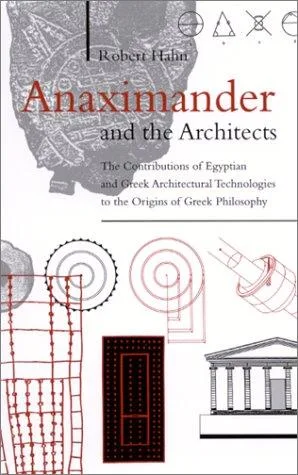
Anaximander and the Architects
 76
76

Anaximander and the Architects
Robert Hahn's Anaximander and the Architects offers a compelling argument for the enduring legacy of a single pre-Socratic philosopher. Hahn adeptly connects Anaximander's abstract notion of the apeiron to the very structure of Western thought, suggesting its influence stretches into realms as tangible as architecture. The strength of the book lies in its meticulous tracing of these conceptual lineages, demonstrating how a 6th-century BCE idea about indeterminate origin could inform later ideas of form and order. A point of limitation, however, is the speculative leap required by the reader in connecting Anaximander's cosmology to 'architects' in a direct, causal sense; the link is primarily intellectual and analogical rather than historical fact. Hahn's discussion of the apeiron as a source of both being and becoming, and its subsequent echoes in later dialectical thought, is particularly illuminating. Ultimately, Hahn presents a persuasive, albeit sometimes demanding, case for the foundational role of Anaximander's philosophy.
📝 Description
76
### What It Is
Anaximander and the Architects is a scholarly examination of the philosophical underpinnings that shaped early Western thought, particularly focusing on the pre-Socratic philosopher Anaximander. The book traces the evolution of abstract concepts from early cosmological ideas to their influence on subsequent philosophical and even architectural developments. It scrutinizes how foundational ideas about the cosmos and existence, as articulated by figures like Anaximander around the 6th century BCE, established frameworks for understanding order and form.
### Who It's For
This work is intended for academics, graduate students, and serious enthusiasts of ancient philosophy, the history of ideas, and the intellectual roots of Western civilization. Readers who appreciate rigorous analysis of primary philosophical texts and their historical impact will find substantial value. It appeals to those interested in how abstract metaphysical concepts can manifest in concrete cultural and intellectual structures, extending beyond pure philosophy into related disciplines.
### Historical Context
The book situates Anaximander's thought within the burgeoning intellectual climate of Ionia in the 6th century BCE. This era saw the first significant departures from mythological explanations of the universe towards rational inquiry. Anaximander's concept of the apeiron, an unbounded, indeterminate primordial substance, marked a radical shift from earlier cosmogonies. The work explores how this nascent rationalism contrasted with prevailing mythological cosmologies and laid groundwork for later scientific and philosophical inquiry.
### Key Concepts
Central to the text is the exploration of Anaximander's cosmology and his introduction of the apeiron as the origin of all things. The book analyzes the implications of this concept for understanding concepts of order, balance, and change. It examines how Anaximander's ideas about justice and cosmic law, derived from his understanding of the apeiron, might have indirectly influenced notions of proportion and structure in later eras, potentially impacting fields like geometry and early architectural principles.
💡 Why Read This Book?
• Gain insight into Anaximander's concept of the apeiron, understanding its departure from mythological explanations and its role as a primordial, indeterminate source for all existence as explored in the 6th century BCE. • Discover how early philosophical ideas about cosmic order and justice, originating with figures like Anaximander, may have indirectly shaped later conceptions of form and structure in Western thought. • Appreciate the intellectual lineage connecting abstract metaphysical concepts to concrete manifestations, as the book posits a link between Anaximander's philosophy and early architectural principles.
⭐ Reader Reviews
Honest opinions from readers who have explored this book.
❓ Frequently Asked Questions
What is the Apeiron according to Anaximander and how does it differ from earlier cosmogonies?
The Apeiron, a concept introduced by Anaximander around the 6th century BCE, is an unbounded, indeterminate primordial substance from which all things arise and to which they return. This contrasts sharply with earlier cosmogonies that often posited specific, defined elements like water or chaos as the origin.
What is the primary argument of Robert Hahn's 'Anaximander and the Architects'?
Hahn argues that Anaximander's philosophical concepts, particularly the apeiron, profoundly influenced subsequent Western thought, extending even to the principles of structure and form found in architecture, thereby establishing intellectual foundations for Western civilization.
Who was Anaximander and when did he live?
Anaximander was a pre-Socratic Greek philosopher from Miletus, a student of Thales, who lived approximately between 610 and 546 BCE. He is known for his cosmological theories and his concept of the apeiron.
Does the book suggest a direct, historical link between Anaximander and specific architects?
The book primarily explores an intellectual and analogical connection. It suggests that Anaximander's abstract ideas about order, proportion, and indeterminate origins may have indirectly informed the principles later adopted by architects, rather than a direct mentorship or influence.
What intellectual currents were present during Anaximander's time that 'Anaximander and the Architects' discusses?
The book places Anaximander within the milieu of early Ionian natural philosophy in the 6th century BCE, an era characterized by a transition from mythological explanations to rational inquiry about the cosmos and its origins.
What is the significance of Anaximander's concept of the apeiron for understanding later philosophy?
The apeiron represents a crucial conceptual leap, moving beyond specific, observable elements to an abstract, unlimited source. This idea influenced subsequent thinkers grappling with concepts of unity, multiplicity, and the fundamental nature of reality.
🔮 Key Themes & Symbolism
The Apeiron as Primordial Source
This theme centers on Anaximander's revolutionary concept of the apeiron, an unbounded, indefinite, and eternal principle that serves as the origin of all things. The book unpacks how this idea represented a significant departure from earlier, more concrete cosmological models, such as those proposing water or chaos as the primary substance. It highlights the philosophical implications of an indeterminate origin for understanding existence, change, and cosmic balance, positioning it as a foundational element for abstract thought in Western philosophy.
Cosmic Order and Justice
The work delves into Anaximander's extension of his cosmological principles to ethical and legal realms. His notion that the apeiron governs all things through a form of cosmic justice – with elements paying penalties for their injustice to one another – is explored. This theme examines how early Greek philosophers began to conceptualize universal laws and balance, linking the structure of the universe to principles of fairness and retribution, which laid groundwork for later ethical systems.
From Philosophy to Form
This theme investigates the speculative but intriguing connection between Anaximander's abstract philosophical ideas and the emergence of structured forms in later cultural expressions, particularly architecture. The book posits that Anaximander's emphasis on proportion, balance, and the derivation of form from an underlying principle might have indirectly influenced the conceptualization of design and order in physical structures. It explores how metaphysical frameworks can inform aesthetic and practical disciplines.
The Birth of Rational Inquiry
Central to the book is the context of the 6th century BCE Ionian Enlightenment, where Anaximander was a key figure. This theme focuses on the shift from mythological explanations of the world to rational, empirical, and philosophical investigation. It positions Anaximander as a pioneer in seeking naturalistic explanations for cosmic phenomena, marking a critical juncture in the development of Western scientific and philosophical thought.
💬 Memorable Quotes
“The apeiron is the source of all things that are, have been, and will be.”
— This paraphrase encapsulates Anaximander's core tenet: the identification of a single, boundless, and eternal principle as the ultimate origin of the universe. It emphasizes the all-encompassing nature of this primordial substance, serving as the wellspring for all existence across time.
“Things give way to each other according to necessity, and pay penalty for their injustice.”
— This captures Anaximander's idea of cosmic justice. It suggests that the operations of the universe are not random but governed by inherent laws of balance and consequence, where imbalances are corrected, and elements face retribution for transgressing their bounds.
“Anaximander's thought represents a transition from mythos to logos.”
— This interpretation highlights the book's argument that Anaximander's philosophical approach marked a pivotal shift from reliance on mythological narratives to rational explanation, signifying the dawn of philosophical and scientific reasoning in the West.
“The form of the earth is a segment of a cylinder.”
— This specific cosmological observation by Anaximander illustrates his empirical and rational approach to understanding the cosmos, moving beyond purely speculative or mythological descriptions of celestial bodies and terrestrial forms.
“The origin of the cosmos is an indeterminate, boundless substance.”
— This paraphrased concept directly refers to the apeiron, stressing its fundamental characteristic: its lack of definition and its infinite nature. It underscores how Anaximander conceived of the ultimate reality as something beyond immediate perception or conceptualization.
🌙 Esoteric Significance
Tradition
While Anaximander himself predates many formalized esoteric traditions, his work is foundational to the Western philosophical lineage that later informed Hermeticism and Neoplatonism. His concept of a single, generative principle (the apeiron) from which all multiplicity arises is a recurring theme in mystical thought, echoing Gnostic ideas of emanation and the Hermetic principle of 'All is One'. The book's exploration of Anaximander's rational cosmology provides a pre-esoteric anchor for understanding the intellectual quest for ultimate reality.
Symbolism
The primary symbol is the 'apeiron' itself – representing the undifferentiated, boundless potential from which all forms emerge. It symbolizes the unmanifest, the source of all being before creation. Another motif is the concept of cosmic 'justice' or balance, suggesting an inherent order and cyclical process (birth, decay, return) that governs existence, akin to alchemical cycles or the balance of forces in Hermetic philosophy.
Modern Relevance
Contemporary thinkers exploring the origins of consciousness, the nature of reality, and the relationship between abstract thought and material manifestation can find resonance in Anaximander's ideas. His concept of an indeterminate source has been revisited in discussions of quantum physics and cosmology. Furthermore, the philosophical underpinnings he established continue to inform comparative mythology and the study of foundational cosmological narratives across various cultures and esoteric schools.
👥 Who Should Read This Book
• Students of Ancient Greek Philosophy: Those seeking a deeper understanding of the pre-Socratics, particularly Anaximander, and his foundational role in Western thought. • Comparative Religion and Mythology Scholars: Individuals interested in the transition from mythological explanations of the world to rational inquiry and its impact on cosmogonies. • Philosophers of Science and Metaphysics: Readers fascinated by the historical development of concepts like origin, form, order, and the relationship between abstract principles and the observable universe.
📜 Historical Context
Robert Hahn's Anaximander and the Architects situates its subject within the vibrant intellectual milieu of 6th century BCE Ionia, a period marked by the nascent Ionian Enlightenment. This era witnessed a crucial shift from mythological cosmogonies to rational inquiry, with figures like Thales and Anaximander pioneering naturalistic explanations for the universe. Anaximander's introduction of the apeiron, an unbounded primordial substance, was a radical departure from earlier, more defined cosmic origins. This development occurred in parallel with, and in contrast to, more traditional mythological accounts of creation still prevalent across the ancient world. The book explores how this foundational philosophical innovation, born from a desire to understand order and existence through reason, indirectly laid conceptual groundwork that would echo through subsequent centuries, potentially influencing not just philosophy but also the emergent ideas of structure and proportion in fields like geometry and early architectural theory.
📔 Journal Prompts
Anaximander's Apeiron as a concept of ultimate origin.
The necessity of cosmic justice in Anaximander's thought.
Tracing the influence of abstract principles on concrete forms.
The shift from mythological to rational explanations of the cosmos.
The earth's form as a 'segment of a cylinder'.
🗂️ Glossary
Apeiron
Anaximander's term for the boundless, indeterminate, and eternal primordial substance from which all things originate and to which they return. It is the source of all being and becoming.
Pre-Socratic
A designation for Greek philosophers who lived and wrote before Socrates (c. 470–399 BCE). They were primarily concerned with cosmology, the nature of reality, and the fundamental substance of the universe.
Cosmogony
The study or theory of the origin and development of the universe. It often involves mythological or philosophical accounts of creation.
Logos
In Greek philosophy, a term with various meanings, including 'word,' 'reason,' 'principle,' or 'discourse.' It signifies rational thought and order, contrasting with mythos (mythological narrative).
Ionian Enlightenment
A period of significant intellectual and scientific development in Ionia (ancient Greek cities on the coast of Asia Minor) during the 6th century BCE, characterized by a move towards rational inquiry.
Milesian School
The earliest school of philosophy in ancient Greece, founded in Miletus. Its main figures were Thales, Anaximander, and Anaximenes, all of whom sought naturalistic explanations for the world.
Cosmology
The study of the origin, evolution, and eventual fate of the universe, as well as its large-scale properties and phenomena.