Amenhotep III
 72
72

Amenhotep III
Kozloff's "Amenhotep III" presents a compelling case for the pharaoh's pivotal role, moving beyond his more famous son. The author meticulously details Amenhotep III's considerable construction efforts, particularly the colossal statues and temples dedicated to himself and the gods, underscoring his immense power and divine self-perception. A particular strength lies in the examination of the royal titulary and its evolution, reflecting a sophisticated understanding of Egyptian ideology. However, the work occasionally suffers from a dense, academic prose that might deter casual readers. While the analysis of Amenhotep III's relationship with Aten is thorough, the narrative could benefit from more direct engagement with the political ramifications of his extensive diplomatic marriages, a topic only touched upon. Ultimately, this is a valuable resource for specialists seeking an in-depth study of a crucial, yet often underestimated, Egyptian monarch.
📝 Description
72
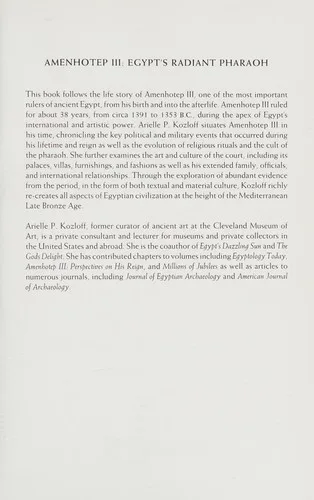
### The Man Behind the Aten Cult Arielle P. Kozloff's "Amenhotep III" offers a deep exploration into the reign of one of Egypt's most significant pharaohs, a period often overshadowed by his successors. The work examines Amenhotep III's role not just as a political leader, but as a central figure in the religious and artistic developments of the Eighteenth Dynasty. It sheds light on his extensive building projects and his cultivated image as a divine ruler.
### For Students of Ancient Egypt and Esoteric History This book is intended for those with a serious interest in Ancient Egyptian history, particularly the Amarna period and the preceding reign. It will appeal to scholars of religion, art history, and Egyptology who seek a detailed account of Amenhotep III's influence. Furthermore, individuals fascinated by the evolution of divine kingship and the esoteric underpinnings of ancient belief systems will find substantial material here.
### The Apex of Eighteenth Dynasty Power Amenhotep III ascended to the throne around 1391 BCE, inheriting a prosperous and stable empire. His reign is often characterized as a golden age, marked by unprecedented wealth, diplomatic success, and monumental construction. This era saw the height of Egyptian power and influence in the Near East, facilitated by intricate diplomatic marriages and a sophisticated administration. The work contextualizes Amenhotep III's rule within this framework of imperial dominance.
### Divine Manifestation and Royal Ideology The book scrutinizes the ways Amenhotep III presented himself as a living god, particularly through his association with the sun god Aten. This focus on solar theology and the pharaoh's divine manifestation was a precursor to the radical religious changes later enacted by his son, Akhenaten. Kozloff examines how Amenhotep III's reign solidified the concept of the pharaoh as the earthly embodiment of divine will, a cornerstone of Egyptian state religion.
💡 Why Read This Book?
• Gain a nuanced understanding of Amenhotep III's reign, moving beyond his association with Akhenaten, by examining his extensive construction projects and the ideological underpinnings of his rule, as detailed in the book's discussion of his solar theology. • Explore the evolution of divine kingship in Ancient Egypt, focusing on how Amenhotep III cultivated his image as a living god, a concept central to Egyptian state religion and detailed through specific examples of royal iconography. • Appreciate the political and religious context of the Eighteenth Dynasty's zenith, understanding how Amenhotep III's diplomatic strategies and massive building programs, such as those at Malkata, shaped the empire's trajectory.
⭐ Reader Reviews
Honest opinions from readers who have explored this book.
❓ Frequently Asked Questions
What was Amenhotep III's relationship with the god Aten?
Amenhotep III significantly elevated the prominence of the sun god Aten, associating himself closely with Aten's divine power and manifesting this connection through extensive temple construction and iconography, a key focus of the book's analysis.
When did Amenhotep III reign as pharaoh of Egypt?
Amenhotep III reigned during the Eighteenth Dynasty of Egypt, with his rule beginning around 1391 BCE and concluding approximately 1353 BCE, marking a significant period of prosperity and artistic development.
What are some key achievements attributed to Amenhotep III?
Key achievements include vast building projects like the Colossi of Memnon, extensive temple construction across Egypt and Nubia, and a flourishing of arts and diplomacy that solidified Egypt's imperial power during his prosperous reign.
How did Amenhotep III's reign influence his son, Akhenaten?
Amenhotep III's emphasis on the Aten and his cultivation of a divine kingship ideology laid the groundwork for Akhenaten's more radical monotheistic reforms, as explored in the book's examination of the transition between reigns.
What evidence exists for Amenhotep III's divine status?
Evidence includes his royal titulary, the construction of numerous statues and temples dedicated to his divine cult, and his portrayal in art as a god-king, reflecting the deep integration of religious and political authority during his era.
What was the geographical extent of Amenhotep III's empire?
Amenhotep III's empire extended from Syria in the north to Nubia in the south, encompassing territories crucial for trade and resources. His diplomatic efforts, including strategic marriages, helped maintain this vast influence.
🔮 Key Themes & Symbolism
Divine Kingship and Solar Theology
The work meticulously details how Amenhotep III cultivated an image of divine authority, intimately linking his rule to the sun god Aten. This section explores the pharaoh's self-representation as a living god, a concept solidified through monumental architecture and iconography. It examines the theological underpinnings that elevated Aten's status, foreshadowing later religious shifts, and how this divine mandate legitimized his extensive power and building programs across Egypt and Nubia during the Eighteenth Dynasty.
Monumental Construction and Artistic Flourishing
Kozloff analyzes the pharaoh's extensive building projects, including colossal statues, temples, and palaces, such as those at Malkata. This theme highlights the scale of Amenhotep III's ambition and the economic prosperity that funded such endeavors. The book delves into the artistic styles and craftsmanship of the era, showcasing the peak of Egyptian artistic achievement under his patronage and how these creations served to project royal power and religious ideology to both domestic and foreign audiences.
Diplomacy and Imperial Expansion
This theme focuses on Amenhotep III's sophisticated diplomatic strategies, particularly his use of strategic marriages with foreign princesses to secure alliances and maintain Egypt's vast sphere of influence. The work examines the extensive international network he managed, reflecting the height of Egyptian imperial power during the New Kingdom. It discusses how his reign balanced military strength with complex political maneuvering, ensuring stability and prosperity across the empire from Syria to Nubia.
The Aten Cult's Precursors
The book investigates the growing importance of the Aten during Amenhotep III's reign, tracing its evolution from a minor solar deity to a central focus of royal worship. It explores how the pharaoh's personal devotion and the promotion of Aten's cult created a religious environment that directly influenced his son, Akhenaten's, later monotheistic revolution. This section illuminates the gradual shift in Egyptian religious thought that occurred under Amenhotep III.
💬 Memorable Quotes
“Amenhotep III’s reign marked the zenith of Egypt’s imperial might and cultural splendor.”
— This statement encapsulates the overarching theme of the book, emphasizing the period as a peak of Egyptian power, wealth, and artistic production under this specific pharaoh's rule.
“The pharaoh was not merely a ruler but the divine intermediary, manifesting Aten's will on Earth.”
— This highlights the core of Egyptian divine kingship ideology as presented in the book, where the pharaoh's role transcended political leadership to embody a divine connection and earthly representation of the sun god.
“His building programs were not just acts of construction, but declarations of divine status and imperial control.”
— This interpretation underscores the symbolic and political weight of Amenhotep III's vast architectural projects, framing them as powerful statements of his god-like authority and dominion over Egypt and its territories.
“The growing prominence of the Aten began to reshape the religious landscape of the New Kingdom.”
— This suggests that Amenhotep III's reign was a critical turning point in Egyptian religious history, where the increasing focus on the Aten initiated significant shifts that would culminate in later radical reforms.
“Foreign alliances were cemented through strategic marriages, extending Egyptian influence far beyond its borders.”
— This points to the importance of diplomacy and inter-state relations during Amenhotep III's time, illustrating how marital ties were instrumental in maintaining and expanding Egypt's imperial reach in the ancient Near East.
🌙 Esoteric Significance
Tradition
This work engages with the esoteric dimensions of Ancient Egyptian religion, particularly its solar mysticism and the concept of divine kingship. While not strictly Hermetic or Gnostic, it touches upon themes of cosmic order, divine manifestation, and the pharaoh as a mediator between the earthly and celestial realms. It aligns with traditions that explore the symbolic representation of power and the spiritual authority vested in rulers, offering insights into a civilization that deeply integrated metaphysical concepts into its state ideology.
Symbolism
Key symbols explored include the Aten, representing the life-giving power of the sun and the ultimate source of divine authority. The pharaoh himself, particularly Amenhotep III, is depicted as a living symbol of this divine power. The numerous colossal statues and monumental temples serve as physical manifestations of this cosmic order and royal power, acting as focal points for religious ritual and imperial propaganda, connecting the earthly realm to the celestial.
Modern Relevance
Contemporary esoteric practitioners and scholars of comparative religion often draw upon the study of Ancient Egyptian cosmology and divine kingship. Amenhotep III's reign, with its emphasis on solar worship and the pharaoh's divine status, provides a rich case study for understanding the evolution of monotheistic and henotheistic tendencies. Thinkers exploring ancient psychological archetypes or the nature of consciousness often reference the sophisticated symbolic language and ritual practices of this period.
👥 Who Should Read This Book
• Scholars and advanced students of Egyptology seeking a detailed analysis of the Eighteenth Dynasty's most prosperous reign, focusing on political, religious, and artistic developments. • Readers interested in the evolution of divine kingship and solar theology in the ancient world, who wish to understand the precursors to the Amarna revolution. • Individuals fascinated by the intersection of power, religion, and art in ancient civilizations, particularly those who appreciate meticulous historical research and contextualization.
📜 Historical Context
Arielle P. Kozloff's "Amenhotep III" emerges from the scholarly engagement with the New Kingdom of Egypt, specifically the opulent Eighteenth Dynasty. Amenhotep III ascended the throne around 1391 BCE, a period of immense prosperity and international influence, often considered a golden age. This era followed the expulsion of the Hyksos and saw Egypt at its territorial and cultural apex. The intellectual currents of the time were deeply intertwined with religious development, particularly the burgeoning solar theology centered on the god Aten. This focus on Aten, while not yet the radical monotheism of his son Akhenaten, marked a significant shift. Contemporary rulers like Suppiluliuma I of the Hittites engaged in complex diplomatic and sometimes military interactions with Egypt. The reception of works focusing on this period often grapples with the interpretation of divine kingship and the transition towards the Amarna period, a subject that continues to be debated among Egyptologists regarding its causes and consequences.
📔 Journal Prompts
Amenhotep III's self-representation as divine: How did his monuments and titulary reinforce this image?
The significance of the Aten: Reflect on its evolving role before Akhenaten's reforms.
Compare Amenhotep III's diplomatic marriages to modern international relations.
Analyze the function of colossal statuary in projecting royal power.
Consider the economic implications of Amenhotep III's extensive building projects.
🗂️ Glossary
Aten
The disk of the sun, elevated to a supreme deity during the Eighteenth Dynasty, particularly under Amenhotep III and Akhenaten, representing divine creative power and light.
Divine Kingship
The belief system in Ancient Egypt where the pharaoh was considered a god on Earth, a mediator between the divine and human realms, responsible for maintaining cosmic order (Ma'at).
Eighteenth Dynasty
A period in Ancient Egyptian history (circa 1550–1292 BCE) known for its imperial power, prosperity, and monumental building projects, during which Amenhotep III reigned.
Malkata
The site of Amenhotep III's vast palace complex near Thebes, representing a significant focus of royal administration and luxury during his reign.
Solar Theology
A religious framework that emphasizes the sun god as the supreme deity, influencing worship and royal ideology, as seen prominently in Amenhotep III's era.
Titulary
The formal set of names and titles held by an Egyptian pharaoh, which evolved over time to reflect their divine status, achievements, and religious affiliations.
Ma'at
The ancient Egyptian concept of truth, balance, order, law, morality, and justice. The pharaoh's primary duty was to uphold Ma'at.