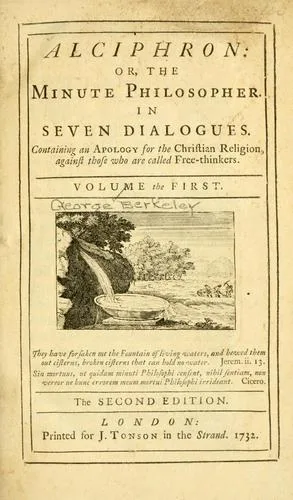
Alciphron, or, The minute philosopher, in seven dialogues
 84
84

Alciphron, or, The minute philosopher, in seven dialogues
Berkeley's *Alciphron* is a curious artifact of Enlightenment debate, less a philosophical treatise and more a series of spirited, albeit somewhat didactic, dialogues. The author, George Berkeley, is at his most formidable when dissecting the rhetorical tricks of the 'minute philosophers,' exposing the logical fallacies embedded in their fashionable skepticism. His refutation of materialism, particularly in the earlier dialogues, remains intellectually potent. However, the work suffers from its allegorical digressions, particularly the extended narrative concerning the painter Lysicles in the later dialogues, which, while intended to illustrate philosophical points, often detracts from the central argument and can feel ponderous to a modern reader. The relentless pace of refutation can also become tiring, with fewer moments for genuine exploration of alternative viewpoints. Despite these limitations, the work's rigorous defense of immaterialism and divine providence offers a clear window into the intellectual anxieties of its time. It is a valuable, if demanding, engagement with foundational skeptical arguments.
📝 Description
84
George Berkeley published Alciphron, or, The Minute Philosopher in 1710, a series of dialogues critiquing contemporary skepticism.
George Berkeley's seven dialogues, *Alciphron, or, The Minute Philosopher*, first published in 1710, offer a critique of early 18th-century intellectual trends. Berkeley targets the rise of skepticism and atheism among educated circles, whom he labels 'minute philosophers.' The work defends religious and moral principles against what he saw as shallow and destructive ways of thinking common in England at the time.
The text is aimed at readers interested in Enlightenment philosophy, particularly debates surrounding religious belief and its challenges. It will also engage those looking into early modern philosophical responses and the intersection of philosophy with social commentary. Scholars of theology, ethics, and the development of empiricist and idealist thought will find it relevant. Berkeley's dialogue format allows for a direct engagement with opposing viewpoints.
Berkeley's work, while a mainstream philosophical text of its era, engages with underlying currents of thought concerning the nature of perception and reality that would later inform esoteric traditions. His challenge to pure empiricism and his emphasis on the mind's role in constructing reality resonate with mystical and idealist philosophies that prioritize inner experience or a divine substratum over brute materialism. The critique of superficial intellectualism also touches upon the esoteric ideal of deeper, intuitive understanding beyond conventional learning.
💡 Why Read This Book?
• Gain insight into George Berkeley's critique of early Enlightenment skepticism, understanding his arguments against materialism as presented in the 1710 publication. • Examine Berkeley's defense of immaterialism and divine providence, learning how he countered contemporary atheistic and deistic viewpoints through reasoned dialogue. • Appreciate the historical context of philosophical discourse in the early 18th century, specifically the intellectual currents Berkeley was responding to in his seven dialogues.
⭐ Reader Reviews
Honest opinions from readers who have explored this book.
❓ Frequently Asked Questions
When was George Berkeley's Alciphron first published?
George Berkeley's *Alciphron, or, The Minute Philosopher* was first published in 1710. This early 18th-century date places it within a crucial period of philosophical development in England.
What is the primary philosophical stance Berkeley defends in Alciphron?
In *Alciphron*, Berkeley primarily defends immaterialism (or idealism) and the existence of God against the skeptical and atheistic arguments of the 'minute philosophers' he depicts.
Who are the 'minute philosophers' in Berkeley's work?
The 'minute philosophers' are fictional characters in Berkeley's dialogues who represent the fashionable skeptics and atheists of the early 18th century, characterized by their superficial reasoning and rejection of traditional morality and religion.
What philosophical tradition did Berkeley's work challenge?
Berkeley's work in *Alciphron* challenged the materialist and empiricist philosophies gaining prominence, particularly those that denied the existence of mind-independent reality or divine intervention.
What is the format of Alciphron?
*Alciphron* is presented in the form of seven dialogues, a literary and philosophical convention used to explore complex ideas through conversational debate between characters.
What is the significance of Berkeley's 'immaterialism'?
Berkeley's immaterialism posits that only minds and their ideas exist, challenging the notion of material substance independent of perception. This is a core tenet he defends in *Alciphron*.
🔮 Key Themes & Symbolism
Critique of 'Minute Philosophy'
Berkeley targets the superficial intellectualism of his era, branding adherents as 'minute philosophers.' These figures, he argues, engage with complex ideas like atheism and skepticism with shallow reasoning, mistaking novelty and fashion for profound insight. The work meticulously dissects their arguments, exposing their reliance on sensory evidence and their dismissal of abstract reasoning and divine concepts. Berkeley contends that this brand of philosophy leads not to enlightenment, but to moral decay and intellectual void, as it strips away the foundations of ethical behavior and meaningful existence.
Immaterialism and the Nature of Reality
Central to *Alciphron* is Berkeley's philosophical stance of immaterialism, also known as idealism. He argues that 'to be is to be perceived' (esse est percipi), suggesting that reality consists of minds and their perceptions, rather than an independently existing material substance. This challenges the prevailing empiricism that grounds knowledge solely in sensory experience of a material world. Berkeley posits that our perception of objects, and indeed the existence of the universe, is sustained by the continuous perception of God, the ultimate mind.
The Role of Divine Providence
Berkeley vigorously defends the concept of divine providence as essential to morality and meaning. He contends that the order and complexity of the natural world, evident in phenomena from the human eye to celestial movements, serve as clear indications of an intelligent Creator. The 'minute philosophers' are criticized for their failure to recognize these signs, often attributing natural phenomena to chance or blind material forces. For Berkeley, God's continuous involvement is not only the guarantor of existence but also the source of moral law and human purpose.
Language, Abstraction, and Truth
The dialogues also engage with the philosophy of language, a crucial area of debate in the early 18th century. Berkeley critiques the misuse of abstract terms by his philosophical opponents, arguing that many of their concepts, particularly concerning matter and atheism, are unintelligible because they are not grounded in concrete experience or divine ideas. He suggests that these philosophers create linguistic confusion, using words as tools to obscure truth rather than to communicate it. This linguistic analysis is integral to his broader project of refuting skeptical claims.
💬 Memorable Quotes
“The minute philosophers are men who, though they know nothing, yet are very forward to think they know everything.”
— This paraphrased sentiment captures Berkeley's characterization of his opponents as intellectually arrogant and overly confident in their superficial understanding of complex philosophical issues. He saw their skepticism as stemming from ignorance, not genuine inquiry.
“The world is a theatre, and the divine power is the author and director of the play.”
— This metaphor, central to Berkeley's argument for design, posits that the observable order and beauty of the universe are evidence of an intelligent, purposeful Creator. It frames existence as a divinely orchestrated performance.
“What is it that we call the material world?”
— This question, posed implicitly or explicitly throughout the dialogues, probes the very substance of reality. Berkeley uses it to dismantle the common-sense notion of matter as an independent, primary constituent of existence, leading towards his immaterialist conclusions.
“Abstract ideas are the great source of error.”
— Berkeley criticizes the formation of abstract concepts, particularly by the 'minute philosophers,' arguing they lack a clear referent in experience and lead to confused thinking and false doctrines, such as atheism.
“Sight is the most noble of the senses.”
— While Berkeley critiques the over-reliance on senses, he also acknowledges their primary role in perceiving the divine order. This quote highlights the importance of visual evidence in his arguments for God's existence through natural theology.
🌙 Esoteric Significance
Tradition
While not strictly an esoteric text in the vein of Hermeticism or Kabbalah, *Alciphron* touches upon Western philosophical traditions that influenced esoteric thought. Berkeley's idealism and his emphasis on mind as primary reality share common ground with Neoplatonic and Gnostic ideas that posit a spiritual or mental basis for existence. His critique of materialism and his argument for an immanent divine intelligence in nature can be seen as a philosophical precursor or parallel to certain mystical interpretations of the cosmos, particularly those found in the Renaissance and later Theosophical movements.
Symbolism
The primary 'symbol' within *Alciphron* is the concept of the 'minute philosopher' itself – a caricature of the shallow, fashionable skeptic. This figure symbolizes the dangers of intellect untethered from reason, faith, and morality. Another symbolic element is the 'theatre' of the world, representing the divinely ordered and purposeful nature of existence, a stark contrast to the chaotic, materialistic worldview Berkeley sought to dismantle. The very act of dialogue serves symbolically, representing the struggle for truth through reasoned discourse.
Modern Relevance
Berkeley's critique of superficial intellectualism and his arguments for idealism continue to find echoes in contemporary philosophy of mind, consciousness studies, and even certain spiritual traditions. Modern thinkers exploring the limits of empirical science, the nature of consciousness, and the relationship between mind and reality often revisit Berkeley's work. His emphasis on perception and the role of the observer can be seen as resonating with quantum physics interpretations and phenomenological approaches, suggesting that his early 18th-century philosophical inquiries remain relevant to 21st-century questions about existence.
👥 Who Should Read This Book
• Students of early modern philosophy: To understand George Berkeley's foundational arguments for idealism and his direct engagement with Enlightenment skepticism, particularly his refutation of materialism. • Comparative religion scholars: To analyze how a prominent philosopher of the 18th century defended religious belief and divine providence against secularizing intellectual trends. • Aspiring writers and debaters: To study the structure and rhetorical strategies employed in philosophical dialogues, learning how to dissect and counter opposing arguments through reasoned discourse.
📜 Historical Context
First published in 1710, George Berkeley's *Alciphron* emerged during a period when empirical philosophy and skepticism were gaining significant intellectual ground in Britain and Europe. The work directly engaged with the ideas of thinkers like John Locke, whose emphasis on sensory experience and critique of innate ideas laid groundwork for later empiricist and skeptical developments. Berkeley, a bishop and philosopher, felt compelled to counter the rising tide of atheism and deism, which he saw as fashionable but destructive trends among the educated elite. He was particularly responding to the arguments of 'minute philosophers' who, he believed, used sophisticated rhetoric to mask shallow reasoning. Contemporaries like Samuel Clarke were also engaged in debates on natural theology and the existence of God, though their approaches often differed. Berkeley's defense of immaterialism and divine intervention represented a significant departure from the prevailing materialistic tendencies, positioning him as a key figure in the development of idealism.
📔 Journal Prompts
The 'minute philosopher's' reliance on sensory data.
The concept of 'immaterialism' as a challenge to materialism.
The divine order as presented in the 'theatre' of the world.
Berkeley's critique of abstract ideas and their role in error.
The relationship between perception and existence explored in the dialogues.
🗂️ Glossary
Minute Philosopher
A term coined by Berkeley to describe fashionable skeptics and atheists of his time, characterized by their superficial reasoning, arrogance, and rejection of traditional morality and religion.
Immaterialism
Berkeley's philosophical doctrine that reality consists solely of minds and their ideas, asserting that material substance independent of perception does not exist. Also known as idealism.
Esse est percipi
Latin for 'to be is to be perceived.' This is the core tenet of Berkeley's immaterialism, meaning that objects only exist when they are being perceived by a mind.
Abstract Ideas
Concepts that are formed by separating qualities from particular objects. Berkeley argued that such ideas are often meaningless and are used by skeptics to obscure truth.
Divine Providence
The belief that God actively governs the universe and guides its course. Berkeley used arguments from design in nature to support this concept.
Deism
A religious philosophy that rejects revelation and interprets religion based on reason alone. Deists believe in a creator God but deny divine intervention in human affairs.
Materialism
The philosophical view that matter is the fundamental substance in nature, and that all phenomena, including mental states and consciousness, are results of material interactions.


![ERIC ED051965: The Remedial [Reading] Teacher: Special Training and Professional Responsibilities.](/img/thumb/eric-ed051965-the-remedial-reading-teacher-special-training-and-professional-responsibilities-eric.webp)