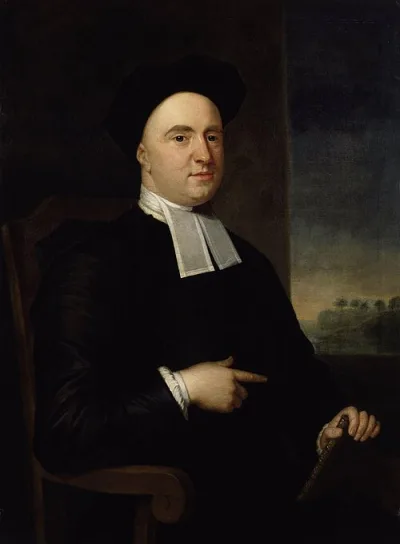
George Berkeley
George Berkeley was an Anglo-Irish philosopher, clergyman, and founder of subjective idealism, known for challenging materialism and the existence of matter.
George Berkeley, an Anglo-Irish philosopher, writer, and clergyman, is recognized as the originator of immaterialism, a philosophical concept later termed subjective idealism. He was a significant figure in the empiricism movement and profoundly influenced subsequent philosophers like Kant and Hume. Berkeley's work questioned the existence of material substance, proposing instead that objects are merely ideas perceived by the mind. This perspective was articulated in his key works, including "An Essay Towards a New Theory of Vision" (1709) and "A Treatise Concerning the Principles of Human Knowledge" (1710), later presented in dialogue form as "Three Dialogues Between Hylas and Philonous" (1713). He also critiqued Newtonian concepts of absolute space and motion and offered a critique of calculus foundations.
Beyond his philosophical contributions, Berkeley was ordained as a priest and later served as the Bishop of Cloyne. He was involved in humanitarian efforts, such as helping establish a home for abandoned children in London. His later life included a significant, albeit unsuccessful, project to found a college in Bermuda. Despite facing challenges and controversy, his ideas on perception, abstraction, and the nature of reality have continued to be studied and debated, with renewed interest emerging in the 20th century due to their relevance to contemporary philosophical issues.
Philosophical Foundations: Immaterialism and Idealism
George Berkeley is renowned for establishing immaterialism, a philosophical stance that denies the existence of material substance independent of perception. He contended that the objects we commonly perceive, such as tables and chairs, are not inherently material but rather collections of ideas existing only when apprehended by a mind. This theory, often referred to as subjective idealism, posits that "to be is to be perceived." Berkeley's arguments against abstraction were crucial premises for his immaterialist system. He also challenged Isaac Newton's concepts of absolute space, time, and motion, proposing arguments that anticipated later thinkers like Mach and Einstein. His philosophical work aimed to counter the prevailing materialistic viewpoints of his era.
Key Works and Intellectual Influence
Berkeley's philosophical journey began with "An Essay Towards a New Theory of Vision" (1709), where he explored the nature of sight and its limitations, suggesting that visual perception pertains to light and color rather than material objects. This was followed by his seminal work, "A Treatise Concerning the Principles of Human Knowledge" (1710), which laid out his theory of immaterialism. Due to its initial poor reception, he later published "Three Dialogues Between Hylas and Philonous" (1713), using the characters of Hylas (representing matter) and Philonous (representing mind) to defend his views. These works, alongside "De Motu" (1721) and "The Analyst" (1734), established him as a highly cited philosopher of the 18th century, significantly impacting later intellectual traditions.
Later Life, Humanitarianism, and Legacy
Beyond his academic and philosophical pursuits, George Berkeley served as the Bishop of Cloyne in the Church of Ireland. He was also involved in social causes, contributing to the establishment of the Foundling Hospital in London for abandoned children. His later publications, such as "Siris" (1744), explored diverse subjects, including the purported medicinal benefits of tar-water. Despite a significant project to establish a college in Bermuda that ultimately did not materialize, Berkeley's intellectual legacy endured. His philosophical ideas experienced a resurgence in interest in the 20th century, addressing fundamental questions in epistemology and metaphysics, leading to institutions and places being named in his honor.
Key Ideas
- Immaterialism: The theory that reality consists only of minds and their ideas, denying the existence of material substance independent of perception.
- Subjective Idealism: The philosophical stance that the existence of objects depends on their being perceived by a mind.
- Critique of Abstraction: An argument that abstract ideas, particularly of material substance, are not possible or meaningful.
- Critique of Absolute Space, Time, and Motion: Challenging Newtonian physics by arguing against the existence of absolute spatial and temporal frameworks.
Books by George Berkeley
2 free public domain books · Read online or download