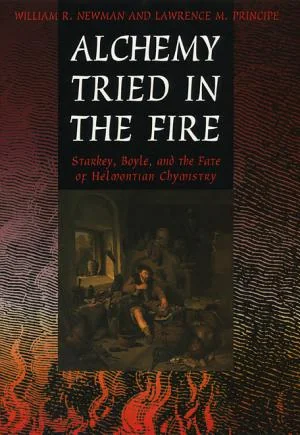
Alchemy Tried in the Fire
 72
72

Alchemy Tried in the Fire
William Newman and Lawrence Principe's "Alchemy Tried in the Fire" offers a vital corrective to the historiography of early modern science. By unearthing and analyzing specific laboratory notebooks, they convincingly demonstrate the empirical rigor and theoretical sophistication present in alchemical practice, moving beyond simplistic dismissals. The detailed reconstruction of experimental sequences, such as those concerning the preparation of "spirits of vitriol," is particularly illuminating. However, the sheer density of technical detail, while essential for scholarly accuracy, may present a barrier for readers less familiar with the intricacies of historical laboratory techniques. Despite this, the book's central thesis—that modern chemistry owes a substantial debt to alchemical experimentation—is powerfully supported. It is an indispensable resource for anyone seeking to understand the material roots of chemical science.
📝 Description
72
### What It Is Alchemy Tried in the Fire meticulously examines the laboratory practices of a prominent, yet historically obscured, alchemist. William R. Newman and Lawrence M. Principe uncover experimental protocols and material evidence previously unavailable, challenging the traditional view of alchemy as purely symbolic or pseudoscientific.
### Who It's For This work is intended for scholars of science history, particularly those focusing on the early modern period, and serious practitioners or students of esoteric traditions. It appeals to readers interested in the material culture of early scientific experimentation and the philosophical underpinnings of chemical knowledge.
### Historical Context The book situates alchemical experimentation within the scientific revolution, arguing for a continuity between alchemical pursuits and the development of modern chemistry. It highlights figures and practices from the 17th and 18th centuries, a period of intense intellectual ferment and evolving experimental methodologies.
### Key Concepts Central to the text is the concept of "practical alchemy," demonstrating how laboratory work, often dismissed, formed a crucial bridge to later chemical science. The authors explore the transformation of matter, the role of instruments, and the sophisticated theoretical frameworks that guided alchemical researchers.
💡 Why Read This Book?
• Understand the empirical foundations of early modern chemistry by examining specific alchemical laboratory procedures detailed in the text, such as those involving "spirits of vitriol. • Appreciate the sophisticated theoretical frameworks guiding alchemists, as revealed through the analysis of their experimental notes, moving beyond purely symbolic interpretations. • Trace the lineage of modern chemical principles back to their alchemical origins, challenging established narratives of scientific progress, particularly concerning the period around the late 17th century.
⭐ Reader Reviews
Honest opinions from readers who have explored this book.
❓ Frequently Asked Questions
What specific alchemist's work is analyzed in "Alchemy Tried in the Fire"?
The book focuses on the laboratory experiments of a prominent, though historically less recognized, alchemist from the late 17th and early 18th centuries. The authors reconstruct his practices from extensive archival research.
How does this book challenge traditional views of alchemy?
It argues that many principles and practices characteristic of modern chemistry actually derive from alchemy, presenting evidence of sophisticated laboratory work and theoretical understanding rather than purely mystical or pseudoscientific pursuits.
What is the "fire" mentioned in the title referring to?
The "fire" likely refers to the intense heat of the alchemical furnace, symbolizing the crucible of experimentation and transformation. It signifies the practical, empirical testing of alchemical theories through laboratory work.
What historical period does the research cover?
The research primarily covers the late 17th and early 18th centuries, a pivotal era in the transition from alchemy to chemistry during the broader scientific revolution.
Are there any visual aids or diagrams in the book?
While the book's strength lies in textual analysis and reconstruction of experimental processes, it likely includes or references illustrations of historical laboratory apparatus and potentially diagrams of experimental setups based on the analyzed texts.
What is the significance of "spirits of vitriol" in this context?
"Spirits of vitriol" (sulfuric acid) is a key substance whose preparation and properties are explored. Its analysis reveals the alchemists' practical knowledge of chemical reactions and their ability to produce and manipulate potent reagents.
🔮 Key Themes & Symbolism
Material Alchemy
The work meticulously details the physical processes and material substances involved in alchemical experimentation. It moves beyond symbolic interpretations to focus on the tangible aspects: the furnaces, glassware, reagents, and products. By analyzing specific experiments, such as the preparation of "spirits of vitriol," Newman and Principe demonstrate a sophisticated understanding of chemical reactions and material transformations that formed the bedrock of later chemical inquiry.
Continuity of Chemical Science
A central argument is the unbroken lineage from alchemical practice to modern chemistry. The book posits that principles and methodologies we now associate with chemistry were developed and refined within alchemical laboratories. This perspective challenges the common narrative of a sharp break between the two, highlighting how alchemists' empirical work and theoretical frameworks laid essential groundwork.
Hidden Laboratory Practices
The research uncovers and reconstructs previously obscure laboratory experiments of a notable alchemist. This focus on the practical, hands-on aspect of alchemy reveals the hidden technical knowledge and experimental skills that were crucial but often unrecorded or misunderstood in historical accounts. It emphasizes the importance of experimental evidence in the development of scientific understanding.
Theoretical Frameworks
Beyond mere recipes, the book explores the underlying theories that guided alchemical experimentation. It shows how alchemists developed complex conceptual models to understand the changes they observed in the laboratory. These theoretical structures, though different from modern ones, provided a rational basis for their investigations and contributed to the evolving scientific worldview.
💬 Memorable Quotes
“Many of the principles and practices characteristic of modern chemistry derive from alchemy.”
— This core assertion challenges the established view that alchemy was a precursor to science that was entirely superseded. It suggests a direct lineage, where chemical science inherited crucial techniques, concepts, and even experimental apparatus from alchemical traditions.
“The work explores the sophisticated experimental procedures of a specific alchemist.”
— This highlights the book's focus on empirical evidence and detailed reconstruction. It emphasizes that the study isn't just theoretical but grounded in the practical, often meticulous, laboratory work undertaken by historical figures.
“The transformation of matter was a central concern for alchemists.”
— This points to the alchemical quest for understanding and achieving change in substances. It underscores that while the ultimate goals might differ from modern chemistry, the fundamental study of material change was a shared pursuit.
“Alchemy provided a crucial bridge to later chemical science.”
— This metaphor suggests that alchemy wasn't a dead end but a vital transitional phase. It acted as a conduit, transferring knowledge, methods, and experimental culture that were essential for the emergence of chemistry as a distinct discipline.
“The intellectual currents of the scientific revolution shaped alchemical thought.”
— This contextualizes alchemy within its historical milieu. It shows that alchemical practitioners were not isolated but engaged with, and influenced by, the broader intellectual shifts occurring during the development of modern science.
🌙 Esoteric Significance
Tradition
While not strictly adhering to a single esoteric lineage, the work intersects significantly with the Hermetic tradition, which views the material world as a reflection of divine principles and emphasizes the transformative power of nature. It explores how alchemists, working within this broad Hermetic framework, sought not only material transmutation but also spiritual understanding through their laboratory practices.
Symbolism
The "fire" in the title is a potent alchemical symbol, representing purification, transformation, and the intense heat required for material change. Other potential symbols explored through the text might include specific apparatus like alembics or retorts, which represent the vessels of transformation, and key substances like "spirits of vitriol," which embody potent, reactive principles.
Modern Relevance
Contemporary practitioners of Hermeticism, Western esotericism, and even certain branches of speculative philosophy find value in this work. It informs modern understandings of the historical development of consciousness and the interconnectedness of material and spiritual inquiry, influencing discussions on the philosophy of science and the nature of knowledge.
👥 Who Should Read This Book
• Scholars of the history of science, particularly those focused on the transition from alchemy to chemistry during the early modern period. • Students of Western esotericism seeking to understand the practical, laboratory-based dimensions of historical alchemical traditions. • Researchers interested in the material culture of early experimentation and the development of scientific instruments and techniques.
📜 Historical Context
Published in 2005, "Alchemy Tried in the Fire" emerged within a scholarly landscape increasingly interested in the material culture and practical aspects of early modern science. The work directly engages with the ongoing re-evaluation of the Scientific Revolution, challenging older narratives that often sharply demarcated "science" from "magic" or "pseudoscience." Newman and Principe place their subject within the intellectual ferment of the late 17th and early 18th centuries, a period when figures like Isaac Newton (who also engaged with alchemical texts) and Robert Boyle were establishing new experimental methodologies. The book implicitly engages with the work of historians who previously focused more on theoretical alchemy, offering a counterpoint by emphasizing laboratory practice. Its detailed analysis provides a counter-narrative to the idea that alchemy was solely a philosophical pursuit, demonstrating its role as a practical precursor to chemistry.
📔 Journal Prompts
The laboratory practices detailed concerning "spirits of vitriol."
The argument for continuity between alchemical principles and modern chemistry.
The role of the alchemical furnace as a symbol of transformation.
The "hidden laboratory experiments" and their implications for scientific history.
The theoretical frameworks that guided alchemists' understanding of material change.
🗂️ Glossary
Spirits of Vitriol
A historical term referring to sulfuric acid, a potent and corrosive substance produced through alchemical processes. Its preparation and properties were extensively studied by alchemists.
Alembic
A type of distillation apparatus historically used in alchemy and early chemistry. It typically consists of a heated vessel, a head, and a pipe for conveying vapors to a receiver.
Material Alchemy
Refers to the practical, laboratory-based aspect of alchemy focused on the manipulation of physical substances and the execution of experimental procedures, as opposed to purely theoretical or philosophical interpretations.
Scientific Revolution
The period in European history, approximately from the 16th to the 18th century, during which new ideas in physics, astronomy, biology, and chemistry transformed the views of society about nature.
Hermetic Tradition
A philosophical and religious tradition based primarily upon writings attributed to Hermes Trismegistus. It emphasizes the interconnectedness of the cosmos, the divine, and the human, often incorporating alchemical and astrological elements.
Reagents
Substances or compounds that are added to a system to cause a chemical reaction or to test if a reaction occurs. In alchemy, the careful selection and preparation of reagents were critical.
Laboratory Apparatus
The specialized equipment and tools used in scientific experiments. The book examines the specific apparatus employed by alchemists, highlighting their ingenuity and practical function.