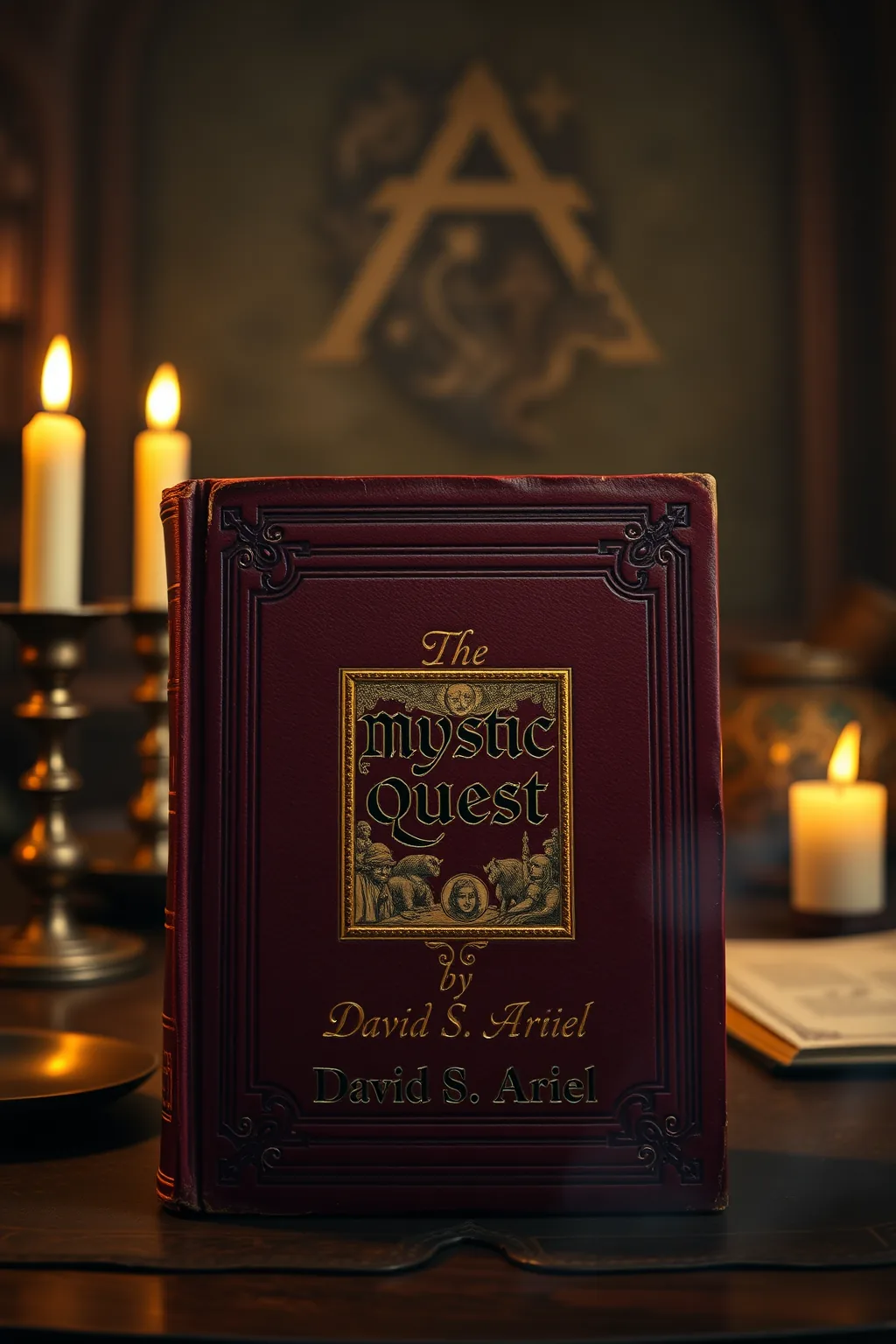
The Mystic Quest
 73
73

The Mystic Quest
David S. Ariel's The Mystic Quest offers a much-needed clarity to the often-obscured world of Jewish mysticism. Its primary strength lies in its author's ability to distill complex theological and cosmological ideas into language that avoids jargon, a feat not easily achieved when discussing concepts like the Sefirot. The book's detailed explanation of the historical evolution of these ideas, placing them within their proper intellectual lineage, is commendable. However, the work occasionally feels more like a comprehensive overview than a deep dive, perhaps a necessary trade-off for accessibility. A particularly illuminating section discusses the concept of *Ein Sof*, the Infinite, and its relationship to the manifest world, demonstrating Ariel's skill in rendering abstract notions tangible. The Mystic Quest succeeds in its stated goal of making Jewish mysticism understandable, though seasoned practitioners might seek further esoteric depth.
📝 Description
73
David S. Ariel's 1977 book offers a clear introduction to Jewish mysticism.
David S. Ariel wrote The Mystic Quest in 1977 to make the complex ideas of Jewish mysticism accessible. He explains core concepts like the nature of God and the soul's connection to the Infinite. The book uses research to clarify subjects often seen as difficult, aiming to connect academic study with general readers interested in this tradition. It is suitable for those new to Kabbalah, including students of religion, philosophy, and history, and anyone interested in spirituality. Readers who find traditional Kabbalah texts hard to understand will appreciate Ariel's approach. It provides a way to learn the main principles and history of Jewish mystical traditions without needing prior specialized knowledge.
The work emerged during a time of growing global interest in esoteric subjects. While Kabbalah has ancient origins, its study and public awareness increased in the late 20th century. Ariel's book gave people an easy starting point. It stood apart from earlier, more private or devotional writings, fitting into a period where the academic study of these traditions was becoming more structured. The book covers fundamental ideas such as the divine nature, the structure of spiritual worlds, and the human soul's relation to the Absolute.
The Mystic Quest was published in 1977, a year that saw a rise in global interest in esoteric traditions. Jewish mysticism, or Kabbalah, has roots stretching back to ancient times, but its academic study and wider dissemination gained momentum in the latter half of the 20th century. Ariel's book arrived as the academic study of these traditions was becoming more formalized, providing a direct entry point for those outside of specialized circles.
💡 Why Read This Book?
• Gain a clear understanding of the *Ein Sof* (the Infinite) and its emanations, the Sefirot, as presented in Jewish mystical thought, providing a foundational framework for understanding divine manifestation. • Grasp the historical trajectory of Kabbalah, tracing its development from biblical interpretations to later medieval schools, offering context often missing in contemporary discussions. • Learn about the concept of *Tzimtzum* (Divine Contraction) and its role in creation, enabling a deeper comprehension of the relationship between the boundless God and the finite universe.
⭐ Reader Reviews
Honest opinions from readers who have explored this book.
❓ Frequently Asked Questions
When was The Mystic Quest first published?
The Mystic Quest was first published on July 7, 1977, making it a significant work from the late 20th century's surge of interest in esoteric studies.
Who is the author of The Mystic Quest?
The author is David S. Ariel, who was the president of the Cleveland College of Jewish Studies at the time of the book's initial publication.
What is the primary subject matter of The Mystic Quest?
The book's primary subject is Jewish mystical thought, explaining its major ideas and concepts for a general audience, covering historical development and core principles.
Is The Mystic Quest suitable for beginners?
Yes, the book is specifically designed for the general reader and layperson, aiming to make the complex elements of Jewish mysticism accessible without prior specialized knowledge.
What are some key concepts explored in the book?
Key concepts include the nature of God, divine realms, the human soul's connection to the Infinite, divine emanations, and mystical cosmology, all explained in an accessible manner.
What is the historical significance of The Mystic Quest?
Published in 1977, it contributed to the academic and popular understanding of Jewish mysticism during a period of growing global interest in esoteric traditions.
🔮 Key Themes & Symbolism
Divine Emanation (Sefirot)
The book details the concept of the Sefirot, the ten divine emanations through which the Infinite (Ein Sof) manifests in the created universe. Ariel explains this intricate system as a structure of divine attributes and energies, crucial for understanding the Kabbalistic cosmology. It’s not merely abstract theology but a framework for spiritual ascent and understanding the divine presence within all existence, bridging the transcendental and immanent aspects of God.
The Infinite (Ein Sof)
Central to the work is the exploration of Ein Sof, the concept of God as an unfathomable, limitless, and unknowable absolute. Ariel clarifies how Jewish mysticism grapples with the paradox of an infinite God creating and interacting with a finite world. This section explores the philosophical and theological challenges of conceiving the divine beyond human comprehension, laying the groundwork for understanding subsequent emanations.
Creation and Cosmic Structure
The Mystic Quest examines the Kabbalistic account of creation, particularly the concept of Tzimtzum (Divine Contraction), as a prerequisite for existence. It outlines the structured descent of divine energy through various realms, forming a cosmic hierarchy. Understanding this structure is presented as vital for comprehending the spiritual significance of the material world and the interconnectedness of all levels of reality.
The Human Soul's Journey
Ariel discusses the nature of the human soul within the Kabbalistic framework, often viewed as a spark of the divine with the potential for spiritual ascent. The book touches upon the soul's journey, its connection to the Sefirot, and the purpose of earthly existence in facilitating spiritual growth and reunification with the divine source. This aspect highlights the practical, experiential dimension of Jewish mysticism.
💬 Memorable Quotes
Direct passages from the work, attributed to the author.
“Jewish mysticism is as old as the Bible itself.”
— This statement emphasizes the deep historical roots of Jewish mystical traditions, suggesting that esoteric interpretations and practices are not a later development but an integral, ancient strand within Judaism.
“The extremely difficult and complex elements of Jewish mysticism in language that makes it accessible to the layperson.”
— This highlights the book's core objective: to clarify Kabbalah and its profound concepts, translating them into understandable terms for those without specialized academic or religious training.
“Drawing upon his own extensive research as well as on the growing body of scholarly material on the subject.”
— This indicates the author's methodology, combining personal scholarly investigation with existing academic discourse to provide a well-researched and credible exposition of Jewish mystical thought.
“Presents the major ideas and concepts of Jewish mystical thought.”
— This frames the book's scope, promising a comprehensive overview of the foundational principles and central themes that define the field of Jewish mysticism.
“Dr. David Ariel, president of the Cleveland College of Jewish Studies.”
— This identifies the author and his academic credentials, lending authority and establishing his position as a knowledgeable guide for the reader navigating complex spiritual and theological subjects.
🌙 Esoteric Significance
Tradition
The Mystic Quest primarily engages with the Kabbalistic tradition within Jewish mysticism. It positions itself as an accessible introduction to the core tenets and historical development of Kabbalah, a lineage deeply rooted in Jewish scripture and commentary. While focusing on Kabbalah, it implicitly connects to broader esoteric concepts of divine emanation and cosmic structure found in other mystical traditions, acting as a bridge for those interested in comparative esoteric studies.
Symbolism
Key symbols explored include the Tree of Life (Etz Chaim), representing the ten Sefirot and the structure of divine manifestation, and the concept of Light (Ohr) as the primordial divine energy. The book likely discusses the interplay between these symbols to illustrate the process of creation, divine presence, and the path of spiritual return, explaining their significance within the Kabbalistic cosmological map.
Modern Relevance
Contemporary thinkers and practitioners in fields ranging from comparative religion to depth psychology often reference foundational texts like The Mystic Quest for understanding the symbolic language and philosophical underpinnings of Kabbalah. Its clear explanations continue to inform spiritual seekers and academics interested in Jewish mysticism's influence on Western esotericism and its enduring relevance in discussions of consciousness and the divine.
👥 Who Should Read This Book
• Students of comparative religion and philosophy seeking a clear introduction to Jewish mystical thought and its historical context. • Individuals curious about Kabbalah but daunted by its complex terminology and esoteric nature, looking for an accessible, well-researched guide. • Spiritual seekers interested in exploring the concept of divine emanation, cosmic structure, and the soul's relationship to the Infinite within a specific religious tradition.
📜 Historical Context
Published in 1977, The Mystic Quest emerged during a period of burgeoning global interest in esoteric studies, coinciding with a growing academic engagement with Kabbalah. The late 20th century saw a shift towards more rigorous scholarly examination of Jewish mystical texts, moving beyond earlier, more devotional or popular interpretations. Ariel's work provided a clear, accessible entry point for a wider audience, differentiating itself from more specialized academic treatises or esoteric manuals. At the time, figures like Gershom Scholem were foundational in the academic study of Kabbalah, and Ariel's book contributed to this trend by making core ideas understandable. The intellectual currents included a general curiosity about non-Western and esoteric spiritual traditions, making works that translated complex systems particularly valuable.
📔 Journal Prompts
The concept of Ein Sof and its relationship to the Sefirot.
The historical development of Kabbalistic ideas as presented by Ariel.
The symbolic meaning of the Tree of Life within Jewish mysticism.
The practical implications of Tzimtzum for understanding creation.
The human soul's perceived role within the Kabbalistic cosmos.
🗂️ Glossary
Kabbalah
The esoteric system of Jewish mysticism, concerned with the divine nature, creation, and the relationship between God and humanity, often expressed through symbolic interpretation of scripture.
Ein Sof
The Kabbalistic term for the Infinite, the absolute, unknowable, and limitless aspect of God beyond all description or comprehension.
Sefirot
The ten divine emanations or attributes through which the Ein Sof manifests and interacts with the created universe, forming the structure of the Kabbalistic Tree of Life.
Tzimtzum
Literally 'contraction' or 'withdrawal,' a Kabbalistic concept describing God's self-limitation to make space for creation to exist.
Ohr
Hebrew for 'light,' often used in Kabbalah to symbolize divine energy, consciousness, or emanation flowing from the Ein Sof.
Malkuth
The tenth Sefirah, often translated as 'Kingdom,' representing the manifest world and the final stage of divine emanation, the receptacle of divine influence.
Keter
The first Sefirah, meaning 'Crown,' representing the highest, most transcendent aspect of the divine will or the divine head before manifestation.