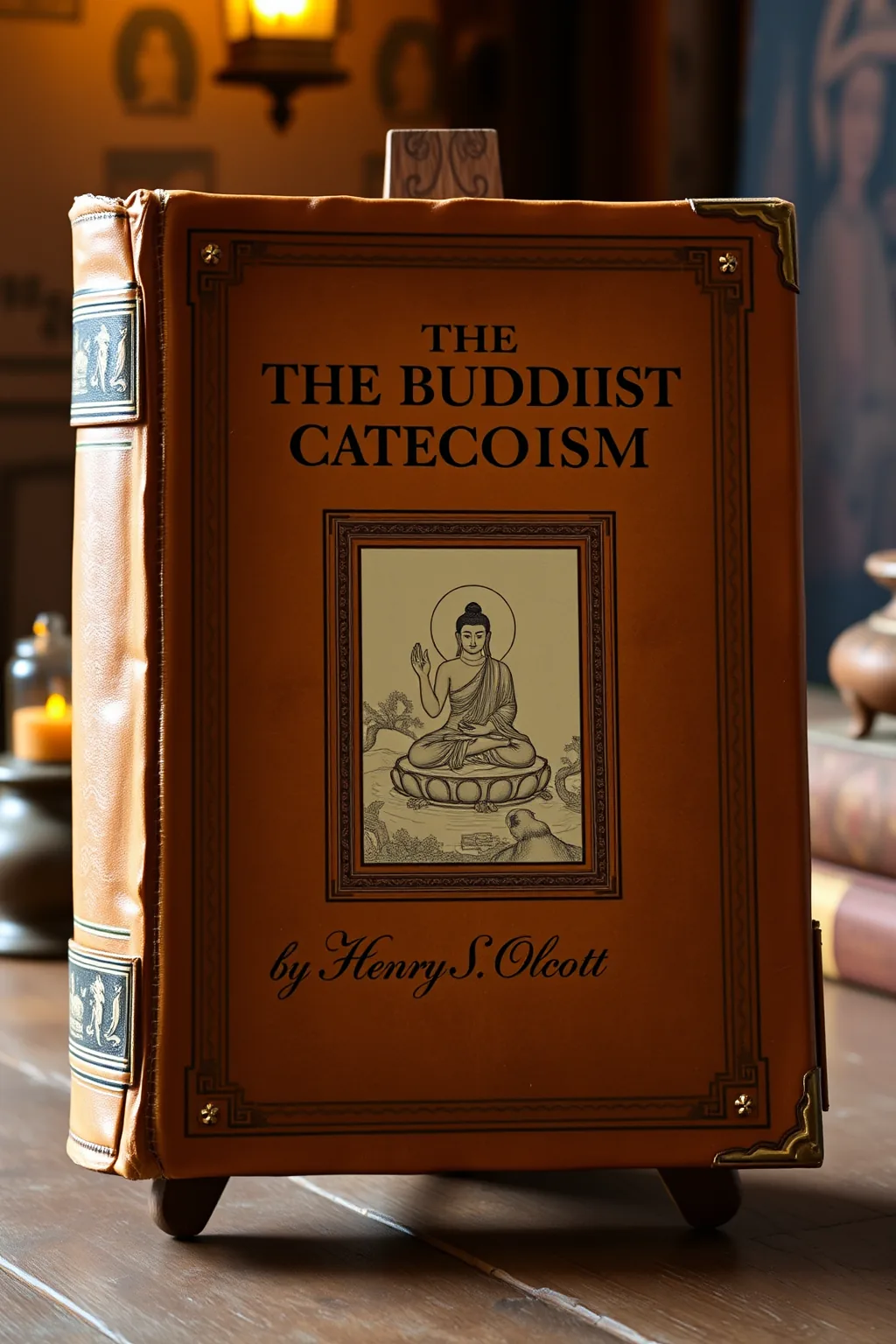
The Buddhist Catechism
 75
75

The Buddhist Catechism



Celeste Moreau (Divination & Symbolism Reviewer) — Henry S. Olcott's 'The Buddhist Catechism' stands as a cornerstone for anyone seeking to understand the esoteric underpinnings of Buddhism. Its elegant Q&A structure demystifies complex doctrines, making them accessible without sacrificing depth. Olcott's unique ability to bridge traditional Buddhist thought with Western rationalism is particularly striking, offering a rare perspective on the universal resonance of the Dharma. This work is indispensable for scholars, practitioners, and curious minds alike, providing a clear, concise, and spiritually rich introduction to the Buddha's teachings. Its enduring legacy lies in its capacity to ignite contemplation and foster a deeper connection to timeless wisdom.
📝 Description
75
Henry S. Olcott published "The Buddhist Catechism" in 1881 to explain Buddhist principles.
Originally published in 1881, Henry S. Olcott's "The Buddhist Catechism" uses a question-and-answer format to explain core Buddhist concepts. Olcott structured the book to make the teachings accessible, drawing parallels between Buddhist philosophy and the scientific rationalism of his time. It covers the life of Siddhartha Gautama, the concept of Dharma, and the principles of the Sangha.
The text aims to present Buddhist doctrine in a clear and systematic way. It was intended for a Western audience unfamiliar with Eastern religions. Olcott sought to synthesize these teachings, making them understandable within a late 19th-century intellectual climate. The book functions as an introduction to the fundamental ideas of Buddhism.
Henry S. Olcott, a key figure in the Theosophical Society, compiled "The Buddhist Catechism" during a period of intense Western interest in Eastern religions. His work aimed to present Buddhist teachings in a structured, accessible format that could resonate with a Western readership. This catechism was part of a broader late 19th-century effort to interpret and disseminate Asian spiritual traditions, often framing them in ways that addressed contemporary philosophical and scientific concerns. Olcott's approach sought to bridge the gap between Eastern spirituality and Western thought.
✍️ Author
💡 Why Read This Book?
This book is essential for understanding the foundational principles of Buddhism through a unique, accessible lens. It is ideal for spiritual seekers, students of comparative religion, and anyone intrigued by ancient wisdom traditions that harmonize with modern thought. Olcott's work provides a clear roadmap to the Buddha's teachings, fostering contemplation and insight for a more balanced life.
⭐ Reader Reviews
Honest opinions from readers who have explored this book.
❓ Frequently Asked Questions
What is the primary purpose of 'The Buddhist Catechism'?
Its primary purpose is to provide a clear, systematic, and accessible explanation of the fundamental principles of Buddhism, making its teachings understandable to a broad audience, including those new to the subject.
Who was Henry S. Olcott and why is he significant in relation to Buddhism?
Henry S. Olcott was an American journalist and theosophist who became a prominent advocate for Buddhism in the West. He played a crucial role in its revival and spread, particularly in Sri Lanka, where he helped establish Buddhist schools.
How does the book reconcile Buddhism with science?
Olcott presents Buddhist concepts in a manner that aligns with rational inquiry and scientific understanding prevalent in his era, demonstrating that the Dharma is not in opposition to reason but rather complements it.
What historical context influenced the writing of this catechism?
The book was written during the colonial period in Sri Lanka, aiming to provide a structured curriculum for Buddhist education in schools established to counter Western religious influence and preserve local cultural heritage.
Is this book suitable for absolute beginners to Buddhism?
Yes, its question-and-answer format is specifically designed for clarity and ease of comprehension, making it an excellent starting point for individuals with no prior knowledge of Buddhist philosophy.
🔮 Key Themes & Symbolism
The Four Noble Truths and the Eightfold Path
This catechism meticulously breaks down the core of Buddhist doctrine: the Four Noble Truths, which diagnose the nature of suffering and its cessation, and the Eightfold Path, the practical guide to achieving liberation. Olcott presents these concepts not as abstract philosophy but as actionable wisdom for working through the human condition and cultivating inner peace. Understanding these foundational elements is crucial for anyone seeking to grasp the essence of Buddhist practice and its transformative potential for the individual soul.
The Life and Teachings of the Buddha
Olcott offers a clear and inspiring narrative of Siddhartha Gautama's journey from prince to Buddha. The text illuminates the key moments of his life, from his renunciation and meditation under the Bodhi tree to his enlightenment and subsequent teachings. This biographical element serves as a powerful evidence of the possibility of human awakening and provides a humanistic anchor for the profound spiritual and philosophical doctrines that follow, encouraging readers to find inspiration in the Master's example.
The Interplay of Reason and Spirituality
A remarkable aspect of 'The Buddhist Catechism' is its adeptness at harmonizing ancient spiritual wisdom with the empirical and rationalistic spirit of the late 19th century. Olcott demonstrates how Buddhist principles are not only compatible with, but often anticipate, scientific observations and logical reasoning. This theme encourages a holistic worldview, where faith and intellect are not opposing forces but complementary paths toward truth and understanding, making the Dharma relevant to the modern, questioning mind.
💬 Memorable Quotes
Direct passages from the work, attributed to the author.
“What is the object of the Noble Eightfold Path?”
— This question highlights the practical, goal-oriented nature of Buddhist practice. It signifies that the path is not merely intellectual but a deliberate journey toward a specific spiritual outcome: cessation of suffering and attainment of enlightenment.
“What is the difference between the Arhat and the Buddha?”
— This distinction studies the nuances of spiritual attainment within Buddhism, differentiating between one who has achieved personal liberation (Arhat) and one who has attained supreme enlightenment and can teach others (Buddha).
“What is Karma?”
— This fundamental concept explains the law of cause and effect in Buddhist ethics. It underscores the importance of volitional actions and their consequences, emphasizing personal responsibility for one's experiences and future.
“What is Nirvana?”
— Nirvana represents the ultimate goal of Buddhist practice – the extinguishing of suffering and the cycle of rebirth. It is the state of profound peace and liberation, often described as beyond conceptual understanding.
“What are the Three Jewels?”
— This refers to the Buddha, the Dharma (teachings), and the Sangha (community) – the foundational pillars of Buddhist refuge. Taking refuge in these signifies commitment to the path of enlightenment.
🌙 Esoteric Significance
Tradition
This work is deeply rooted in the Theravada tradition of Buddhism, yet its broad appeal and Olcott's rational approach lend it a universal, almost esoteric, quality. It acts as a bridge, making profound spiritual insights accessible without requiring initiation into complex ritualistic practices, thereby offering a path to self-discovery through clear understanding of core principles.
Symbolism
The catechism implicitly decodes key Buddhist symbols such as the Wheel of Dharma (representing the Buddha's teachings), the Bodhi Tree (enlightenment), and the lotus flower (purity and spiritual unfolding). While not overtly focused on esoteric symbolism, the explanations of concepts like Karma and Nirvana invite deeper contemplation on the hidden mechanics of existence and consciousness.
Modern Relevance
In an era often marked by information overload and spiritual fragmentation, 'The Buddhist Catechism' offers a grounding in timeless wisdom. Its emphasis on rational inquiry and personal transformation resonates strongly with contemporary seekers. The book provides a clear framework for cultivating mindfulness, compassion, and ethical living, making its ancient teachings directly applicable to the challenges and opportunities of modern life.
👥 Who Should Read This Book
This foundational text is important for a diverse audience. For the **beginner**, it offers a clear, non-intimidating entry into Buddhist philosophy. **Students of religion and comparative spirituality** will find it an essential resource for understanding a major world tradition. **Spiritual seekers** yearning for wisdom that harmonizes intellect and intuition will be drawn to its clarity. **Practitioners** seeking to deepen their understanding of core concepts will appreciate its systematic approach. It is a gateway for anyone wishing to explore the profound and practical teachings of the Buddha.
📜 Historical Context
Published in 1881, 'The Buddhist Catechism' emerged during a period of intense global exchange and burgeoning interest in Eastern philosophies within the West. Colonialism had brought Western scholars and thinkers into closer contact with Asian cultures, sparking both academic study and a spiritual quest for alternatives to prevailing Western doctrines. Henry S. Olcott, a key figure in the Theosophical Society, was instrumental in this movement, aiming to present Buddhism in a structured, accessible format suitable for educational purposes, particularly for Buddhist communities in Sri Lanka grappling with colonial influence. The book's success reflects a broader societal shift towards questioning established norms and seeking universal truths, making it a significant document of both religious history and intellectual evolution.
📔 Journal Prompts
Reflect on the concept of suffering (Dukkha) as presented in the catechism. How does this understanding align with or challenge your personal experiences?
Consider the Eightfold Path. Which aspect resonates most strongly with you, and what practical steps can you take to integrate it into your daily life?
Olcott bridges Buddhist teachings with scientific rationalism. How do you see the relationship between your own spiritual beliefs and your understanding of the natural world?
Meditate on the essence of Karma. How can understanding this principle influence your choices and actions in the coming week?
What does 'taking refuge' in the Three Jewels (Buddha, Dharma, Sangha) mean to you personally, beyond a simple declaration?
🗂️ Glossary
Dharma
In Buddhism, Dharma refers to the teachings of the Buddha, the universal truth, and the path that leads to liberation. It encompasses the cosmic order and the nature of reality itself.
Sangha
The Sangha is the monastic community of ordained Buddhist monks and nuns. More broadly, it can also refer to the community of all Buddhist practitioners, lay and ordained, who follow the Dharma.
Karma
The principle of causality where intentional actions (physical, verbal, or mental) have consequences in this life and future lives. It is the law of cause and effect governing all sentient beings.
Nirvana
The ultimate goal of Buddhism, representing the cessation of suffering, ignorance, and the cycle of rebirth (samsara). It is a state of profound peace, liberation, and enlightenment.
Arhat
A 'worthy one' or 'perfected person' who has attained enlightenment and achieved Nirvana through following the Buddha's teachings. They are liberated from the cycle of rebirth but may not have the same universal wisdom as a Buddha.
This book appears in 3 collections
🔮 Readers Also Liked
Browse all →





From the “Meditation” Collection
View all →





![Paul Foster Case The Tarot ( A Key To The Wisdom Of The Ages)[ebook Pdf]](/img/thumb/paul-foster-case-the-tarot-a-key-to-the-wisdom-of-the-ages-ebook-pdf.webp)



More Free Mysticism & Contemplation Books
View all →