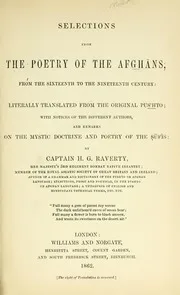
Selections from the poetry of the Afghans from the 16th to the 19th century
 76
76

Selections from the poetry of the Afghans from the 16th to the 19th century


By Celeste Moreau (Divination & Symbolism Reviewer) — Smirna Si's 'Selections from the poetry of the Afghans' is a luminous offering for the discerning esoteric reader. This compilation masterfully captures the incandescent spirit of Sufi mysticism, presenting poetry that transcends time and culture. Si's insightful remarks illuminate the profound spiritual doctrines embedded within these verses, revealing hidden layers of meaning and esoteric symbolism. The collection serves as a powerful testament to the universal language of divine love and the soul's yearning for union. Ideal for scholars of mysticism, practitioners of contemplative traditions, and anyone seeking a deeper connection to the sacred through the beauty of poetic expression. An indispensable addition to any occult or metaphysical library.
📝 Description
76
Smirna Si's 2023 collection presents Afghan mystical poetry from the 16th to 19th centuries.
This volume gathers selections of poetry from Afghan mystics spanning four centuries, from the 1500s to the 1800s. Smirna Si, the curator, has brought together verses that express spiritual longing and the pursuit of divine union. The poems use rich symbolism and imagery to describe the Sufi path, which is understood as a process of the heart leading to absorption in the Divine.
These selections articulate the ecstatic expressions of those devoted to God, showing the subtle streams of esoteric understanding that inform daily life. The collection functions as a guide for those seriously pursuing spiritual realization. It demonstrates the lasting strength of mystical experience and the human spirit's deep desire to find ultimate truth. The poetry transports the reader to a space where love is the primary teaching and oneness is the highest achievement.
This collection falls within the broader tradition of Islamic mysticism, specifically Sufism. Sufi poetry often uses ecstatic language and symbolic imagery to convey the experience of direct communion with God. The concept of 'annihilation in the Divine' (fana) is a central theme, representing the dissolution of the ego in the presence of the Beloved. The 'veiled truths' mentioned refer to the hidden meanings and esoteric knowledge accessible through spiritual practice and inner realization, distinct from exoteric religious observance.
💡 Why Read This Book?
Embark on a transformative journey through the heart of Sufi mysticism. 'Selections from the poetry of the Afghans' offers direct access to the profound spiritual insights and ecstatic utterances of ancient mystics. Uncover hidden layers of symbolism, explore the universal language of divine love, and deepen your understanding of the esoteric path. This collection is essential for seekers of truth, scholars of comparative religion, and practitioners of contemplative arts.
⭐ Reader Reviews
Honest opinions from readers who have explored this book.
❓ Frequently Asked Questions
What is the primary focus of this poetry collection?
The primary focus is the mystical and spiritual poetry of Afghan Sufis from the 16th to 19th centuries, exploring themes of divine love, longing, and the esoteric path towards union with the Divine.
Who is Smirna Si, the curator?
Smirna Si is the editor and curator of this collection, known for her deep engagement with esoteric and mystical literature, providing insightful commentary on the works presented.
What does 'Sufism' refer to in this context?
Sufism is the mystical dimension of Islam, characterized by its emphasis on inner purification, ecstatic experiences, and the direct experience of God, often expressed through poetry and music.
Are the poems translated?
While not explicitly stated, such collections typically involve translations to make the poetry accessible to a wider, non-Afghan speaking audience, preserving the essence of the original spirit.
Is prior knowledge of Sufism required to appreciate this book?
No, prior knowledge is not strictly required. The curator's remarks and the nature of the poetry itself guide the reader, though some familiarity may enhance the appreciation of deeper esoteric concepts.
🔮 Key Themes & Symbolism
The Divine Beloved and the Ecstasy of Love
This theme explores the central Sufi concept of the 'Beloved' – God – as the ultimate object of desire and the source of all existence. The poems express an intense, often intoxicating love for the Divine, manifesting as ecstatic states, passionate longing, and a profound sense of union. It explores the lover-beloved dynamic as a metaphor for the soul's journey, where surrender, devotion, and the shedding of the ego lead to spiritual intoxication and direct communion. This is the heart of the Sufi experience, articulated through vibrant, often paradoxical imagery that speaks of both pain and rapture.
The Path of Annihilation (Fana) and Subsistence (Baqa)
Central to Sufi doctrine is the concept of fana, the annihilation of the self in the Divine. This theme explores how the poets grapple with the dissolution of their individual ego and worldly attachments to achieve a state of pure being. The poetry often describes the arduous yet liberating process of shedding illusions and desires, leading to a profound inner transformation. This is contrasted with baqa, the subsistence in God, where the individual consciousness, though transformed, finds eternal existence within the Divine essence. It represents the ultimate goal of the spiritual journey.
Symbolism of the Tavern and the Wine of Divine Love
Many Sufi poems employ the detailed symbolism of the tavern, wine, and intoxication to convey spiritual states. This theme examines how these earthly metaphors are reinterpreted to represent the divine intoxication that arises from the presence of God. The 'tavern' becomes a place of spiritual gathering, the 'wine' the ecstatic experience of divine love, and 'intoxication' the state of being overwhelmed by divine grace. This symbolic language allows poets to express ineffable spiritual realities in a way that is both accessible and deeply profound, often challenging conventional religious interpretations.
💬 Memorable Quotes
Direct passages from the work, attributed to the author.
“In the cup of nothingness, I drank the wine of eternity.”
— This speaks to the Sufi practice of fana (annihilation of self), where by relinquishing the ego, one experiences the eternal presence of the Divine.
“The universe is but a whisper of His name.”
— Highlighting the Sufi belief in divine immanence and the interconnectedness of all creation, suggesting that every element of existence is a manifestation of God's presence.
“Tears of separation water the garden of reunion.”
— This paradoxical statement illustrates the spiritual journey, where the pain of being separated from the Divine ultimately purifies the soul and leads to ecstatic union.
“My silence is a song only the wise can hear.”
— Reflects the esoteric nature of Sufi wisdom, suggesting that true spiritual understanding often lies beyond verbal expression and requires inner perception.
💡 Key Ideas
Editorial paraphrase of the work's core concepts — not direct quotes.
My heart, a moth, circles the flame of the Beloved's face.
This quote embodies the Sufi concept of intense devotion and surrender, where the soul (moth) is drawn irresistibly to the Divine light (flame), even at the risk of self-immolation.
🌙 Esoteric Significance
Tradition
This collection is deeply rooted in the Sufi tradition, the mystical dimension of Islam. Sufism emphasizes inner purification, the direct experience of God, and the journey of the soul towards divine union. The poetry presented here serves as a evidence of the esoteric teachings within Sufism, focusing on concepts like divine love, annihilation of the ego (fana), and spiritual intoxication, offering a path of inner transformation accessible through contemplation and devotion.
Symbolism
The poetry is rich with symbolism, drawing from both Islamic cosmology and common life. Key symbols include the 'tavern' and 'wine' representing spiritual gatherings and ecstatic states, the 'moth' and 'flame' symbolizing the soul's yearning for the Divine, and the 'beloved' representing God. These symbols are not literal but allegorical, used to express ineffable spiritual experiences and esoteric truths about the nature of reality and the human soul's relationship with the Creator.
Modern Relevance
In an age often characterized by materialism and disconnection, this collection offers a potent reminder of the enduring human quest for meaning and spiritual fulfillment. The timeless themes of divine love, self-discovery, and the pursuit of inner peace resonate deeply with contemporary seekers. The esoteric insights provided by these ancient poets offer a framework for understanding consciousness, overcoming egoic limitations, and cultivating a more profound connection to the sacred in our modern lives.
👥 Who Should Read This Book
This collection is a treasure for the dedicated seeker of esoteric knowledge, particularly those drawn to Islamic mysticism and Sufism. Scholars of comparative religion and comparative literature will find invaluable primary source material here. Practitioners of contemplative disciplines, such as meditation and mindfulness, will discover profound reflections on inner states and the nature of consciousness. Furthermore, lovers of poetry who appreciate detailed symbolism and profound emotional depth will be deeply moved by these verses, finding guidance and inspiration for their own spiritual journeys.
📜 Historical Context
The period from the 16th to the 19th century in Afghanistan was marked by significant cultural and religious dynamism, particularly within the Sufi orders. This era saw the flourishing of various Sufi brotherhoods, each with its unique interpretations of Islamic mysticism and its own poetic traditions. These poets, often living in regions where spiritual devotion was paramount, used their verses to articulate complex theological ideas, personal spiritual experiences, and the socio-political realities of their time through the lens of divine love and esoteric knowledge. The poetry served as a vital medium for spiritual instruction, communal devotion, and the expression of a deeply felt connection to the Divine, reflecting a rich intellectual and spiritual heritage that profoundly influenced the broader Islamic world.
📔 Journal Prompts
Reflect on a time you felt an intense, almost overwhelming sense of love or longing. How does this compare to the descriptions of divine love in the poems?
What does the symbol of the 'tavern' or 'wine' evoke for you in a spiritual context? Explore its potential esoteric meanings.
Consider the concept of 'annihilation of the self' (fana). What aspects of your ego do you find most challenging to let go of in your spiritual practice?
How can the paradoxes found in Sufi poetry (e.g., pain leading to reunion) be applied to understanding difficulties in your own life?
If silence is a song only the wise can hear, what 'songs' might be present in your own moments of quiet contemplation?
🗂️ Glossary
Sufism
The mystical dimension of Islam, focused on the inner purification of the heart and the direct experience of God. It emphasizes love, devotion, and the annihilation of the ego.
Fana
An Arabic term in Sufism meaning 'annihilation' or 'dissolution.' It refers to the extinction of the ego and worldly attachments in the presence of the Divine.
Baqa
An Arabic term in Sufism meaning 'subsistence' or 'permanence.' It describes the state of remaining or continuing in God after the experience of fana, characterized by a transformed consciousness.
Beloved
In Sufi poetry, this term typically refers to God, the ultimate object of love and desire for the mystic. The relationship is often portrayed as that of a lover to their beloved.
Tawhid
The Islamic concept of the absolute oneness of God. In Sufism, this is understood not just intellectually but as a deeply felt experiential reality of unity.
This book appears in 2 collections
🔮 Readers Also Liked
Browse all →





More by Smirna Si
All books →

From the “Christian Mysticism” Collection
View all →








More Free Mysticism & Contemplation Books
View all →