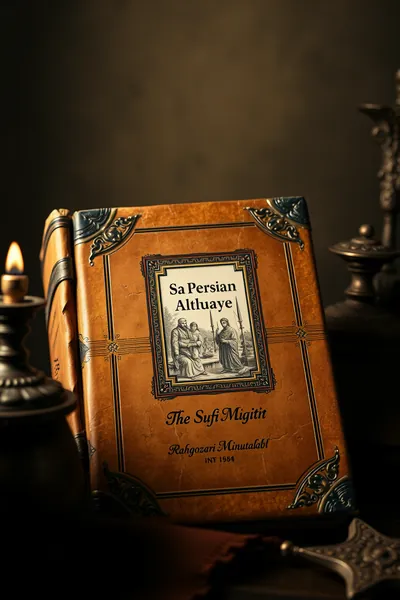
Bārgāh-i Khānqāh dar kavīr-i haft kāsah

 80
80

Bārgāh-i Khānqāh dar kavīr-i haft kāsah
Bastani Parizi's "Bārgāh-i Khānqāh dar kavīr-i haft kāsah" offers a layered allegorical exploration that moves beyond simple historical narrative. The author's skill in weaving metaphorical significance into ostensibly historical or literary settings is evident, particularly in his use of the "khānqāh" as a locus for spiritual encounters. A notable strength is the evocative imagery, which invites sustained contemplation. However, the work's allegorical nature, while its core appeal, can also present a significant barrier to readers unfamiliar with the specific symbolic language of Persian Sufism; a more explicit glossary of terms or conceptual frameworks within the text itself would have been beneficial. The passages discussing the traveler's encounter with the "mirage" as a spiritual illusion are particularly compelling, demonstrating the book's potential for profound reflection. Ultimately, this is a text demanding patience and a willingness to engage with its symbolic depths.
📝 Description
80
Muhammad Ibrahim Bastani Parizi's 2005 book uses a desert caravanserai to explore Sufi concepts.
Bārgāh-i Khānqāh dar kavīr-i haft kāsah, published in 2005, by Muhammad Ibrahim Bastani Parizi, examines the confluence of Sufi mysticism, Persian history, and literary allegory. The title itself, translating to 'Caravanserai in the Desert of Seven Bowls,' immediately signals its symbolic approach. Rather than a straightforward historical account, the book employs the imagery of a desert caravanserai and seven bowls to investigate spiritual ideas and historical narratives. It invites readers to uncover deeper meanings within Persian cultural and spiritual traditions.
The work appeals to those studying Persian literature and Islamic mysticism, especially Sufi traditions and their philosophical foundations. Readers interested in comparative religion or the symbolic language found in classical Persian poetry and prose will find this text valuable. Those who appreciate allegorical storytelling, capable of conveying complex spiritual concepts, will also benefit from its contents.
Written by the prominent Iranian historian and man of letters, Muhammad Ibrahim Bastani Parizi, this book draws from a long-standing Persian scholarly tradition that merges historical inquiry with esoteric interpretation. Bastani Parizi's work reflects a deep engagement with Iran's pre-Islamic and Islamic heritage, often seeking hidden meanings within historical events and literature. This approach is characteristic of intellectuals dedicated to uncovering the subtler dimensions of their cultural and spiritual history.
💡 Why Read This Book?
• Gain insight into the symbolic meaning of the "khānqāh" as a spiritual gathering place, distinct from its historical architectural form, by examining its role in the desert allegory. • Understand the metaphorical significance of the "haft kāsah" (seven bowls) as representations of spiritual trials or stages of attainment within Sufi thought. • Explore the desert landscape not merely as a physical setting but as a symbolic space for purification and self-discovery, as depicted in the book's narrative structure.
⭐ Reader Reviews
Honest opinions from readers who have explored this book.
❓ Frequently Asked Questions
When was Bārgāh-i Khānqāh dar kavīr-i haft kāsah first published?
The book "Bārgāh-i Khānqāh dar kavīr-i haft kāsah" by Muhammad Ibrahim Bastani Parizi was first published in 2005, making it a relatively contemporary work engaging with historical and spiritual themes.
What is the primary focus of Bastani Parizi's writing in this book?
The primary focus is an allegorical exploration of Sufi mysticism and Persian spiritual traditions, using evocative imagery like a caravanserai in a desert of seven bowls to convey deeper meanings.
What does the "khānqāh" represent in the context of this book?
In this work, the "khānqāh" is not just an architectural space but a metaphor for a spiritual center or gathering place for seekers on the mystical path.
What is the significance of the "haft kāsah" or seven bowls?
The "haft kāsah" are interpreted as symbolic representations of spiritual stages, challenges, or levels of attainment that individuals may encounter on their mystical journey.
Is this book a historical account or a spiritual treatise?
It functions more as a spiritual treatise presented through allegory and symbolic narrative rather than a straightforward historical account. It uses historical and literary elements to explore metaphysical concepts.
Who was Muhammad Ibrahim Bastani Parizi?
Muhammad Ibrahim Bastani Parizi was a distinguished Iranian historian, writer, and scholar known for his extensive work on Persian history and culture, often infusing his writings with literary and symbolic depth.
🔮 Key Themes & Symbolism
The Spiritual Journey (Sayr wa Suluk)
The book conceptualizes the spiritual path as a journey through a symbolic desert, punctuated by "seven bowls" representing stages of purification, insight, or divine testing. This aligns with classic Sufi notions of the traveler's progression from the material to the spiritual realm, emphasizing internal transformation over external achievement. The "khānqāh" itself acts as a waypoint, a sanctuary where the traveler can pause, reflect, and prepare for the next phase of their quest for divine knowledge.
Allegory and Symbolic Language
Central to the work is its reliance on allegory to convey complex metaphysical truths. The "khānqāh" and the "haft kāsah" are not literal but symbolic constructs designed to evoke specific spiritual states and concepts. This approach mirrors the rich tradition of symbolic storytelling in Persian literature, where seemingly simple narratives often conceal profound philosophical and mystical teachings, encouraging readers to look beyond the surface meaning.
The Desert as a Space of Revelation
The desert setting functions as more than just a backdrop; it is an active element in the spiritual process. In many mystical traditions, the desert represents a place of stripping away worldly attachments, a space where the ego is humbled and the soul becomes more receptive to divine presence. Bastani Parizi utilizes this trope to illustrate the arduous yet essential nature of spiritual purification and the potential for profound self-discovery in solitude.
Divine Love and Seeking
Implicit within the journey described is the driving force of Divine Love (Ishq). The quest undertaken by the symbolic travelers is fueled by a deep yearning for union or proximity to the Divine. The "khānqāh" can be seen as a place where this love is nurtured through community and guidance, while the desert tests the sincerity and strength of this devotion, pushing seekers towards a deeper understanding of love's many-sided nature.
💬 Memorable Quotes
Direct passages from the work, attributed to the author.
“The caravanserai in the desert of seven bowls is a place of passage, not permanence.”
— This highlights the transient nature of worldly experiences and spiritual waystations. The "khānqāh" serves as a temporary refuge or meeting point for those on a longer, transformative journey, emphasizing that true arrival is not in resting but in continuing the quest.
“Each bowl contains a reflection, some clear, some distorted.”
— This suggests that the "haft kāsah" represent stages of spiritual perception. The clarity or distortion of the reflection implies the state of the seeker's inner vision; true insight requires purification of the self to perceive reality accurately.
“The desert teaches silence, a language the soul understands.”
— This points to the contemplative aspect of the spiritual path. The vast, quiet expanse of the desert fosters an inner stillness where the soul can communicate and receive divine guidance, unburdened by the noise of the external world.
“Within the khānqāh, travelers share not provisions, but glimpses of the path.”
— This emphasizes the community aspect of spiritual seeking. The "khānqāh" is a place for mutual encouragement and shared experience, where individuals support each other by sharing their understanding and progress on the spiritual journey, rather than material sustenance.
“To drink from the seven bowls is to taste the essence of being.”
— This interprets the "haft kāsah" as containing the fundamental truths or experiences of existence. Partaking from them signifies a direct engagement with reality, leading to a profound understanding of one's own being and its connection to the Divine.
🌙 Esoteric Significance
Tradition
This work is firmly rooted in the Persianate Sufi tradition, drawing heavily on its symbolic language and conceptual frameworks for spiritual development. It aligns with the Neoplatonic and Gnostic influences often found within Sufism, emphasizing the journey of the soul towards its Divine Source. Bastani Parizi's approach, while scholarly, reflects a deep familiarity with the practices and philosophical underpinnings of the Khanaqa order, presenting its spiritual dimensions through allegory.
Symbolism
The "khānqāh" (caravanserai) symbolizes a spiritual center or gathering place for seekers, a liminal space where souls pause on their journey. The "haft kāsah" (seven bowls) are potent symbols representing stages of spiritual purification, divine trials, or levels of gnosis (ma'rifa) attainable on the path. The desert itself signifies a space of detachment from the material world, conducive to introspection and the shedding of the ego.
Modern Relevance
Contemporary scholars and practitioners of Sufism, particularly those interested in the literary and allegorical dimensions of the tradition, find value in Bastani Parizi's work. It offers a lens through which to re-examine classical Sufi concepts in a modern context, appealing to those who appreciate a more symbolic and less dogmatic approach to spirituality. Thinkers interested in comparative mysticism and the cross-cultural transmission of esoteric ideas also engage with such works.
👥 Who Should Read This Book
• Students of Islamic mysticism and Sufism seeking to understand the allegorical language of the Persian tradition, particularly its concepts of spiritual stages and symbolic settings. • Researchers in comparative literature and religious studies interested in how historical and cultural narratives are used to convey metaphysical truths and esoteric doctrines. • General readers drawn to allegorical storytelling and philosophical reflection who wish to explore themes of spiritual journeying and self-discovery through a unique cultural lens.
📜 Historical Context
Published in 2005, "Bārgāh-i Khānqāh dar kavīr-i haft kāsah" emerged during a period of renewed scholarly interest in classical Persian literature and Sufi traditions, particularly within Iran and among international academia. Muhammad Ibrahim Bastani Parizi, a respected historian, often approached his subjects with a blend of meticulous research and literary flair, a method that allowed him to engage with esoteric themes without strictly adhering to academic positivism. This era saw continued dialogue between historical scholarship and mystical interpretation, a practice sometimes contrasted with more secularized historical methodologies. Bastani Parizi's work, by exploring allegorical dimensions, implicitly engaged with the rich legacy of Persian poets like Rumi and Hafez, whose writings are deeply imbued with Sufi symbolism. While not a direct engagement, the book participates in a broader intellectual current that seeks to understand the enduring influence of mystical thought on Persian culture and identity.
📔 Journal Prompts
The symbolic desert: How does the concept of a "desert of seven bowls" challenge conventional notions of spiritual progress?
Reflect on the "khānqāh" as a transient spiritual space: What does its impermanence suggest about the nature of spiritual communities?
The "haft kāsah" as stages of perception: How might distorted reflections in the bowls represent egoic illusions on the spiritual path?
Consider the desert's silence: What inner dialogues or revelations might be fostered in such an environment?
The traveler's sharing: How does the sharing of "glimpses of the path" within the "khānqāh" differ from sharing material provisions?
🗂️ Glossary
Khānqāh
A building designed for gatherings of Sufi mystics, often serving as a place of spiritual retreat, teaching, and community. In this book, it functions metaphorically as a spiritual waypoint.
Kavīr
Persian word for desert, often referring to a salt desert or arid wasteland. Here, it sets a scene of spiritual desolation and purification.
Haft Kāsah
Literally "seven bowls." In the context of the book, this likely refers to symbolic stages, tests, or vessels of spiritual attainment encountered on the mystical journey.
Sayr wa Suluk
A fundamental concept in Sufism referring to the spiritual journey or path taken by a mystic towards union with God. It involves stages of ethical, intellectual, and spiritual development.
Ishq
Arabic and Persian term for passionate, divine love. It is a central concept in Sufism, representing the intense longing for and love of God that drives the spiritual seeker.
Pir
A spiritual guide or master in Sufism. Equivalent to Shaykh, often used in specific Sufi orders. The Pir guides disciples on the spiritual path.
Ma'rifa
Gnosis or direct intuitive knowledge of God, often considered a higher stage of spiritual attainment in Sufism than mere knowledge or belief.
🔮 Readers Also Liked
Browse all →


More Free Mysticism & Contemplation Books
View all →