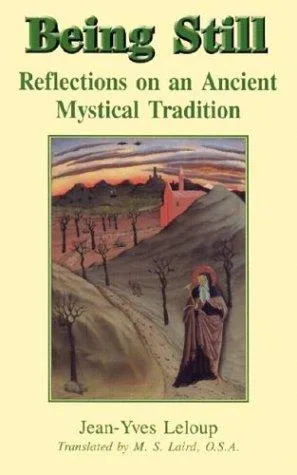
Being Still
 76
76

Being Still
Jean-Yves Leloup’s 'Being Still' offers a welcome antidote to the frantic pace of contemporary life, presenting a robust framework for contemplative practice. Its strength lies in its cross-traditional approach, adeptly weaving insights from Christian mysticism and Zen Buddhism without dilution. The author’s discussion of the ‘inner citadel’ is particularly compelling, offering a Stoic-informed perspective on cultivating an unshakeable inner peace. A notable limitation, however, is the dense philosophical language that may challenge readers new to these traditions. For instance, the exploration of the ego's resistance, while insightful, occasionally verges on academic abstraction rather than direct experiential guidance. The verdict is that 'Being Still' provides a profound, if occasionally demanding, pathway to inner quietude.
📝 Description
76
Jean-Yves Leloup's 2003 book, 'Being Still,' offers a path to inner silence through contemplative practice.
'Being Still' guides readers toward inner silence and presence, drawing from Christian contemplative traditions, Zen Buddhism, and Stoicism. Leloup presents exercises and reflections designed to cultivate a deeper state of being, moving past superficial mindfulness. The book addresses the human need for stillness in a world filled with constant distractions.
This work is for those wishing to enrich their spiritual lives, especially individuals interested in how Eastern and Western contemplative methods intersect. Practitioners of meditation, yoga, or any practice focusing on inner awareness and quieting the mind will find value here. The principles discussed offer a way to achieve a more grounded existence amidst modern anxieties.
Published in 2003, 'Being Still' appeared during a time of renewed interest in mindfulness. Leloup's approach stands apart by grounding these practices in a wider philosophical and theological context. He references early Christian mystics and Zen masters, linking contemporary practices to a much older lineage. The book provides a more rigorous, historically informed alternative to the secular popularization of meditation.
This book connects contemplative practices to ancient spiritual lineages. Leloup bridges the gap between contemporary mindfulness and older traditions, specifically referencing early Christian mystics and Zen masters. It acknowledges the 'inner citadel' concept, a notion found in Stoic philosophy, as a space for mental refuge and clarity. The work implicitly contrasts its approach with secularized mindfulness, advocating for a more historically informed and theologically grounded understanding of stillness.
💡 Why Read This Book?
• Gain practical methods for cultivating deep inner silence, moving beyond superficial mindfulness techniques by engaging with Leloup's concept of the 'active presence' of stillness. • Understand the historical lineage of contemplative practices, tracing connections between early Christian mystics and Zen masters as presented in the text, offering a richer context than secular approaches. • Develop resilience against modern anxieties by learning to access the 'inner citadel,' a concept explored in Chapter 3, providing a stable point of reference amidst external chaos.
⭐ Reader Reviews
Honest opinions from readers who have explored this book.
❓ Frequently Asked Questions
What is the primary goal of the contemplative practices discussed in 'Being Still'?
The primary goal is to cultivate a state of active, vibrant presence and inner silence, moving beyond mere relaxation to a deeper connection with oneself and the present moment, as explored in the book's initial chapters.
Which spiritual traditions does Jean-Yves Leloup draw upon in 'Being Still'?
Leloup integrates insights from Christian contemplative traditions, Zen Buddhism, and Stoic philosophy, creating a unique synthesis that broadens the scope of traditional meditation practices discussed throughout the text.
How does 'Being Still' address the challenge of constant mental chatter?
The book offers techniques for observing and disengaging from incessant thoughts by fostering an awareness of the 'inner citadel,' a concept elaborated upon in the text as a sanctuary of peace.
Is 'Being Still' suitable for beginners in meditation?
While accessible, the book delves into complex philosophical and theological concepts. Beginners may find it beneficial to approach it with an open mind and perhaps alongside introductory meditation guides, especially when encountering terms like 'non-doing'.
When was 'Being Still' first published?
'Being Still' was first published in 2003, a period marked by a growing interest in mindfulness and contemplative practices across Western cultures.
What does the concept of 'non-doing' signify in Leloup's work?
In 'Being Still,' 'non-doing' refers to a state of profound presence and action that arises from stillness, distinct from passive inactivity. It is an effective action stemming from a deep connection to the present moment.
🔮 Key Themes & Symbolism
Cultivating Presence
The core of 'Being Still' lies in the active cultivation of present-moment awareness. Leloup guides readers away from passive observation towards an engaged stillness that permeates all aspects of life. This isn't about emptying the mind but about being fully present with whatever arises, a concept deeply rooted in both Zen and Christian contemplative traditions. The work emphasizes that true presence is not a goal to be achieved but a state to be inhabited, requiring consistent practice and discernment.
The Inner Citadel
Drawing on Stoic philosophy, Leloup introduces the concept of the 'inner citadel' as a refuge of inner peace and stability. This is a space within the self that remains untouched by external circumstances or inner turmoil. The book provides methods for accessing and strengthening this inner sanctuary, suggesting that true freedom comes not from changing the world, but from cultivating an unassailable inner state. This concept serves as a practical anchor for navigating life's challenges.
Ego and Stillness
A significant theme is the ego's inherent resistance to stillness and surrender. Leloup explores how our sense of self, built on desires and aversions, actively works against the dissolution of self that true contemplative practice entails. Understanding this dynamic is crucial for progress. The book encourages readers to observe the ego's strategies without judgment, facilitating a gradual softening and opening towards a more authentic way of being, a journey common in many spiritual paths.
Non-Doing as Action
Contrary to common perceptions of stillness as mere inactivity, Leloup presents 'non-doing' as a potent form of action. This is action that arises spontaneously from a place of deep inner quiet and connection, unburdened by egoic striving. It is the most effective and appropriate action that emerges when one is fully aligned with the present moment. This paradox challenges conventional notions of productivity and achievement, offering a different paradigm for engagement with life.
💬 Memorable Quotes
“Stillness is not an absence of movement, but a presence.”
— This highlights Leloup's view that true stillness is not a void but a vibrant, active state of being fully present and aware, contrasting with mere inactivity.
“The inner citadel is the space within that remains untouched by the world's storms.”
— This metaphor, drawing from Stoicism, represents an unshakeable inner peace and resilience that can be cultivated, independent of external conditions.
“To do nothing is often the most effective way to do something.”
— This points to the concept of 'non-doing,' suggesting that sometimes the most appropriate and powerful action arises from a state of deep stillness and surrender.
“The ego fights stillness because stillness dissolves the ego.”
— This interpretation addresses the inherent conflict between the constructed self (ego) and the transformative potential of contemplative practice, where the ego's boundaries are challenged.
“Presence is not found by looking outward, but by turning inward.”
— This emphasizes the introspective nature of achieving true presence, suggesting that the path to genuine awareness lies in self-exploration rather than external seeking.
🌙 Esoteric Significance
Tradition
Leloup's work aligns with the Christian contemplative tradition, particularly its mystical and apophatic streams, while also deeply integrating concepts from Zen Buddhism. It departs from purely devotional or dogmatic approaches, offering a more universalist and experiential path. The emphasis on 'non-doing' and the 'inner citadel' resonates with Hermetic principles of achieving inner mastery and aligning with the divine, though its primary textual roots are Christian and Buddhist.
Symbolism
The 'inner citadel' serves as a potent symbol of the immutable Self or divine spark within, a concept echoed in Gnostic ideas of the Pleroma. The idea of 'stillness' itself functions symbolically, representing not emptiness but the unmanifest potential from which all creation arises, akin to the Kabbalistic concept of Ein Sof. The act of 'turning inward' symbolizes the alchemical process of internal transformation.
Modern Relevance
Contemporary thinkers and practitioners in fields ranging from depth psychology to somatic experiencing find value in Leloup's exploration of presence and stillness. His cross-traditional approach informs modern integrations of mindfulness with established spiritual paths, influencing spiritual directors, therapists exploring contemplative interventions, and educators seeking to foster inner resilience in students.
👥 Who Should Read This Book
• Practitioners of Christian contemplative prayer or Zen meditation seeking to deepen their practice through cross-traditional insights and a focus on presence. • Individuals grappling with anxiety and the pressures of modern life who are looking for practical, philosophically grounded methods to cultivate inner peace and stability. • Students of comparative religion and mysticism interested in the synthesis of Western and Eastern contemplative techniques, particularly Leloup’s engagement with early Christian mystics and Zen masters.
📜 Historical Context
Published in 2003, Jean-Yves Leloup's 'Being Still' entered a landscape increasingly interested in contemplative practices, partly fueled by secular adaptations of mindfulness. However, Leloup positioned his work within a much older lineage, drawing explicitly from early Christian mystics like Meister Eckhart and contemporary engagement with Zen Buddhism, notably influenced by figures like D.T. Suzuki's writings on the subject. This approach offered a counterpoint to more clinically focused mindfulness movements, grounding contemplative techniques in deep spiritual and philosophical traditions. While the popularization of meditation was on the rise, Leloup’s work stood apart by integrating these practices with a rigorous theological and philosophical inquiry, implicitly engaging with the intellectual currents of comparative religion and mysticism that were gaining traction in academic and spiritual circles.
📔 Journal Prompts
Reflect on moments of 'active presence' described in Chapter 2.
Describe your experience of the 'inner citadel' when facing external challenges.
How does the ego's resistance to stillness manifest in your daily life?
Explore the paradox of 'non-doing' in relation to your personal goals.
Consider the concept of 'discerning the Self' as presented in the text.
🗂️ Glossary
Inner Citadel
A metaphor, drawing from Stoic philosophy, representing an unshakeable inner sanctuary of peace and stability, independent of external circumstances or inner turmoil.
Non-Doing
A state of profound presence and effective action that arises from stillness, distinct from passive inactivity. It signifies acting from a place of deep connection and alignment.
Active Presence
The book's concept of stillness not as emptiness, but as a vibrant, engaged awareness of the present moment, permeating all activities.
Ego
In this context, the constructed sense of self, often characterized by desires, attachments, and resistance, which tends to oppose the dissolution required for deep contemplative practice.
Discernment
The faculty of distinguishing between different states of mind, impulses, or phenomena, particularly in the context of spiritual practice, to understand their true nature.
Apophatic
Referring to a type of theology or mysticism that emphasizes negation and silence, focusing on what God or the ultimate reality is not, rather than what it is.
Contemplation
A deep, sustained, and often silent form of meditation or reflection focused on spiritual truths or divine presence, aiming for union or profound understanding.