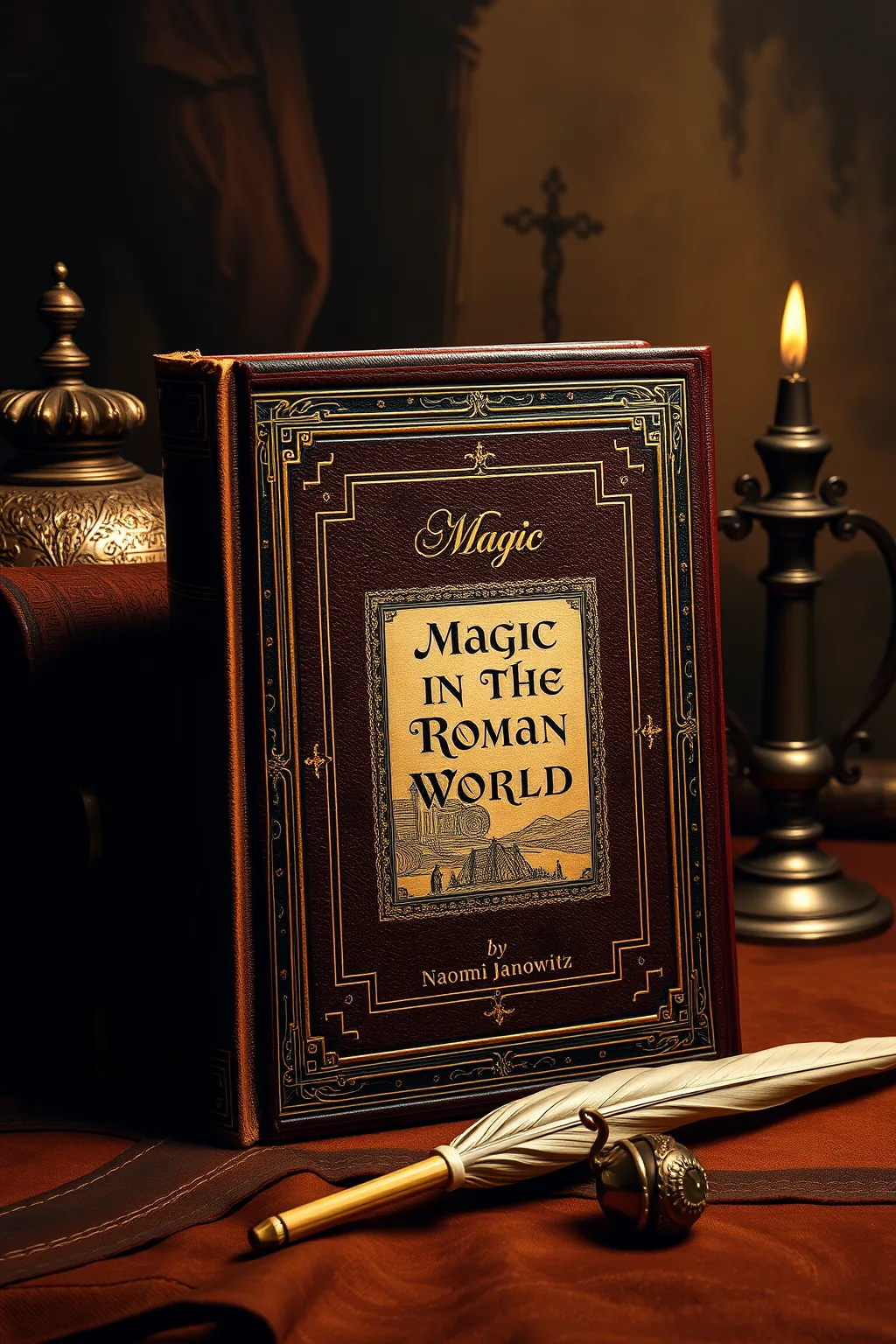
Magic in the Roman World
 81
81

Magic in the Roman World
Naomi Janowitz’s Magic in the Roman World provides a much-needed, grounded perspective on a subject often shrouded in sensationalism. The strength of this study lies in its meticulous engagement with primary sources, presenting magic not as an exotic outlier but as an integral, if sometimes disreputable, aspect of Roman life. Janowitz adeptly demonstrates how magical practices were interwoven with daily concerns, from health and social status to legal disputes. A particularly illuminating section details the use of curse tablets (defixiones), revealing the personal grievances and anxieties of their authors. However, the book's scholarly tone, while accurate, can occasionally render the subject matter less accessible to a general audience. The dense academic prose, while laudable for its precision, might deter readers seeking a more narrative account. Ultimately, Janowitz's work offers a vital corrective, positioning Roman magic within its complex social and religious matrix.
📝 Description
81
### What It Is Magic in the Roman World, by Naomi Janowitz, offers a scholarly examination of magical practices and beliefs during antiquity. Published initially in 2001, the book moves beyond simplistic categorizations to present a nuanced view of how magic functioned within Roman society. It investigates the diverse forms of magic, from curses and divination to healing and protection rituals, as understood and employed by people of various social strata.
### Who It's For This work is intended for students and scholars of ancient history, religious studies, and the history of magic. It will also appeal to individuals interested in the practical application of beliefs in pre-modern societies, particularly those seeking to understand the intersection of magic, religion, and everyday life in the Greco-Roman world. It is for readers who appreciate rigorous research and detailed analysis.
### Historical Context Janowitz's research situates magic within the broader religious and social landscape of the Roman Empire, a period marked by a syncretic blend of Greek, Egyptian, and local traditions. The work implicitly engages with earlier scholarship that often viewed Roman religion and magic as separate, arguing instead for their deep entanglement. The early 2000s saw a growing academic interest in the lived experience of religion and the 'popular' aspects of ancient belief systems, a trend this book contributes to.
### Key Concepts The book explores the concept of *contagion* in magical thought, where contact with an object or person could transfer qualities or effects. It also examines the role of *sympathetic magic*, the idea that like affects like, and *analogy* as a principle for understanding the cosmos and influencing it. The prevalence of *apotropaic* magic, intended to ward off evil or misfortune, is another significant focus, revealing a deep-seated concern with security and well-being.
💡 Why Read This Book?
• Gain specific insights into the function of curse tablets, understanding their use in Roman legal and personal disputes as detailed within the text. • Learn about the principle of *contagion* as a foundational concept in Roman magical thought, moving beyond vague notions of 'superstition'. • Discover the prevalence and purpose of *apotropaic* magic, illustrating Roman strategies for warding off misfortune and malevolent forces in their daily lives.
⭐ Reader Reviews
Honest opinions from readers who have explored this book.
❓ Frequently Asked Questions
What kind of magical practices does Naomi Janowitz discuss in Magic in the Roman World?
The book covers a wide array of practices including curse tablets (defixiones), divination, healing rituals, protective amulets, and various forms of folk magic, all situated within the social and religious context of the Roman Empire.
When was Magic in the Roman World first published?
Magic in the Roman World by Naomi Janowitz was first published in 2001.
What is the significance of curse tablets (defixiones) in Roman magic?
Curse tablets reveal personal animosities and legalistic approaches to magic, often inscribed with the names of victims and deities invoked to inflict harm, serving as a direct window into individual grievances.
How does Janowitz connect magic to Roman religion?
Janowitz argues that magic was not separate from Roman religion but deeply integrated, used to achieve specific outcomes within the divine framework that Romans understood and interacted with.
Who would benefit most from reading Magic in the Roman World?
Students and scholars of ancient history, classical studies, religious history, and anyone interested in the practical application of beliefs in antiquity will find this book particularly valuable.
Does the book discuss the belief in specific Roman deities related to magic?
Yes, the work explores how deities associated with magic, such as Hecate, Mercury, and various chthonic spirits, were invoked and understood within the context of magical practices and rituals.
🔮 Key Themes & Symbolism
Magic as Social Practice
This theme highlights magic not as an abstract philosophical concept but as a set of tangible practices embedded in Roman daily life. Janowitz focuses on how individuals utilized magic to address concrete problems, from health and relationships to legal and economic matters. The book examines the social dynamics surrounding magical practitioners and the recipients of magical acts, underscoring its role in community interactions and conflict resolution. The use of curse tablets, for instance, reveals personal vendettas and the desire for immediate, often harmful, intervention.
The Principles of Contagion and Analogy
Janowitz elucidates the underlying logic of Roman magical thinking, particularly the principles of contagion and analogy. Contagion posits that objects or persons once in contact can continue to influence each other, while analogy suggests that like affects like. These principles are demonstrated through examples such as the use of hair or nail clippings in spells (contagion) or the creation of effigies to affect a person (analogy). Understanding these concepts is crucial for grasping how Romans perceived the interconnectedness of the material and spiritual worlds.
Divination and the Roman Worldview
The book explores the pervasive role of divination in Roman society, encompassing methods like augury, haruspicy, and astrology. Janowitz illustrates how Romans sought to understand and influence their future, seeing omens and signs as messages from the divine or fate. This theme underscores the Roman belief in an ordered, albeit often capricious, cosmos that could be interpreted and, to some extent, manipulated through skilled practitioners. Divination was not merely superstition but a vital tool for decision-making in both public and private spheres.
Apotropaic Magic and Security
A significant focus is placed on apotropaic magic, the practice of warding off evil, harm, or misfortune. This theme reveals a deep-seated Roman concern with protection, both physical and spiritual. Examples include the use of amulets, protective inscriptions, and rituals designed to create a barrier against malevolent forces or the 'evil eye.' The prevalence of such practices indicates a worldview where threats were ever-present and active measures were necessary to maintain well-being and security.
💬 Memorable Quotes
“Magic was not an alien import into Roman religion, but rather an integral part of it.”
— This interpretation highlights Janowitz's central argument that magic and religion in the Roman world were not distinct categories but deeply interwoven, functioning together to address the Romans' spiritual and practical needs.
“The use of curse tablets (defixiones) reveals personal grievances and a desire for direct intervention.”
— This paraphrase points to the function of curse tablets as evidence of individual conflicts and the appeal to supernatural forces for immediate retribution, showcasing the practical, often vindictive, application of magic.
“Understanding contagion and analogy is key to grasping Roman magical logic.”
— This interpretation emphasizes the core theoretical underpinnings Janowitz explores, suggesting that these principles were fundamental to how Romans conceptualized the mechanisms of magical influence and cosmic connection.
“Apotropaic rituals aimed to create a shield against perceived threats.”
— This paraphrase captures the essence of protective magic, illustrating how Romans actively sought to safeguard themselves and their property from unseen dangers and malevolent influences through ritualistic means.
“Divination served as a crucial tool for Roman decision-making.”
— This interpretation underscores the practical importance of divination in Roman society, positioning it not as mere curiosity but as a vital method for navigating uncertainty and guiding actions in both personal and public life.
🌙 Esoteric Significance
Tradition
While not strictly belonging to a single esoteric lineage, Janowitz's work is foundational for understanding the historical roots of Western esotericism, particularly practices that later informed Hermeticism and Neoplatonism. It provides empirical grounding for concepts like sympathetic magic and the magical worldview, which are central to many esoteric traditions. The book departs from purely theoretical esoteric texts by focusing on the lived, often mundane, application of magical beliefs within a specific historical context.
Symbolism
The book frequently engages with symbols of protection, such as phallic imagery used apotropaically to ward off the evil eye, and animal symbolism in divination (e.g., birds in augury). Another key motif is the inscribed tablet itself, a direct medium for channeling intent and power, representing the materialization of magical will. These symbols reveal a Roman understanding of the cosmos where the tangible world was imbued with spiritual significance and susceptible to intentional manipulation.
Modern Relevance
Contemporary practitioners of modern witchcraft, Hellenistic reconstructionist paganism, and various forms of ceremonial magic draw heavily on Janowitz's research. Her detailed examination of Roman curse tablets, divination techniques, and protective spells provides source material and inspiration for modern magical work. Thinkers exploring the psychology of belief and the sociology of religion also utilize her findings to understand the enduring human impulse to influence the unseen forces that shape our lives.
👥 Who Should Read This Book
• Students of Classical Antiquity seeking to understand the practical religious and social landscape beyond formal state cults. • Researchers in the History of Magic interested in primary source analysis and the theoretical underpinnings of ancient magical practices. • Practitioners of Western Esoteric Traditions looking for historical context and source material on divination, curse-craft, and protective rituals.
📜 Historical Context
Magic in the Roman World emerged in 2001, a period when academic interest in the history of magic and religion was gaining momentum, moving beyond earlier, more dismissive approaches. Naomi Janowitz's work contributed to a growing body of scholarship that sought to understand magic as an integral component of ancient societies, rather than an aberration. This era saw scholars like Fritz Graf and Sarah Iles Johnston also publishing influential works on Greek and Roman magic, often challenging the strict boundaries between 'magic' and 'religion.' Janowitz's study situates itself within this intellectual current, emphasizing the functional aspects of magic within the Roman social and religious fabric. The book implicitly engages with the legacy of earlier classical scholarship, which sometimes viewed Roman religion through a Hellenocentric lens, and instead offers a more localized and practice-oriented perspective. The reception of such works generally involved academic discourse rather than public controversy, reflecting a mature scholarly engagement with the topic.
📔 Journal Prompts
The function of curse tablets in Roman society.
Principles of contagion and analogy in magical thinking.
Roman approaches to warding off misfortune (apotropaic magic).
The role of divination in Roman decision-making.
Intersections between magic and Roman religious practice.
🗂️ Glossary
Defixiones
Latin term for curse tablets, typically thin sheets of lead or other metal inscribed with spells intended to inflict harm upon a person or secure a desired outcome, often buried in tombs or springs.
Apotropaic Magic
Magic intended to avert or ward off evil, harm, or misfortune. This includes the use of amulets, charms, and protective rituals designed to create a barrier against malevolent forces.
Contagion
A principle in magical thought suggesting that objects or individuals that have been in contact can continue to influence each other, even when separated. For example, using hair clippings in a spell.
Analogy
A principle in magical thought where similarities between things are believed to imply a connection or influence. The concept of 'like affects like,' such as using an effigy to harm a person.
Divination
The practice of seeking knowledge of the future or the unknown by supernatural means. Roman methods included augury (reading bird flight), haruspicy (examining entrails), and astrology.
Augury
A form of divination practiced by the ancient Romans, involving the observation of bird behavior (flight patterns, eating habits) to interpret divine will or predict future events.
Haruspicy
A practice of divination originating from Etruria and adopted by the Romans, involving the examination of the entrails of sacrificed animals, particularly the liver, to discern omens.