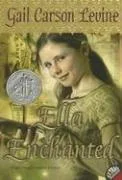
Ella Enchanted

 78
78

Ella Enchanted
Gail Carson Levine's "Ella Enchanted" presents a familiar premise—a young woman burdened by a fairy's curse—but imbues it with a sprightly, modern sensibility. The central conceit, Ella's absolute obedience, is both the book's greatest strength and its inherent limitation. Levine masterfully uses this constraint to explore themes of free will and self-determination, forcing Ella into increasingly ingenious, often humorous, situations to circumvent direct orders. The quest to find Lucinda and break the curse provides a clear narrative drive. However, the sheer implausibility of Ella’s constant near-disasters, while entertaining, occasionally strains credulity, even within a fairy tale context. A particularly memorable sequence involves Ella’s forced attendance at a royal ball, where her obedience is tested in a series of escalating social predicaments. Despite these minor quibbles, the novel is a charming and empowering read, offering a refreshing take on a classic archetype.
📝 Description
78
Gail Carson Levine published Ella Enchanted in 2000, a young adult fantasy novel.
Ella Enchanted retells the Cinderella story from the perspective of a young woman burdened by a fairy's curse. This curse, a "gift" from the fairy Lucinda, compels Ella to obey any direct command given to her. The story follows Ella's struggle to control her life and find a way to break the enchantment. She must navigate courtly life, deal with her stepfamily, and pursue her own desires while constantly battling the effects of the obedience spell.
The novel explores Ella's journey as she seeks freedom from this magical compulsion. Her quest involves outsmarting those who would exploit her "gift" and understanding the true nature of the curse. Levine's reimagining focuses on Ella's internal conflict and her active efforts to reclaim her autonomy, diverging from the passive victim archetype often found in traditional fairy tales.
This work engages with themes of agency and self-determination within the framework of a familiar fairy tale structure. Ella's determination to forge her own path, despite the magical constraints placed upon her, forms the core of the narrative.
While not overtly occult, Ella Enchanted engages with esoteric concepts through its central metaphor of a magical "gift" that dictates behavior. The curse of obedience functions as a form of external control that must be understood and overcome, mirroring philosophical and psychological explorations of free will versus determinism. The narrative's focus on an individual's internal struggle against an imposed destiny and the quest for liberation from such constraints aligns with broader esoteric traditions that examine the nature of the self and its relationship to external forces.
💡 Why Read This Book?
• Learn about the nature of true agency by observing Ella's struggle against the curse of obedience, a core conflict established from the book's opening pages. • Discover how fairy tale tropes are subverted in this 2000 publication, offering a contemporary perspective on classic narratives through Ella's modern voice. • Experience the power of wit and resilience as Ella navigates her predicament, demonstrating how intelligence can be employed even when direct action is restricted.
⭐ Reader Reviews
Honest opinions from readers who have explored this book.
❓ Frequently Asked Questions
What is the central conflict in Ella Enchanted?
The central conflict is Ella's "gift" of obedience, a curse that compels her to obey any direct command, forcing her to seek a way to break Lucinda's enchantment.
Who is the fairy that curses Ella?
The fairy is named Lucinda, who bestowed the "gift" of obedience upon Ella at her birth, intending it as a benevolent act but resulting in a significant burden.
What is the historical publication year of Ella Enchanted?
Ella Enchanted was first published in the year 2000.
Does Ella Enchanted have a connection to the Cinderella story?
Yes, it is a retelling of the Cinderella story, focusing on Ella, a young woman who is forced to obey others, similar to Cinderella's constrained circumstances.
What are some key themes explored in the book?
Key themes include free will versus determinism, the nature of obedience, self-acceptance, and the power of individual agency even under duress.
Is Ella Enchanted suitable for young readers?
Yes, it is a popular young adult novel that addresses mature themes in an accessible way, making it highly suitable for middle school and early high school readers.
🔮 Key Themes & Symbolism
The Curse of Obedience
The central premise revolves around Ella's "gift" of obedience, a magical compulsion to follow any direct order. This isn't a simple magical affliction but a profound exploration of agency. Ella's every action is dictated by this curse, forcing her to confront the very definition of free will. The narrative questions whether true freedom lies in the absence of external control or in the internal strength to resist and redefine one's path, even when outwardly compliant.
Fairy Tale Subversion
Published in 2000, the novel actively engages with and subverts classic fairy tale structures. It takes the familiar Cinderella archetype and infuses it with a modern, feminist perspective. Ella is not passively waiting for a prince; she is actively fighting against a magical constraint that undermines her autonomy. This approach reflects a broader trend in late 20th and early 21st-century literature to re-examine and deconstruct traditional narratives for contemporary audiences.
Quest for Selfhood
Ella's journey is fundamentally a quest for selfhood and liberation. Her obedience curse forces her to develop cunning and resilience, as she must find ways to act without appearing to disobey. This internal struggle mirrors the broader human experience of defining oneself against societal expectations and personal limitations. The narrative emphasizes that self-discovery often involves confronting and overcoming deeply ingrained obstacles, both magical and psychological.
The Nature of Gifts
The "gift" of obedience itself is a powerful symbol. It highlights how intentions can be misconstrued and how seemingly benevolent acts can become oppressive. The fairy Lucinda's role underscores the ambiguity of magical intervention. This theme prompts reflection on the true nature of gifts and blessings, and how they can shape an individual's destiny, for better or worse, challenging the reader to consider the source and consequence of perceived boons.
💬 Memorable Quotes
Direct passages from the work, attributed to the author.
“I am not my father's daughter. I am not my mother's daughter. I am not my brother's sister. I am Ella.”
— This declaration signifies Ella's desperate attempt to forge an identity independent of her familial roles and external influences, especially crucial given her imposed obedience.
“The fairy Lucinda had given me a gift, the gift of obedience.”
— This is the foundational statement of the curse, presented ironically as a 'gift,' immediately establishing the central conflict and the novel's exploration of the nature of blessings and curses.
“I am trying to be a good girl. I am trying to be a good girl.”
— This repetitive internal monologue reveals Ella's constant struggle to reconcile her desire for freedom with the compulsion to obey, highlighting the psychological toll of the curse.
“When you find the fairy who cursed you, you can ask her to undo it.”
— This piece of advice, often given to Ella, sets her on the primary narrative quest: to confront Lucinda and reclaim her autonomy.
“My obedience is not my will.”
— This is a conceptual distillation of Ella's predicament – her actions are dictated, but her inner self recognizes the discrepancy, asserting her true desire for self-determination.
🌙 Esoteric Significance
Tradition
While not explicitly aligned with a specific esoteric tradition, *Ella Enchanted* taps into archetypal themes found across various mystical paths, particularly those concerned with free will, destiny, and the nature of spiritual gifts. It echoes Gnostic ideas about imposed limitations and the search for inner liberation, as well as Neoplatonic concepts of the soul striving to overcome material or imposed constraints to reach its true essence.
Symbolism
The primary symbol is the "gift" of obedience itself, representing external control that stifles inner will—a common theme in spiritual disciplines where the ego or external dogma can hinder direct experience. The fairy Lucinda embodies the ambiguous nature of divine or magical intervention; such powers can bestow blessings or curses depending on their ultimate effect on the individual's spiritual journey. Ella's journey to find Lucinda symbolizes the seeker's quest to confront the source of their limitations, often an internalized or misunderstood aspect of higher power.
Modern Relevance
Contemporary thinkers exploring narrative therapy and the power of personal storytelling might find resonance in Ella's struggle to reclaim her narrative. The book's exploration of agency under duress is relevant to discussions on consent and autonomy. Furthermore, modern fantasy writers continue to draw inspiration from its successful subversion of classic tropes, demonstrating how familiar stories can be reinterpreted to address contemporary concerns about identity, power, and self-determination.
👥 Who Should Read This Book
• Readers interested in fairy tale deconstruction: Those who enjoy analyzing classic stories and exploring modern feminist interpretations will find Ella's journey particularly engaging. • Young adults exploring themes of autonomy: Individuals grappling with societal pressures or seeking to understand personal agency will connect with Ella's quest to assert her will. • Fans of character-driven fantasy: Readers who appreciate narratives focused on a protagonist's internal growth and external challenges will be drawn to Ella's resilience and wit.
📜 Historical Context
Published in 2000, Gail Carson Levine's *Ella Enchanted* arrived during a vibrant period for young adult literature, particularly within the fantasy and fairy tale revival. This era saw authors like Neil Gaiman and Philip Pullman pushing boundaries with darker, more complex mythologies. Levine’s work, while lighter in tone, contributed to a wave of retellings that offered modern sensibilities and stronger female protagonists, moving away from passive heroines. The book resonated with readers seeking narratives that empowered young women, a theme increasingly prevalent in the post-feminist range of children’s fiction. While not facing overt censorship, the novel's success reflected a broader cultural shift towards valuing diverse perspectives and challenging traditional gender roles within storytelling, standing in contrast to the more traditional fairy tales of earlier decades.
📔 Journal Prompts
Ella's struggle against the curse of obedience.
The symbolic meaning of Lucinda's "gift".
The subversion of traditional fairy tale elements in the 2000 publication.
Ella's development of cunning strategies to circumvent direct commands.
The contrast between Ella's outward compliance and her inner desire for freedom.
🗂️ Glossary
The Gift of Obedience
A magical compulsion placed upon Ella at birth by the fairy Lucinda, forcing her to obey any direct command given to her, regardless of her own desires or safety.
Lucinda
The fairy responsible for bestowing the 'gift' of obedience upon Ella. Her motivations are initially unclear, adding an element of mystery to Ella's quest.
Fairy Tale Retelling
A literary work that takes an existing fairy tale and reinterprets it, often updating themes, characters, or settings for a contemporary audience, as seen in *Ella Enchanted*'s approach to Cinderella.
Agency
The capacity of individuals to act independently and make their own free choices. Ella's story is a profound exploration of regaining agency when it is magically suppressed.
Archetype
A recurring symbol or motif in literature and mythology that represents universal patterns of human nature. Ella embodies the archetype of the constrained hero seeking liberation.
Cinderella
The classic fairy tale character whose story serves as the foundation for *Ella Enchanted*, providing a familiar framework for exploring themes of hardship and eventual triumph.
Selfhood
The condition of being an individual person. Ella's journey is fundamentally about defining and asserting her true self beyond the limitations imposed by the curse.
🔮 Readers Also Liked
Browse all →








More by Gail Carson Levine
All books →


More Free Magic & Ritual Books
View all →