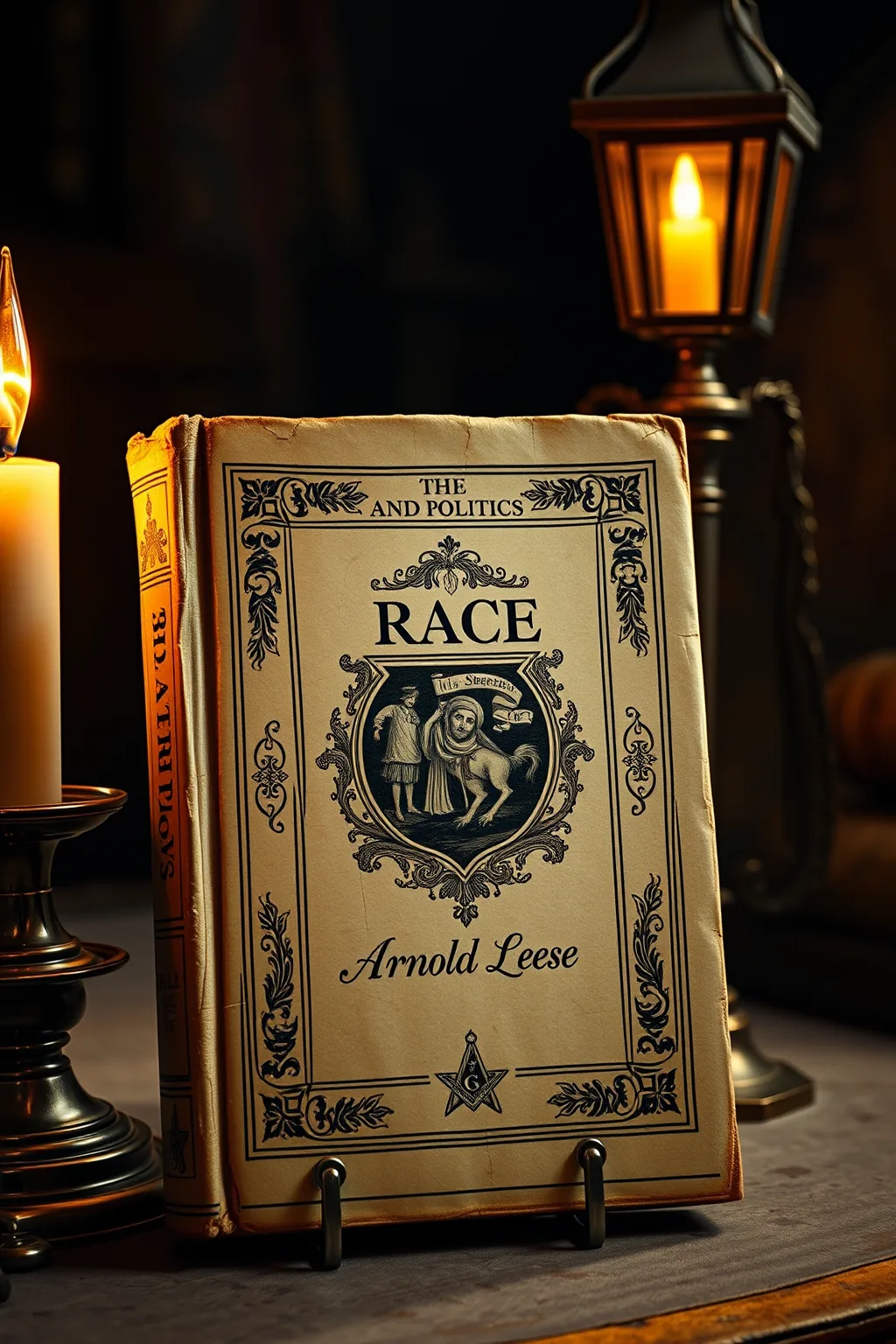
Race and Politics: A counter-blast to the Masonic teaching of universal brotherhood - Arnold Leese
 80
80

Race and Politics: A counter-blast to the Masonic teaching of universal brotherhood - Arnold Leese


Silas Hawthorne, Hermetic Studies Editor — Arnold Leese's 'Race and Politics' is a stark, unvarnished examination of ideological conflict, framed through a lens of traditionalist thought. Leese offers a potent critique of Freemasonry's universalist tenets, presenting them not as benign ideals but as symbols of a potentially destabilizing force. His arguments, though controversial, are rooted in a deep-seated concern for distinct identities and the natural order. For scholars of esoteric societies and traditionalist philosophy, this work provides crucial insights into an alternative perspective on brotherhood and belonging. It challenges readers to scrutinize the symbolic language of social cohesion and to consider the long-term implications of enforced universalism on the fabric of human civilization. A vital, albeit challenging, read for the serious student.
📝 Description
80
In 1938, Arnold Leese published 'Race and Politics' to challenge Masonic universalism.
Arnold Leese's 1938 book, 'Race and Politics: A Counter-Blast to the Masonic Teaching of Universal Brotherhood,' critiques the concept of universal brotherhood, particularly as promoted by Freemasonry. Leese argues that this ideal is a veiled agenda that undermines natural societal divisions. He posits that genuine social cohesion arises not from manufactured unity, but from the inherent differences between races and nations. The work encourages readers to question prevailing ideas about collective existence and power structures.
Leese sought to reveal what he viewed as the hidden mechanisms shaping perceptions of human association. He contended that globalist philosophies obscure the significance of lineage and belonging, which he believed are rooted in symbolic language. The book aims to present a direct perspective on the forces influencing society, targeting readers interested in confronting what the author presents as stark realities about human relationships and political order.
This work engages with esoteric traditions that emphasize racial or national distinctiveness over universalist ideals. Leese's 'counter-blast' suggests a conflict with a perceived esoteric current promoting global unity, which he views as a manipulation. The text implies an understanding of hidden agendas and symbolic meanings in social constructs, aligning with certain esoteric viewpoints that see deeper, often concealed, forces at play in human affairs and history. It reflects a tradition that prioritizes bloodlines and ancestral heritage as fundamental organizing principles.
💡 Why Read This Book?
Uncover a radical critique of universal brotherhood, challenging the esoteric foundations of globalism. This book offers a potent counter-narrative for those who believe in the significance of inherent distinctions and traditional societal structures. Essential for seekers of hidden knowledge, scholars of secret societies, and practitioners of traditionalist thought who wish to understand alternative perspectives on human organization.
⭐ Reader Reviews
Honest opinions from readers who have explored this book.
❓ Frequently Asked Questions
What is the core argument of 'Race and Politics'?
The book argues that the Masonic ideal of universal brotherhood is a deceptive facade, masking a hidden agenda that undermines natural racial and national distinctions, thereby threatening societal cohesion and traditional order.
What esoteric themes are explored?
Leese delves into the perceived esoteric symbolism behind 'universal brotherhood,' suggesting it's a construct designed to obscure fundamental truths about inherent differences and the natural hierarchy of human societies.
Who is the intended audience for this book?
The book is intended for individuals interested in traditionalist politics, critical analysis of secret societies, and those who question universalist ideologies, seeking a deeper understanding of identity and belonging.
Does the book advocate for a specific political system?
While not explicitly outlining a new system, the book champions a traditionalist viewpoint that prioritizes distinct racial and national identities, implicitly critiquing modern liberal and globalist political structures.
Is this book suitable for beginners in esoteric studies?
This is a challenging read, best suited for those with some background in political philosophy or an interest in the more controversial aspects of esoteric thought and secret societies.
🔮 Key Themes & Symbolism
Critique of Universal Brotherhood
Leese dissects the Masonic concept of universal brotherhood, casting it not as a force for unity but as a tool of manipulation. He explores the hidden symbolic language employed by such secret societies, suggesting that their pronouncements of equality mask a deeper, more insidious agenda to homogenize distinct identities and dissolve traditional societal structures. This theme explores the perceived esoteric intent behind fostering a singular, undifferentiated human collective, arguing that it erodes the vital distinctions that Leese believes are essential for genuine social order and individual belonging.
The Esotericism of Race and Identity
This work positions race not merely as a biological descriptor but as a foundational element with profound esoteric significance. Leese argues that inherent racial characteristics carry a deeper, almost spiritual weight, dictating natural affinities and divergences. He explores the idea that understanding these distinctions is a form of hidden knowledge, crucial for comprehending the true dynamics of human interaction and societal evolution, contrasting this with the superficial universalism he opposes.
Traditionalist Ideological Warfare
Leese frames his argument as a direct 'counter-blast' against a prevailing ideology, positioning himself as a defender of traditionalist principles against the encroaching forces of modern universalism. This theme explores the clandestine nature of ideological battles, where concepts like 'brotherhood' are weaponized. The book acts as a manifesto for those who believe in the inherent value of distinct cultures and ancestries, urging a reawakening to the ancient wisdom of natural order and identity preservation.
💬 Memorable Quotes
Direct passages from the work, attributed to the author.
“The brotherhood of man is a myth.”
— This pithy statement captures Leese's central thesis, asserting that the ideal of universal human unity is a false construct, a deceptive illusion that masks deeper, fundamental divisions.
“Equality is the destroyer of distinction.”
— Leese views the pursuit of equality as a destructive force, arguing that it negates the vital differences that define individuals and groups, leading to a loss of unique identity.
“Hidden currents shape the destiny of nations.”
— This suggests a belief in unseen forces, possibly occult or esoteric, that influence historical trajectories and societal development, beyond what is outwardly apparent.
“The serpent of illusion coils around benevolent words.”
— This evocative metaphor implies that seemingly benign concepts like universal brotherhood are in fact deceptive, hiding a dangerous underlying reality, much like a serpent concealed within pleasant foliage.
💡 Key Ideas
Editorial paraphrase of the work's core concepts — not direct quotes.
True kinship lies in blood and soil.
This quote highlights Leese's emphasis on lineage and territorial belonging as the authentic foundations of human connection, contrasting it with abstract notions of universal affiliation.
🌙 Esoteric Significance
Tradition
This work draws heavily from traditionalist and ethno-nationalist esoteric currents, which often posit a divinely ordained natural order based on racial and cultural distinctiveness. It engages with the idea of hidden knowledge concerning human origins and societal structures, contrasting this with what it views as the superficial, occulted doctrines of universalism promoted by groups like Freemasonry. The emphasis is on uncovering a 'truer' understanding of human society rooted in ancient wisdom and ancestral lines.
Symbolism
Leese interprets symbols associated with Freemasonry, such as the 'square and compasses' and the concept of 'brotherhood,' not at face value but as representations of an underlying esoteric agenda. He views these symbols as masks for a doctrine that aims to dissolve natural hierarchies and distinctions. Conversely, he elevates symbols of lineage, blood, and soil as holding genuine, potent esoteric significance, representing immutable truths about identity and belonging that he believes have been deliberately obscured.
Modern Relevance
In an era increasingly dominated by global discourse and the promotion of universal human rights, Leese's critique offers a starkly contrasting perspective on identity and belonging. For those interested in the resurgence of traditionalist thought, ethno-nationalism, and critiques of globalism, his work provides historical context and ideological underpinnings. It remains relevant for understanding the persistent tension between universalist aspirations and the assertion of distinct group identities, particularly within esoteric and fringe political discourse.
👥 Who Should Read This Book
This book is essential for scholars of secret societies and their critiques, particularly those interested in the historical opposition to Freemasonry and its perceived esoteric doctrines. It will resonate with adherents of traditionalist political philosophies and those seeking to understand the intellectual lineage of ethno-nationalist thought. Seekers of hidden knowledge and practitioners of esoteric studies who wish to explore alternative cosmologies of human organization will find it a challenging but informative read. Beginners should approach with caution due to the controversial nature of the content and its challenging philosophical underpinnings.
📜 Historical Context
Written during a period of intense ideological ferment in the early to mid-20th century, 'Race and Politics' emerges from a climate shaped by the aftermath of World War I, the rise of totalitarian regimes, and profound societal shifts. The interwar years saw a resurgence of interest in esoteric thought, occultism, and fringe political ideologies as many grappled with the perceived failures of Enlightenment ideals and the burgeoning forces of globalism. Arnold Leese, a notable figure in British Fascist circles, was deeply embedded in these currents, seeking to articulate a worldview that prioritized racial purity and traditional hierarchies. His critique of Freemasonry, a society often associated with Enlightenment values and internationalist aims, reflects a broader suspicion of secret organizations and their perceived influence on public affairs. The book stands as a proof of the era's anxieties about identity, belonging, and the perceived threat of homogenizing ideologies.
📔 Journal Prompts
How does Leese's critique of 'universal brotherhood' challenge conventional notions of social harmony?
What symbolic interpretations does Leese apply to Masonic tenets, and how do these differ from standard exoteric understandings?
Explore the idea of 'hidden currents' shaping societal destiny as presented by Leese. What might these 'currents' represent in contemporary contexts?
In what ways does Leese's emphasis on 'blood and soil' reflect esoteric traditions concerning lineage and place?
Consider the concept of 'equality as destroyer of distinction.' How might this idea be interpreted through an esoteric lens regarding individual and collective identity?
🗂️ Glossary
Esoteric
Relating to or accessible only by a relatively small number of people with a specialized knowledge or interest, often dealing with hidden or inner meanings.
Exoteric
Relating to or accessible to the general public; outward or common knowledge, as opposed to esoteric.
Counter-blast
A vigorous or forceful reply or protest made in response to an attack or criticism.
Ethno-nationalism
A form of nationalism where the 'nation' is defined in terms of ethnicity and race, emphasizing shared ancestry and cultural heritage.
Traditionalism
A political or social philosophy that emphasizes the importance of tradition and established institutions, often opposing progressive or radical change.
This book appears in 2 collections
🔮 Readers Also Liked
Browse all →








More by Arnold Leese
All books →
From the “Secret Societies” Collection
View all →







More Free Freemasonry & Secret Societies Books
View all →