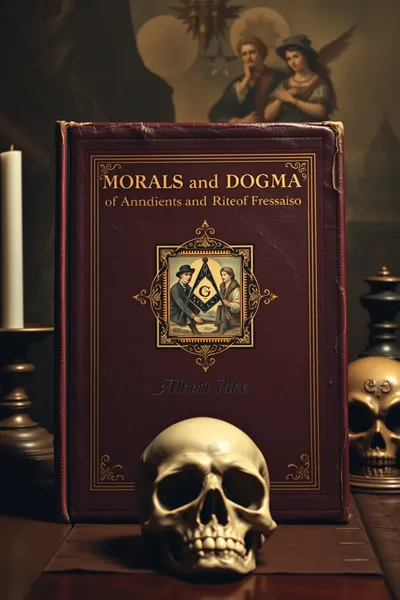
{Gamma }{alpha } DE MANU QUAE MAGUM SUSTINET.
 76
76

{Gamma }{alpha } DE MANU QUAE MAGUM SUSTINET.


Alaric Kestrel, Metaphysical Studies Reviewer: 'The Shadows of Shadows' masterfully weaves personal revelation with esoteric doctrine in {Gamma }{alpha } DE MANU QUAE MAGUM SUSTINET. This work offers a rare glimpse into the spiritual initiations within the secret societies, framed by the potent symbolism of Babalon. The author's candid admission of faltering from the True Will, followed by a profound spiritual awakening in Egypt, provides a compelling narrative arc. The text is dense with veiled meanings, demanding deep contemplation from the reader. It’s a vital text for advanced practitioners and serious scholars of Western Esotericism, particularly those interested in the intersection of Masonic rites and Thelemic cosmology. A challenging, yet immensely rewarding, addition to any occult library.
📝 Description
76
Published by the Shadows of Shadows, {Gamma }{alpha } DE MANU QUAE MAGUM SUSTINET details the Choice of the Word of the Aeon.
This text, authored by the Shadows of Shadows, recounts a personal journey through Freemasonry and secret societies, framed by invocations to Lady BABALON. It describes periods of spiritual renewal necessary for alchemical change. The narrative presents an allegory of straying from one's Will, a descent into lower desires, and subsequent purging of attachments by a guiding force, whether divine or infernal.
The author frames personal struggles as crucial preparation for an event: the 'Choice of the Word of the Aeon' in ancient Egypt. This book invites those on hidden paths to consider the interplay of destiny, will, and the attainment of divine purpose. It connects these ideas to the wisdom found in Solomon's Temple, encouraging contemplation of one's own spiritual progression.
This work engages with traditions rooted in Hermeticism and Western esotericism, particularly drawing parallels with Masonic symbolism and Gnostic concepts of the Aeon. The invocation of Lady BABALON places it within the current of Thelema and related magical practices that acknowledge her significance. The reference to ancient Khem and Solomon's Temple situates its themes within a broader historical and symbolic framework often explored in occult literature, seeking to connect personal spiritual development with cosmic cycles.
💡 Why Read This Book?
Unravel the profound connection between personal will and cosmic destiny. Explore the hidden symbolism within Freemasonry and ancient Khem. Understand the necessity of spiritual trials for ultimate attainment. This book is essential for seekers of hidden knowledge, occult scholars, and practitioners of esoteric arts who crave a deeper understanding of initiation and divine calling.
⭐ Reader Reviews
Honest opinions from readers who have explored this book.
❓ Frequently Asked Questions
What is the primary esoteric tradition explored in this book?
The book deeply explores themes resonant with Western Esotericism, particularly Freemasonry, ancient Egyptian mysticism, and the occult philosophy of Thelema, referencing Lady Babalon and the concept of the Aeon.
Who is 'the Shadows of Shadows'?
'the Shadows of Shadows' is the pseudonym adopted by the author, suggesting a deliberate embrace of anonymity and a focus on the hidden, transcendent nature of their work, aligning with the esoteric tradition of veiling true identities.
What does 'DE MANU QUAE MAGUM SUSTINET' translate to?
The Latin title translates to 'Of the Hand Which Sustains the Magician,' hinting at divine or occult forces that guide, support, or test those on the path of magical and spiritual development.
What is the significance of 'El-Kahira, in the Land of Khem'?
El-Kahira (Cairo) in the Land of Khem (Egypt) is presented as a site of profound spiritual revelation, symbolizing a return to the ancient roots of mystical knowledge and a pivotal moment of selection or empowerment for the author.
Is this book suitable for beginners in occult studies?
While rich in insights, the text's dense symbolism and philosophical depth make it more suited for intermediate to advanced students of esotericism and those with prior exposure to related traditions.
🔮 Key Themes & Symbolism
The Alchemical Crucible of Will
This theme examines the profound concept of the 'True Will' as the guiding star of the adept's journey. The text illustrates how deviations from this inner compass can lead to spiritual trials, symbolized by the 'hand' that intervenes. It posits that periods of perceived loss or hardship are not punishments but essential alchemical processes, designed to purge the seeker of egoic desires and prepare them for a higher consciousness. This transformative crucible refines the soul, stripping away impurities and forging a stronger connection to one's ultimate purpose, making the magician capable of sustaining their own magical operations and divine connection.
Cycles of Spiritual Preparation and Revelation
The book emphasizes that significant spiritual breakthroughs are often preceded by extended periods of introspection and 'recuperation.' These phases, though seemingly dormant, are crucial for integrating past experiences and fortifying the spirit for what lies ahead. The narrative highlights a key 'preparation' leading to a monumental event in Egypt, suggesting that the land of Khem itself acts as a nexus for ancient wisdom and divine selection. This theme underscores the cyclical nature of spiritual growth, where periods of withdrawal and intense inner work culminate in profound moments of revelation and empowerment, marking a new phase of existence.
The Choice of the Word of the Aeon
Central to the book's narrative is the concept of being chosen as the 'Word of the Aeon.' This signifies a profound elevation in spiritual status, a role of immense importance in the unfolding of cosmic cycles. The author's experience in El-Kahira represents a personal instantiation of this grand cosmic event. It speaks to the idea that certain souls are destined to embody or announce the prevailing spiritual consciousness of an era. This theme is deeply rooted in gnostic and thelemic thought, suggesting a divinely ordained mission that transcends personal ambition and aligns the individual with the grand set of universal evolution.
💬 Memorable Quotes
Direct passages from the work, attributed to the author.
“the Hand came upon me, and tore away that which I desired.”
— Symbolic of divine intervention or karmic force, this phrase suggests a powerful, external influence that purges the seeker of attachments, forcing a confrontation with their true path.
“these two Years as a necessary Preparation for that greatest of all Events.”
— Highlights the value of seemingly difficult or stagnant periods as essential groundwork for future spiritual breakthroughs and significant life transformations.
“the Choice of me as the Word of the Aeon.”
— Denotes a profound spiritual election or destiny, signifying a soul chosen to embody or herald a new era of consciousness or spiritual understanding.
“Grace be unto Lady BABALON.”
— An invocation and acknowledgment of the potent feminine divine principle, Babalon, central in certain esoteric traditions, signifying her benevolent or transformative influence upon the seeker.
💡 Key Ideas
Editorial paraphrase of the work's core concepts — not direct quotes.
I fell from my Will, and sought other Ends in Life.
This quote captures the universal human struggle with ego and desire, a deviation from one's authentic spiritual path, leading to inner conflict and spiritual consequence.
🌙 Esoteric Significance
Tradition
The book is deeply rooted in Western Esotericism, drawing heavily from the symbolic language and initiatory structures of Freemasonry and the broader Hermetic tradition. It incorporates elements of Thelemic philosophy, particularly concerning the True Will and the concept of Aeons, as well as a profound reverence for ancient Egyptian mysteries, often seen as the bedrock of Western occultism. The invocation of Lady Babalon further places it within a specific, potent lineage of divine feminine worship and power.
Symbolism
Key symbols include the 'Hand,' representing divine or karmic intervention; the 'Temple of Solomon,' a universal symbol of sacred space and divine presence; and 'Khem' (Egypt), signifying ancient wisdom and spiritual genesis. The 'Word of the Aeon' represents a cosmic truth or decree for a new era. The author's personal journey from 'falling from Will' to 'Choice' embodies the initiatory path: a descent into illusion followed by an ascent to spiritual realization and purpose.
Modern Relevance
In an age often characterized by spiritual seeking and a questioning of established norms, this text offers a timeless perspective on personal agency, divine guidance, and the necessity of embracing life's trials. Its exploration of the True Will speaks to contemporary desires for authenticity and purpose. The emphasis on cyclical growth and preparation provides a valuable framework for navigating personal and collective transformations, offering solace and insight for those on their own unique paths of spiritual development.
👥 Who Should Read This Book
This work is indispensable for serious students of Western Esotericism, particularly those with a foundational understanding of Freemasonry, Hermeticism, and Thelemic principles. Scholars of comparative religion and secret societies will find rich material for analysis. Advanced practitioners seeking to deepen their understanding of will, initiation, and divine calling will be profoundly impacted. Beginners interested in the more advanced strata of occult philosophy may find it challenging but immensely rewarding if approached with dedication and a willingness to engage with complex symbolism and personal introspection.
📜 Historical Context
This text emerges from a rich milieu of late 19th and early 20th-century occult revivalism, a period marked by a fervent interest in Freemasonry, Rosicrucianism, Hermeticism, and Eastern mysticism. Authors and practitioners sought to synthesize ancient wisdom with modern understanding, often through personal experiences and veiled publications. The era witnessed the rise of figures like Aleister Crowley, whose work profoundly influenced concepts of Aeons and divine selection, a resonance clearly present in this book. The 'Shadows of Shadows' likely operated within circles that explored Gnosticism, Kabbalah, and the esoteric dimensions of Egyptian mythology, seeking gnosis through direct experience and symbolic interpretation. The publication format itself, often anonymous or pseudonymous, reflects the clandestine nature of many esoteric societies and the desire to protect privileged knowledge from the uninitiated, ensuring its transmission to worthy successors.
📔 Journal Prompts
Reflect on a time you 'fell from your Will.' What were the consequences, and what did you learn from the 'hand' that intervened?
In what ways have periods of 'recuperation' or perceived stagnation been necessary preparation for significant events in your life?
How does the concept of being the 'Word of the Aeon' resonate with your personal sense of purpose or destiny?
Identify a personal desire that, if pursued, might lead you away from your 'True Will.' How can you reorient yourself?
Consider the symbolism of Egypt in your own spiritual journey. What ancient wisdom or archetypes does it represent for you?
🗂️ Glossary
Aeon
In esoteric cosmology, an Aeon refers to a vast period of time, often associated with a specific cosmic or spiritual dispensation, influencing humanity's collective consciousness and spiritual evolution.
Khem
An ancient name for Egypt, often used in esoteric contexts to evoke its long history of mystical traditions, ancient rituals, and profound spiritual wisdom.
El-Kahira
The Arabic name for Cairo, the capital of Egypt, presented here as a significant location for spiritual revelation and selection.
True Will
A core concept in Thelemic philosophy, referring to one's unique, divinely ordained purpose or path in life, distinct from egoic desires or societal expectations.
Magum
Latin for 'Magician,' referring to an individual engaged in the practice of magic or esoteric arts, often implying a seeker of hidden knowledge and spiritual power.
This book appears in 2 collections
🔮 Readers Also Liked
Browse all →









From the “Secret Societies” Collection
View all →







More Free Freemasonry & Secret Societies Books
View all →![[Comte de Gabalis. English]. The diverting history of the Count de Gabalis: containing, I. An account of the Rosicrucian doctrine of spirits, viz. sylphs, salamanders, gnomes, and d¶mons; ... To which is prefix'd, Monsieur Bayle's account of this work, ... 1714](/img/thumb/comte-de-gabalis-english-the-diverting-history-of-the-count-de-gabalis-containing-i-an-account-of-the-rosicrucian-doctrine-of-spirits-viz-sylphs-salamanders-gnomes-and-d-mons-to-which-is-prefix-d-mons.webp)

![Gould R F History Of Freemasonry Throughout The World V 6 [ 1936 Ed][ 631p]](/img/thumb/gould-r-f-history-of-freemasonry-throughout-the-world-v-6-1936-ed-631p.webp)