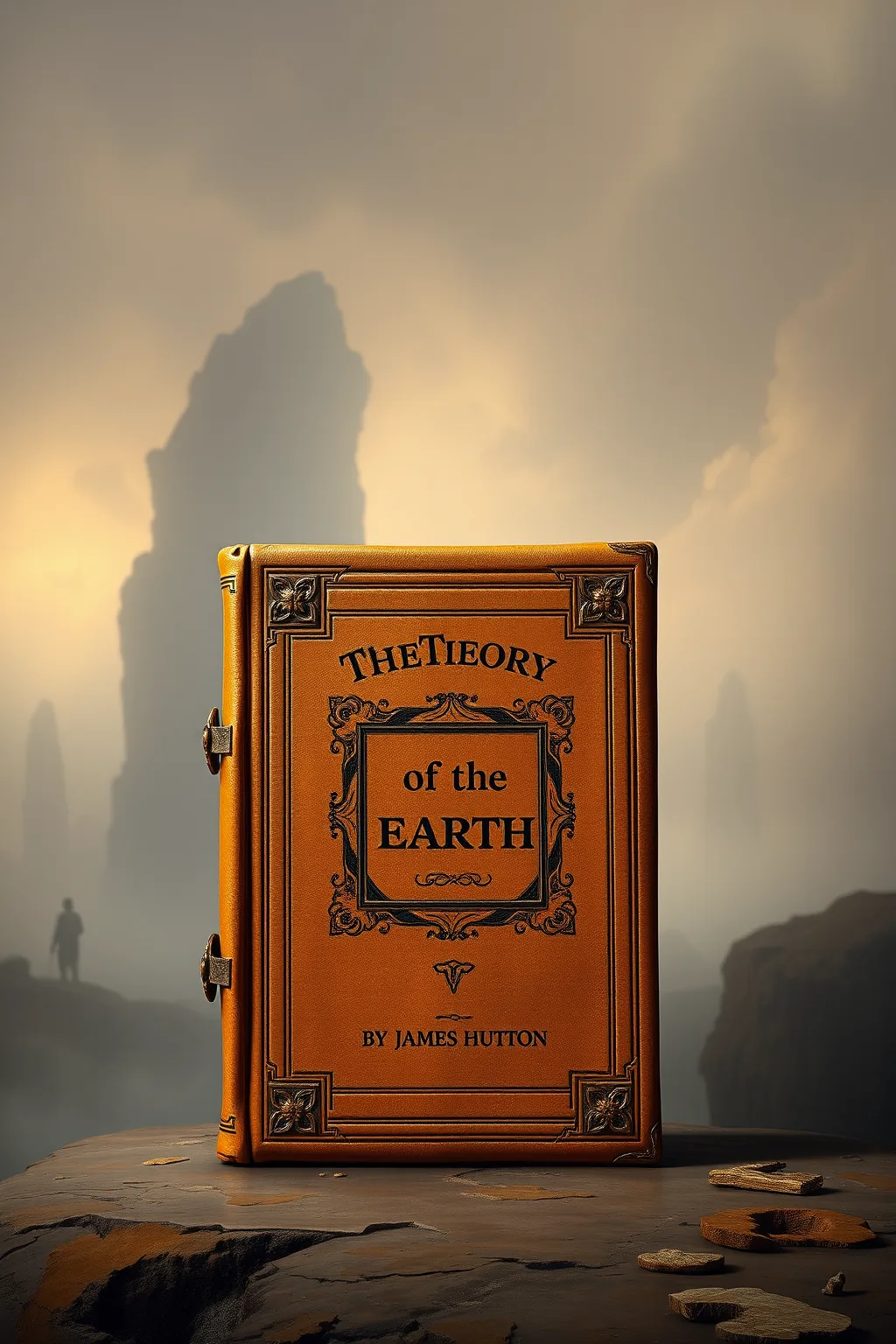
Theory of the Earth
 72
72

Theory of the Earth



Cassian Rothmann (Senior Critic, Ancient Wisdom) — James Hutton's 'Theory of the Earth' is a revelation for those who seek the esoteric beneath the surface of empirical science. Far from a dry geological treatise, it presents a cosmology that resonates with ancient cyclical theories of time and creation. Hutton’s audacious proposal of Earth's immense age, a radical departure from prevailing dogma, mirrors the esoteric pursuit of hidden knowledge that transcends conventional dogma. His meticulous observations of rock strata reveal a profound, almost alchemical, process of planetary renewal. This work is indispensable for scholars of Hermetic philosophy, ancient cosmologies, and anyone interested in the rationalist underpinnings of a universe vast beyond human reckoning.
📝 Description
72
In 1785, James Hutton presented a revolutionary view of Earth's age.
James Hutton's 'Theory of the Earth,' first presented in 1785, challenged contemporary views on the planet's history. Hutton argued that geological processes observed in his time, such as erosion and sedimentation, must have operated over vast stretches of time to shape the Earth's features. He saw the rock strata as records of these slow, continuous changes, suggesting a cyclical nature to geological events. This perspective contrasted sharply with the prevailing belief in a young Earth, often supported by biblical chronology. Hutton's work proposed that Earth was ancient, undergoing constant cycles of destruction and renewal. He used observations of rocks and landscapes to build his argument for deep time. This was a significant departure from the static, divinely created world then commonly understood. His ideas laid groundwork for modern geology. The book is a significant text for understanding the development of geological thought.
While primarily a geological work, Hutton's 'Theory of the Earth' resonates with esoteric traditions that contemplate cosmic cycles and ancient origins. His concept of Earth's perpetual dissolution and rebirth aligns with cyclical philosophies found in Hermeticism and certain ancient mystery schools. The immense timescales he proposed suggest a universe far older and more complex than a singular creation event. This perspective can be seen as an early scientific echo of ideas about vast aeons and recurring cosmic patterns, often explored in esoteric thought. Hutton's focus on observable processes to uncover hidden truths about the Earth's past also mirrors the alchemical pursuit of understanding fundamental principles through material transformation.
💡 Why Read This Book?
Uncover the Earth's ancient secrets and challenge prevailing notions of time. 'Theory of the Earth' offers a profound, scientifically grounded perspective on creation that aligns with esoteric concepts of cyclical existence and deep time. Ideal for seekers of hidden knowledge, scholars of ancient cosmologies, and practitioners interested in the geological underpinnings of our reality.
⭐ Reader Reviews
Honest opinions from readers who have explored this book.
❓ Frequently Asked Questions
What makes 'Theory of the Earth' an esoteric text?
Its challenge to literal interpretations of creation narratives and its presentation of Earth's immense age, aligning with ancient cyclical cosmologies and the pursuit of hidden, profound truths about existence.
How does Hutton's work relate to alchemy?
Hutton's process of observing geological transformations and cycles of destruction and renewal can be seen as a terrestrial echo of alchemical principles of dissolution and reintegration, symbolizing profound change.
Is this book suitable for beginners in geology?
While foundational, its philosophical implications and historical context make it accessible and enriching for those curious about the deeper meanings behind scientific discovery, even without prior geological expertise.
What is the concept of 'deep time' introduced by Hutton?
Deep time refers to the vast, almost unimaginable ages of Earth's history that Hutton revealed through geological evidence, contrasting sharply with the short timescales previously accepted.
Can this book inform spiritual practices?
Yes, by fostering a profound sense of awe and connection to the planet's ancient history, it can deepen one's spiritual understanding of creation, impermanence, and the eternal cycles of life.
🔮 Key Themes & Symbolism
The Unfolding Cycles of Creation
Hutton's theory unveils a universe not born in a single instant, but engaged in an eternal, cyclical process of transformation. He reveals the Earth as a dynamic entity, perpetually undergoing cycles of erosion, deposition, uplift, and metamorphism, mirroring the Hermetic principle of 'as above, so below' and the cyclical cosmologies found in various ancient traditions. This perspective suggests a continuous cosmic unfolding, where endings are merely preludes to new beginnings, and the planet itself is a living evidence of an ongoing creation that dwarfs human comprehension.
Challenging Dogma and Revealing Hidden Truths
Like many seekers of hidden knowledge, James Hutton faced significant resistance for his revolutionary ideas. His theory, which proposed an Earth far older than the few thousand years suggested by literal biblical interpretations, sparked a 'furor' akin to Darwin's later work. This resistance highlights the esoteric struggle against entrenched dogma, where empirical observation and deep contemplation can uncover truths obscured by conventional belief systems. Hutton's courage in presenting his findings underscores the importance of intellectual bravery in the pursuit of genuine understanding, pushing the boundaries of accepted wisdom.
The Earth as a Living Chronicle
For Hutton, the Earth's strata were not mere inert layers, but a vast, living chronicle inscribed with the history of millennia. Each rock formation, each fossil, served as a sacred text, revealing the slow, deliberate, and often cataclysmic processes that shaped our world. This view transforms the planet into a profound repository of wisdom, inviting us to 'read' its surface and depths for divine insights into time, change, and the very nature of existence. It encourages a reverence for the natural world as a source of deep, ancient knowledge, a philosophical perspective resonant with animistic and earth-centered spiritualities.
💬 Memorable Quotes
Direct passages from the work, attributed to the author.
“The past, present, and future are one.”
— This profound statement captures the cyclical nature of time and existence, suggesting an eternal present where all moments are interconnected and part of a continuous cosmic flow.
“We find no vestige of a beginning, no prospect of an end.”
— Hutton's observation of geological continuity implies an Earth without a discernible genesis or terminal point, hinting at an eternal or cyclical existence far beyond human temporal perception.
“The world is a great machine.”
— This metaphor suggests a universe operating under discernible laws and processes, akin to a complex, divinely designed mechanism, where each part plays a central role in the grand, ongoing operation.
“Nature is always the same.”
— Despite immense change, Hutton recognized underlying, consistent natural laws and processes that govern the Earth, implying a fundamental order and predictability within its grand transformations.
“The operations of nature are slow.”
— This highlights the vast timescales involved in geological processes, emphasizing patience and long-term observation as keys to understanding the Earth's profound and gradual evolution.
🌙 Esoteric Significance
Tradition
Hutton's 'Theory of the Earth' resonates deeply with Hermeticism and ancient cyclical philosophies. Its emphasis on perpetual cycles of creation and destruction, the vastness of time, and the Earth as a living chronicle aligns with esoteric understandings of cosmic order and the hidden processes that govern existence. It carries the alchemical pursuit of transformation and the recognition of profound truths obscured by surface appearances, offering a scientifically grounded perspective on universal principles of change and renewal.
Symbolism
The rock strata themselves become potent symbols in Hutton's work, representing the Earth's memory and history. Unconformities, where layers of rock are juxtaposed in seemingly impossible ways, symbolize moments of cosmic upheaval and rebirth. The concept of erosion and deposition signifies the eternal dance of dissolution and formation, mirroring the ouroboros, the serpent eating its tail, representing eternal recurrence and the cyclical nature of all things. The very immensity of geological time symbolizes the divine or cosmic scale of existence, far beyond human ken.
Modern Relevance
In an age grappling with ecological crises and a renewed interest in our planet's health, Hutton's 'Theory of the Earth' offers crucial perspective. His understanding of Earth's long-term cycles underscores the wide impact of human actions on a timescale far exceeding our individual lives. The book's challenge to short-sighted thinking encourages a more sustainable and reverent relationship with the planet. Esoterically, it prompts a deeper appreciation for the Earth as a sacred entity, a living library of wisdom that can inform our present and future existence, connecting us to a lineage of deep time and planetary consciousness.
👥 Who Should Read This Book
This important work is essential for seekers of truth who bridge the domains of science and spirituality. Scholars of esoteric history, ancient cosmologies, and geological philosophy will find its insights profound. For practitioners of earth-centered spirituality, it offers a powerful, scientifically validated framework for understanding planetary cycles and deep time. Beginners curious about the hidden narratives within our world, and those seeking to reconcile empirical knowledge with a sense of the sacred, will find 'Theory of the Earth' a transformative and clear read, expanding their perception of reality.
📜 Historical Context
Published in the late 18th century, James Hutton's 'Theory of the Earth' emerged during the Enlightenment, a period of burgeoning scientific inquiry and a growing skepticism towards purely theological explanations of the natural world. This era witnessed a profound shift in human understanding, driven by empirical observation and rational thought. Hutton's work was revolutionary, directly challenging the prevailing biblical chronology that limited Earth's age to a few thousand years. This defiance of established dogma placed him at the forefront of a new scientific paradigm, laying the groundwork for modern geology and the concept of deep time. His ideas, initially met with controversy, ultimately reshaped humanity's perception of its place in the cosmos, aligning scientific discovery with a more expansive, awe-inspiring view of planetary history.
📔 Journal Prompts
Reflect on a geological feature in your local environment. How might its formation tell a story of deep time?
Consider the concept of 'no vestige of a beginning, no prospect of an end.' How does this idea influence your perception of your own existence?
Hutton saw the Earth as a 'great machine.' What spiritual or philosophical parallels can you draw from this analogy?
Explore a time when you challenged a widely accepted belief based on your own observations. How did it feel, and what was the outcome?
How can understanding Earth's immense age foster a greater sense of responsibility towards its future?
🗂️ Glossary
Unconformity
A buried surface of erosion or non-deposition that separates younger strata above from older strata below, representing a significant gap in geological time and evidence of past geological events.
Strata
Layers of rock or soil, often distinguishable by differences in color, texture, or composition, which record successive periods of deposition over geological time.
Metamorphism
The process by which existing rocks are changed by heat, pressure, or chemical reactions, transforming them into new types of rock, illustrating Earth's dynamic internal processes.
Deposition
The geological process in which sediments, soil, and rocks are added to a landform or land mass, building up layers over time and contributing to the formation of strata.
Erosion
The geological process whereby earth materials are worn away and transported by natural forces such as wind or water, representing a force of dissolution and change in the Earth's surface.
This book appears in 1 collection
🔮 Readers Also Liked
Browse all →









From the “Transcendental Meditation” Collection
View all →







More Free Esoteric History & Biography Books
View all →