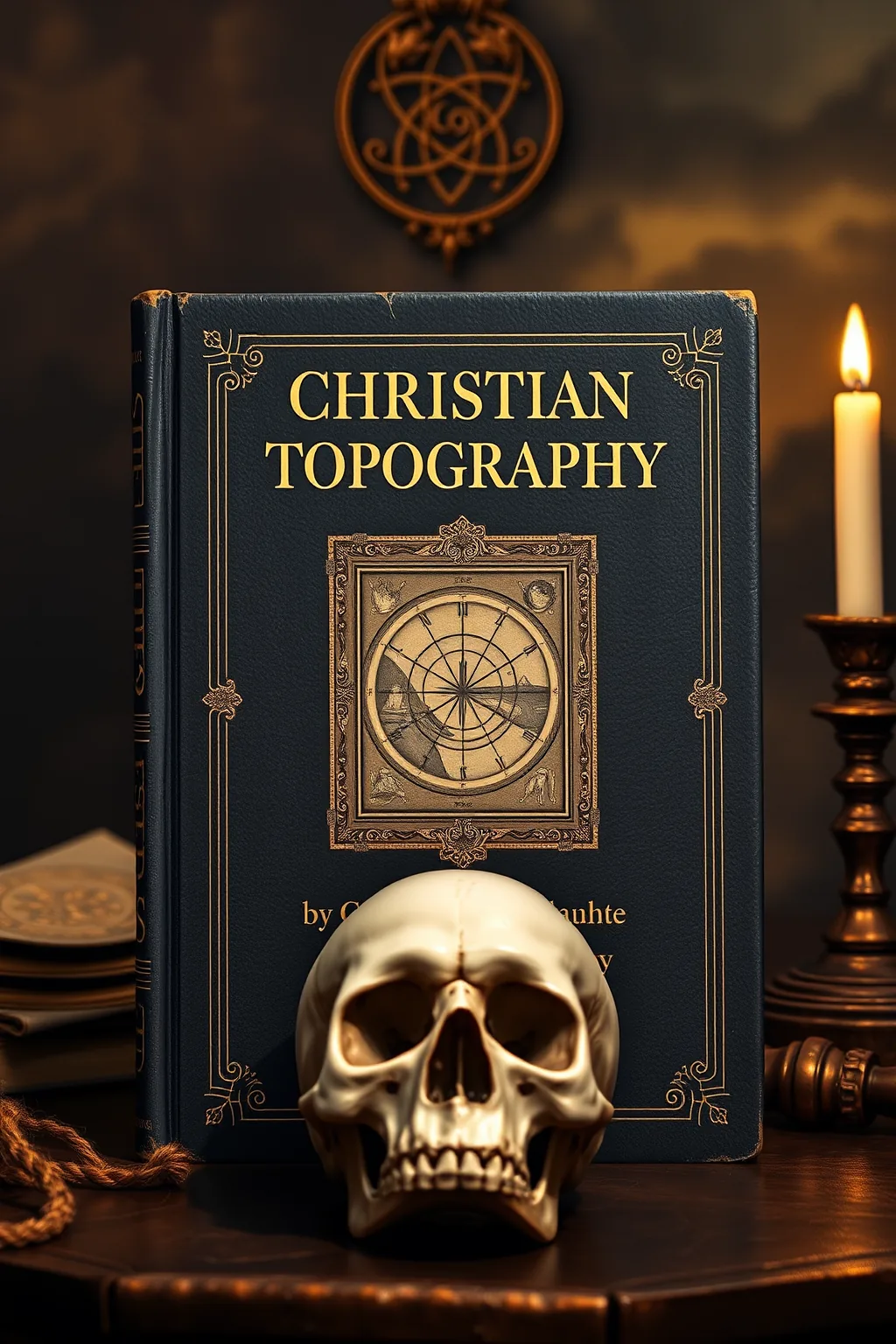
Christian Topography
 81
81

Christian Topography


Aurelia Blackwood (Occult Philosophy Critic) — Cosmas Indiopleustes' 'Christian Topography' is an essential, albeit unconventional, cornerstone of esoteric Christian thought. Far from a simple cosmological treatise, it's a profound exploration of biblical hermeneutics applied to the very structure of existence. Cosmas masterfully weaves scriptural exegesis into a unique, geometrically sound (within its own paradigm) model of the universe. His insistence on the Tabernacle as a cosmic archetype is particularly illuminating for those studying sacred architecture and its spiritual implications. While seemingly archaic to the modern mind, the work's strength lies in its unwavering commitment to a divinely ordered cosmos, offering a rich tapestry of symbolism for scholars and seekers interested in the historical development of mystical worldviews. It challenges conventional notions and rewards deep contemplation.
📝 Description
81
Cosmas Indiopleustes wrote 'Christian Topography' in the sixth century CE, detailing a universe built from divine blueprints.
Cosmas Indiopleustes, a merchant mariner, penned 'Christian Topography' in the sixth century CE. He proposed a universe shaped like Noah's Ark, a cosmic Tabernacle that mirrored earthly sanctuaries. His cosmology depicted a flat, rectangular Earth beneath a celestial vault. The sun, he suggested, traveled behind a great hidden mountain to create day and night. This work is not simply cosmology but also an examination of sacred geometry and the connections between the larger universe and the individual.
'Christian Topography' provides insight into an early Christian perspective where scripture served as the primary guide for understanding the cosmos. The Earth's shape was seen as reflecting divine intent. The text invites readers to grasp the universe through faith and sacred symbols, showing a creation filled with spiritual meaning. It acts as an entry point to an older way of understanding existence, encouraging a perception of the divine structure behind all things.
Cosmas Indiopleustes's 'Christian Topography' stands as a unique example of early Christian cosmological speculation that engaged with philosophical and theological ideas outside standard Aristotelian or Platonic frameworks. It sought to derive a physical model of the universe directly from biblical interpretation, presenting a vision where the structure of creation was a divine artifact, a tangible representation of heavenly realities. This approach aligns with traditions that find symbolic meaning in physical forms and seek divine order within the observable world, albeit through a distinctively Christian lens.
💡 Why Read This Book?
Uncover a forgotten cosmology rooted in sacred scripture and divine symbolism. 'Christian Topography' offers a unique lens into early Christian thought, revealing a universe built on divine proportion and spiritual correspondence. Ideal for seekers of hidden knowledge, scholars of esoteric traditions, and practitioners interested in the intersection of faith and cosmology.
⭐ Reader Reviews
Honest opinions from readers who have explored this book.
❓ Frequently Asked Questions
What is the primary cosmological model presented in 'Christian Topography'?
Cosmas describes a flat, rectangular Earth covered by a cylindrical sky, resembling a cosmic Tabernacle. The sun's movement is explained by its passage behind a great mountain.
What is the significance of the Tabernacle in Cosmas's work?
He believed the Tabernacle constructed by Moses was a divinely revealed model of the universe, with its earthly form reflecting celestial and cosmic structures.
What kind of evidence does Cosmas use to support his theories?
Cosmas primarily relies on interpretations of biblical passages and scriptural arguments to justify his unique cosmological and geographical views.
Is 'Christian Topography' a scientific text?
No, 'Christian Topography' is a theological and philosophical work, not a scientific treatise in the modern sense. Its aim is to interpret the cosmos through a spiritual and scriptural lens.
Who was Cosmas Indiopleustes?
Cosmas Indiopleustes was a 6th-century Byzantine merchant, traveler, and Christian writer known for his cosmological and geographical works based on his interpretations of scripture.
🔮 Key Themes & Symbolism
Sacred Geometry and Divine Architecture
Cosmas Indiopleustes radically reinterprets the cosmos through the lens of sacred geometry, positing that the universe itself is a divinely constructed edifice. His central thesis is that the Tabernacle, as described in the Old Testament, is not merely a terrestrial sanctuary but a perfect microcosm mirroring the macrocosm. This perspective elevates architectural principles to cosmic significance, suggesting a hidden order and intentionality in creation. The text invites readers to perceive the universe as a meticulously designed structure, where every element, from the shape of the Earth to the path of the sun, serves a divine purpose and reflects heavenly blueprints. It's a profound meditation on the tangible manifestation of the divine in the physical realm.
Biblical Hermeneutics and Literal Interpretation
Fundamentally, , 'Christian Topography' is a evidence of a specific method of biblical interpretation, one that seeks to derive cosmological truths directly from scripture. Cosmas argues that the sacred texts provide the ultimate authority for understanding the Earth's form and the heavens' arrangement. He meticulously dissects passages, combining them into a cohesive, albeit unconventional, worldview. This approach highlights a historical tendency within certain theological traditions to prioritize scriptural literalism as the foundation for all knowledge, including natural philosophy. The book serves as a fascinating case study in how faith can shape perception and lead to radical reinterpretations of the physical world.
The Cosmic Tabernacle and Celestial Symbolism
The concept of the universe as a cosmic Tabernacle is the central, most evocative metaphor in Cosmas's work. He envisions the Earth as the base and the heavens as a divinely crafted tent or ark, symbolizing God's dwelling place among creation. This strong symbolism transforms the mundane into the sacred, suggesting that the physical world is imbued with spiritual meaning and acts as a veiled representation of divine presence. The celestial vault, the hidden mountain, and the sun's circuit are all elements within this grand, symbolic structure. For the esoteric reader, this perspective offers a profound connection between earthly worship and cosmic reality, blurring the lines between the immanent and the transcendent.
💬 Memorable Quotes
Direct passages from the work, attributed to the author.
“The sky is made like a vault...”
— This statement captures Cosmas's unique vision of the celestial sphere, not as an infinite expanse but as a structured, contained entity, directly influenced by divine craftsmanship.
“The earth is flat and rectangular...”
— A direct assertion of his controversial cosmology, framing the Earth's form as a deliberate, divinely ordained shape rather than an arbitrary natural occurrence.
“...and the Tabernacle is an image of the whole world.”
— This important quote reveals the core of Cosmas's theological framework: the earthly Tabernacle is a divinely revealed blueprint for the entire cosmos, linking human worship to universal structure.
“There is a great mountain behind which the sun goes...”
— This vividly describes his explanation for night and day, presenting a tangible, albeit hidden, mechanism within his structured universe, emphasizing divine control over celestial phenomena.
“We must believe the Scriptures.”
— The ultimate justification for his entire system, underscoring the primacy of biblical authority in shaping his understanding of reality and the cosmos.
🌙 Esoteric Significance
Tradition
Cosmas Indiopleustes' work is deeply rooted in early Christian esoteric traditions that sought hidden meanings within scripture and creation. It aligns with Gnostic and other mystical interpretations that viewed the material world as a symbolic representation of divine truths. His emphasis on sacred geometry and the Tabernacle as a cosmic model connects to Hermeticism and Pythagoreanism, where numbers and forms hold profound spiritual power. The text is a valuable resource for understanding how a faith-based cosmology can be constructed to reveal divine order and intention.
Symbolism
The symbolism in 'Christian Topography' is rich and pervasive. The flat Earth represents stability and God's foundation, while the cylindrical sky is a divine dwelling. The Tabernacle, a central symbol, is a microcosm of the universe, with its dimensions and structure mirroring celestial arrangements. The hidden mountain behind which the sun travels symbolizes the veiled nature of divine power and the unseen forces governing creation. This collection of symbols invites readers to look beyond the literal and perceive the spiritual architecture underlying all existence.
Modern Relevance
While its literal cosmological claims are not scientifically accepted, 'Christian Topography' holds significant modern relevance for scholars of religious history, esoteric philosophy, and the history of ideas. It provides a unique window into how early Christians grappled with reconciling faith and their understanding of the world. For contemporary seekers, it offers a provocative challenge to conventional paradigms, encouraging a deeper contemplation of the relationship between belief, perception, and the perceived structure of reality. It highlights the enduring human quest for meaning and divine order in the cosmos.
👥 Who Should Read This Book
Scholars of ancient history, religious studies, and the history of science will find 'Christian Topography' an indispensable primary source for understanding early Christian cosmology. Seekers of esoteric knowledge and those interested in alternative worldviews will be drawn to its mix of faith and cosmology. Practitioners of contemplative traditions may find inspiration in its symbolic interpretations of the universe as a divine dwelling. Even for those unfamiliar with its specific doctrines, the book offers a fascinating glimpse into a worldview where the sacred is intrinsically woven into the fabric of existence.
📜 Historical Context
Written in the 6th century CE, 'Christian Topography' emerged during a period of significant intellectual and religious transition in the Byzantine Empire. Following the decline of classical Greco-Roman scientific traditions and the ascendancy of Christian theology, many thinkers sought to reconcile faith with observable phenomena through scriptural interpretation. Cosmas Indiopleustes, a merchant and traveler, was influenced by this milieu, offering a stark contrast to the lingering Aristotelian cosmology. His work represents a bold, yet ultimately marginal, attempt to construct a comprehensive worldview solely from biblical texts, prioritizing theological doctrine over empirical observation. It reflects a desire to see God's hand directly in the mechanics of the universe, a perspective that, while diverging from later scientific trajectories, offers invaluable insight into the spiritual and intellectual field of early medieval Christianity.
📔 Journal Prompts
How does Cosmas's interpretation of the Tabernacle as a cosmic model challenge or resonate with your understanding of sacred spaces?
Reflect on the idea of the universe as a 'divine workshop.' What elements of creation do you perceive as bearing divine craftsmanship?
Cosmas uses scripture as his primary cartographical tool. How might a similar approach, if applied metaphorically, inform your understanding of personal or spiritual landscapes?
Consider the concept of a 'hidden mountain' that governs celestial movement. What unseen forces or principles do you believe influence your own life's trajectory?
In what ways does the search for order and meaning in the cosmos, as exemplified by Cosmas, reflect timeless human aspirations?
🗂️ Glossary
Tabernacle
In Jewish tradition, the portable sanctuary used by the Israelites during their wanderings in the desert, believed by Cosmas to be a model of the universe.
Cosmology
The study of the origin, evolution, and eventual fate of the universe; in this context, a divinely inspired view of the cosmos.
Macrocosm
The universe considered as a complex and orderly entity, often contrasted with the microcosm.
Microcosm
A miniature representation of the universe, such as the human body or the Tabernacle in Cosmas's view.
Scriptural Exegesis
Critical explanation or interpretation of a text, especially of the Bible, used by Cosmas to derive his cosmological theories.
This book appears in 2 collections
🔮 Readers Also Liked
Browse all →









From the “Transcendental Meditation” Collection
View all →






More Free Esoteric History & Biography Books
View all →