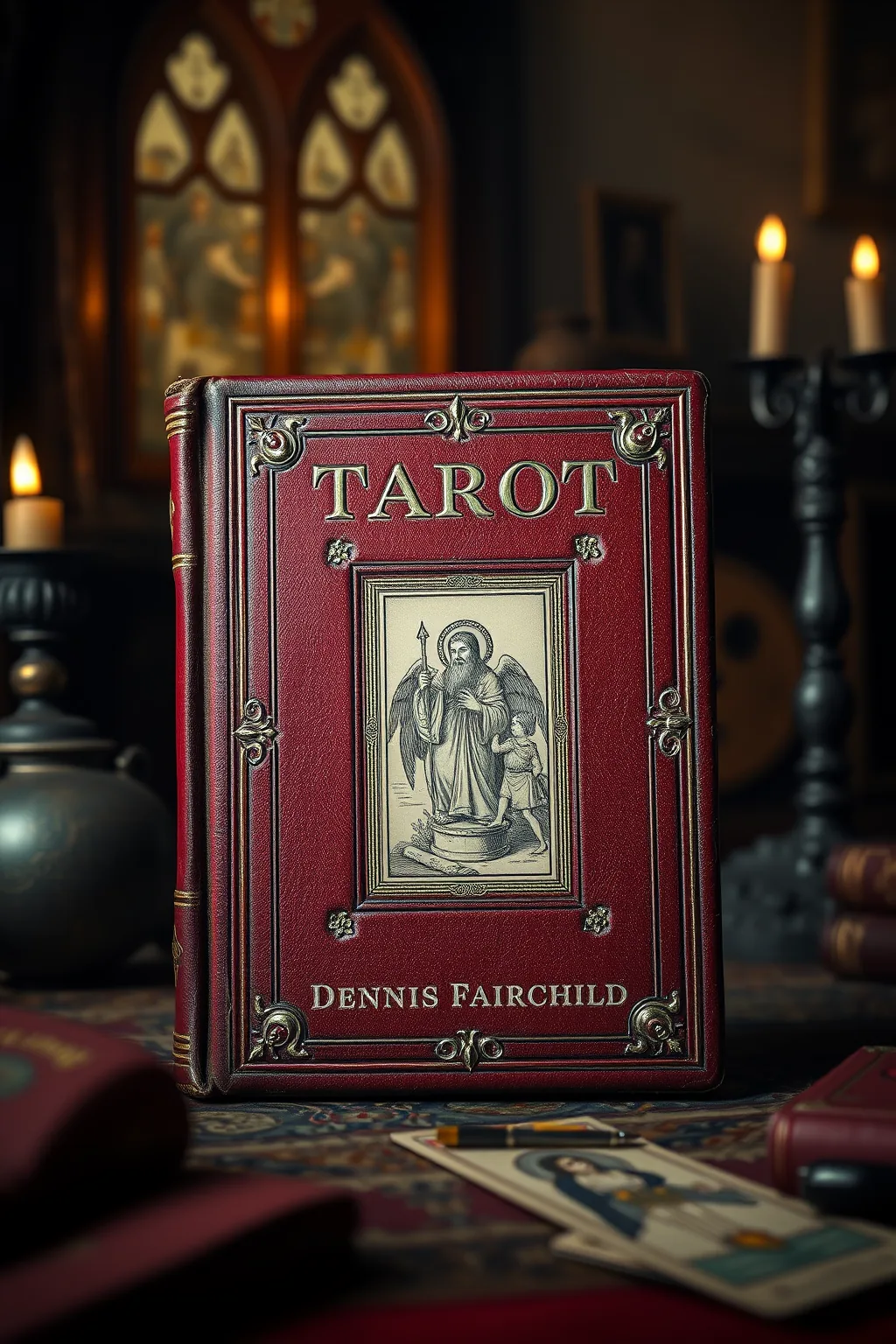
Tarot
 84
84

Tarot
Dennis Fairchild's "Tarot" offers a sober and scholarly approach to a subject often mired in sensationalism or superficiality. The author commendably grounds the cards in their historical and symbolic context, moving beyond mere predictive applications. His analysis of the Major Arcana, particularly the Fool's journey as an archetypal progression, is well-articulated and insightful. However, the treatment of the Minor Arcana, while thorough, occasionally feels more like a catalog than a deep dive into their dynamic interplay, especially when compared to the more evocative discussions of the trumps. A passage that stands out is the detailed breakdown of the Pips, where Fairchild attempts to link each number to specific stages of development, a concept that, while ambitious, sometimes strains the symbolic connections. Despite this minor reservation, the book provides a solid foundation for understanding the Tarot as a system of profound symbolic meaning. It is a valuable addition for those seeking depth over divination.
📝 Description
84
### What It Is
Dennis Fairchild's "Tarot" presents a comprehensive examination of the seventy-eight card system, moving beyond simple divinatory interpretations to explore its deeper psychological and spiritual underpinnings. First published in 2002, the book positions the Tarot as a symbolic language, a mirror reflecting the human condition and the archetypal forces that shape it. It meticulously details the Major and Minor Arcana, offering insights into their historical roots and their application in personal growth and esoteric understanding.
### Who It's For
This work is intended for serious students of esoteric philosophy, psychology, and comparative religion. It will appeal to those who view the Tarot not merely as a fortune-telling tool but as a sophisticated system of wisdom, akin to Kabbalistic or Gnostic texts. Readers interested in Jungian archetypes, hermeneutics, and the history of Western esotericism will find a valuable resource here. It is also suitable for practicing Tarot readers seeking to deepen their comprehension of the cards' symbolic grammar and their potential for self-discovery.
### Historical Context
Fairchild's exploration of the Tarot emerges from a late 20th and early 21st-century revival of interest in Western esoteric traditions. This period saw a confluence of psychological theories, particularly Carl Jung's work on archetypes, with traditional occult studies. Unlike earlier, purely divinatory manuals, "Tarot" reflects a scholarly approach that seeks to integrate the cards into a broader framework of symbolic understanding. It follows in the lineage of occultists like Eliphas Lévi and A.E. Waite, who sought to systematize and imbue Tarot with philosophical depth, while also engaging with modern psychological paradigms that gained prominence in the post-war era.
### Key Concepts
The book systematically breaks down the Tarot into its constituent parts, illuminating the progression from the Fool's journey through the Major Arcana to the four suits and court cards of the Minor Arcana. Fairchild emphasizes the concept of the Tarot as a psycho-spiritual map, illustrating the soul's journey. He details the numerological and elemental correspondences inherent in the cards, linking them to established esoteric systems. The structure of the deck itself, with its division into trump cards and numbered/court cards, is presented as a microcosm of universal principles and human experience.
💡 Why Read This Book?
• Gain a structured understanding of the Tarot's seventy-eight cards as a symbolic system, as detailed in Fairchild's systematic breakdown of the Major and Minor Arcana. • Explore the connection between Tarot archetypes and psychological concepts, particularly Jung's theories of the psyche, as presented in the book's examination of the Fool's journey. • Grasp the historical and esoteric lineages that inform the Tarot, learning how its structure reflects principles explored in Western esotericism since the 19th century.
⭐ Reader Reviews
Honest opinions from readers who have explored this book.
❓ Frequently Asked Questions
What is the primary focus of Dennis Fairchild's "Tarot"?
Fairchild's "Tarot," first published in 2002, focuses on the seventy-eight card system as a symbolic language and a map for psychological and spiritual exploration, rather than solely as a tool for divination.
Does the book cover the historical origins of the Tarot?
Yes, the book situates the Tarot within its historical context, touching upon its development and the influences of esoteric traditions that shaped its symbolic structure over time.
Who would benefit most from reading "Tarot" by Dennis Fairchild?
Serious students of esoteric philosophy, psychology, comparative religion, and those interested in Jungian archetypes or Western esotericism would find this book particularly beneficial.
How does Fairchild's approach differ from typical Tarot guides?
Fairchild moves beyond simple predictive interpretations, emphasizing the Tarot's role as a mirror for the human condition and a system for personal growth, drawing parallels with psychological theories.
Are the Kabbalistic or elemental correspondences of the Tarot explained?
Yes, the book details the numerological and elemental correspondences inherent in the Tarot cards, linking them to established esoteric systems for deeper understanding.
When was "Tarot" by Dennis Fairchild first published?
Dennis Fairchild's "Tarot" was first published in 2002, reflecting a period of renewed scholarly interest in esoteric symbolism and its psychological applications.
🔮 Key Themes & Symbolism
Archetypal Journey
The book presents the Major Arcana as a symbolic representation of the human soul's progression through various life stages and existential challenges. This journey, often initiated by the Fool, is framed as an archetypal path of individuation. Fairchild explores how each trump card embodies universal psychological patterns and spiritual lessons, offering a framework for understanding personal development and the underlying forces of existence. This perspective aligns the Tarot with depth psychology, viewing it as a tool for self-awareness and spiritual unfolding.
Symbolic Language
Fairchild positions the Tarot as a complex symbolic language, a visual lexicon that communicates profound truths about the human psyche and the cosmos. The intricate imagery, numerology, and elemental associations of each card are analyzed not in isolation, but as interconnected components of a cohesive system. This symbolic grammar, he argues, allows for a deeper understanding of both inner states and external realities, functioning as a sophisticated medium for introspection and esoteric wisdom that transcends simple divinatory answers.
Esoteric System Integration
The work delves into how the Tarot's structure and symbolism are interwoven with established esoteric traditions, such as Hermeticism and Kabbalah. Fairchild elucidates the numerological relationships, elemental attributions, and planetary correspondences that link the cards to ancient wisdom systems. This integration highlights the Tarot's function as a microcosm, reflecting universal principles and offering a practical method for engaging with metaphysical concepts and enhancing spiritual perception.
Psychological Mirror
Fairchild emphasizes the Tarot's capacity to act as a mirror reflecting the querent's inner psychological landscape. The cards are presented as potent symbols that can illuminate subconscious patterns, unresolved conflicts, and hidden potentials. By engaging with the archetypal figures and scenarios depicted, individuals can gain insight into their own motivations, fears, and desires, fostering a greater degree of self-understanding and psychological integration through this symbolic dialogue.
💬 Memorable Quotes
“The Fool's journey is not a linear path, but a cyclical return, each stage offering a new perspective on the whole.”
— This interpretation suggests that the Fool's progression through the Major Arcana is less about arriving at a final destination and more about the continuous process of learning and re-evaluation inherent in spiritual growth.
“Each numbered card in the minor suits represents a distinct phase within a larger elemental and numerological framework.”
— This highlights Fairchild's systematic approach, emphasizing that the Pips are not random cards but hold specific meanings derived from their position within the suit's elemental theme and their numerical value.
“The Tarot's true power lies in its ability to translate the ineffable into tangible symbolic form.”
— This paraphrase points to the book's core argument: that the Tarot acts as a bridge between abstract spiritual or psychological concepts and the concrete imagery of the cards, making the intangible accessible.
“Court cards embody archetypal personalities and social roles, offering insights into interpersonal dynamics.”
— This interpretation frames the King, Queen, Knight, and Page not just as characters but as representations of fundamental human archetypes and the roles we play in our relationships and society.
“Understanding the elemental composition of a suit provides the key to interpreting its associated challenges and potentials.”
— This suggests that the inherent nature of each suit (Wands/Fire, Cups/Water, Swords/Air, Pentacles/Earth) is crucial for deciphering the specific themes and energies it brings to a reading or personal reflection.
🌙 Esoteric Significance
Tradition
Fairchild's "Tarot" fits within the Western Esoteric tradition, particularly drawing from Hermetic and Kabbalistic frameworks, and incorporating post-Jungian psychological concepts. It extends the lineage of occultists who viewed the Tarot not just for divination but as a compendium of cosmic and psychological principles. The work aligns with the Hermetic dictum 'As Above, So Below,' by correlating the microcosm of the cards with macrocosmic universal laws and the inner landscape of the human psyche.
Symbolism
Key symbols include the Fool, representing the potentiality and innocence at the dawn of consciousness, and the World card, signifying completion and integration. The four suits – Wands (spirit/action), Cups (emotion/relationships), Swords (intellect/conflict), and Pentacles (materiality/body) – represent fundamental forces and elements, providing a structure for understanding human experience through elemental and numerological associations.
Modern Relevance
Contemporary practitioners of depth psychology and archetypal studies often reference works like Fairchild's to understand the Tarot's symbolic language. It informs modern approaches to mindfulness, self-reflection, and personal development that utilize symbolic systems. Thinkers and groups exploring embodied spirituality and the integration of ancient wisdom with modern consciousness continue to draw on the systematic, psychologically-informed interpretations found in this book.
👥 Who Should Read This Book
• Students of Western Esotericism: Those seeking to understand the Tarot's place within Hermeticism, Kabbalah, and other mystical traditions will find a structured analysis. • Psychology Enthusiasts: Individuals interested in Jungian archetypes and the use of symbolic systems for self-exploration will appreciate the psychological framing. • Dedicated Tarot Readers: Practitioners looking to move beyond superficial readings and develop a deeper, more philosophical understanding of the cards' symbolic grammar will benefit.
📜 Historical Context
Dennis Fairchild's "Tarot," published in 2002, emerged during a period of sustained interest in esoteric traditions, particularly within post-Jungian psychology and comparative mysticism. The late 20th century saw a significant revival of occult studies, moving beyond the Victorian occult revival. Fairchild's work reflects a scholarly engagement with the Tarot, building on the symbolic systematization initiated by figures like A.E. Waite in the early 20th century. Unlike the more purely divinatory or spiritualist approaches prevalent in earlier eras, this period saw a greater emphasis on the Tarot as a psychological tool and a philosophical system. Fairchild's approach can be seen as a contemporary response to the integration of archetypal psychology, pioneered by Carl Jung, with traditional hermeneutic practices. This integration distinguished it from earlier, more dogmatic or strictly predictive interpretations, positioning it within a broader intellectual current that sought to reconcile ancient wisdom with modern scientific and psychological thought. While not directly engaging in public debates, the work was part of a wider academic and practitioner discourse that included contemporaries exploring similar symbolic systems, such as the Kabbalah and Hermetic philosophy, often published in journals dedicated to esoteric studies.
📔 Journal Prompts
The Fool's journey: Identify a personal experience mirroring the archetypal progression through the Major Arcana.
Elemental attributions: Reflect on how the energies of Fire (Wands), Water (Cups), Air (Swords), and Earth (Pentacles) manifest in your daily life.
Court card archetypes: Analyze a recent interpersonal interaction through the lens of a specific court card personality.
The concept of symbolic language: How can the Tarot's imagery offer insights into a situation where words fail?
Numerological progression: Consider the numerical journey of one suit and its reflection in a personal project or phase.
🗂️ Glossary
Major Arcana
The twenty-two trump cards of the Tarot deck, typically depicting archetypal figures and significant life events, representing the soul's journey.
Minor Arcana
The fifty-six cards of the Tarot deck, divided into four suits, representing the everyday events, challenges, and experiences of life.
Archetype
A universal, archaic pattern of behavior, image, or symbol that is part of the collective unconscious, as described by Carl Jung.
Hermeticism
A philosophical and religious tradition based on the purported teachings of Hermes Trismegistus, emphasizing esoteric knowledge, alchemy, and astrology.
Kabbalah
A body of Jewish mystical teachings that explores the nature of God and the universe, often using symbolic systems like the Tree of Life.
Divination
The practice of seeking knowledge of the future or the unknown by supernatural means, often through tools like the Tarot.
Pips
The numbered cards (Ace through Ten) within the Minor Arcana suits.