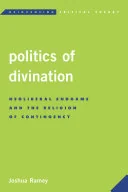
Politics of Divination
 79
79

Politics of Divination
Joshua Ramey's "Politics of Divination" offers a challenging perspective on the resilience of neoliberalism, moving beyond standard economic critiques. The central thesis, that a hidden "political theology" sustains neoliberal hegemony, is both compelling and meticulously argued. Ramey effectively dissects how abstract principles of market logic echo older, almost sacred, doctrines of order and salvation, thereby rendering alternative systems unthinkable. A particular strength lies in his detailed exploration of how concepts like "risk" and "uncertainty" function not merely as economic variables but as quasi-theological pronouncements. However, the book's dense philosophical language and reliance on complex theoretical frameworks, particularly its engagement with Carl Schmitt's concept of political theology, might present a barrier for readers less familiar with these specific intellectual traditions. The work's insistence on the "obscure" nature of this political theology, while central to its argument, occasionally feels under-exemplified with concrete, widely recognizable historical parallels beyond those already established in political theology scholarship. "Politics of Divination" provides a potent, albeit demanding, lens through which to re-examine contemporary political thought.
📝 Description
79
### What It Is Joshua Ramey's "Politics of Divination" examines the persistent hold of neoliberalism, particularly in the wake of the 2008 financial crisis. The book posits that the ideology's endurance is not solely due to economic arguments but is deeply intertwined with an archaic and obscure political theology. It argues that this theological undergirding, often unacknowledged, provides a framework that allows neoliberalism to present itself as the only viable system, despite its detrimental effects on labor, capital, ecology, and society.
### Who It's For This work is intended for readers interested in the philosophical underpinnings of contemporary economic and political systems. It will appeal to those who question the seemingly unassailable dominance of neoliberal thought and seek to understand its deeper, often hidden, sources of power. Academics, critical theorists, and advanced students of political philosophy, sociology, and religious studies will find its arguments particularly relevant.
### Historical Context The book's initial publication in 2016 places it within a period of intense scrutiny of global financial institutions and the ideologies that shaped them. The aftermath of the 2008 crisis fueled critical discourse on capitalism, market fundamentalism, and the role of state power. Ramey's work engages with a lineage of critical thought that questions the secularization thesis and looks for theological or metaphysical dimensions in apparently secular phenomena.
### Key Concepts Ramey explores the concept of "political theology," a term associated with thinkers like Carl Schmitt, which examines how theological ideas and structures influence secular political systems. He investigates how neoliberalism, often presented as purely rational and secular, draws upon or mirrors certain theological modes of thought. The book also touches upon the idea of "hegemony," as theorized by Antonio Gramsci, to explain how dominant ideologies become normalized and accepted as common sense.
💡 Why Read This Book?
• Understand the theological roots of neoliberalism: Learn how concepts like "risk" and "uncertainty" function as quasi-divine pronouncements, offering a framework beyond mere economic analysis, as explored in the book's discussion of political theology. • Grasp the persistence of market ideology: Discover why neoliberalism remains dominant, even after crises like the 2008 financial crash, by examining its underlying, often unacknowledged, theological structures. • Engage with critical theory: Gain insights into how thinkers like Carl Schmitt and Antonio Gramsci inform Ramey's analysis, providing tools to deconstruct contemporary political discourse and its hidden assumptions.
⭐ Reader Reviews
Honest opinions from readers who have explored this book.
❓ Frequently Asked Questions
What is the core argument of Joshua Ramey's "Politics of Divination"?
The book argues that the enduring power of neoliberalism, especially after the 2008 financial crisis, stems not just from economic policy but from an underlying "political theology" that shapes its discourse and presents it as the only viable system.
When was "Politics of Divination" first published?
The book was first published on September 26, 2016.
Who is Joshua Ramey?
Joshua Ramey is a philosopher and author known for his work on political theology, contemporary political theory, and critical theory, exploring the intersection of ideas and power structures.
What does the book mean by "political theology"?
Political theology, in the context of this book, refers to how theological concepts, structures, or modes of thinking influence secular political systems, providing them with a sense of order, authority, or inevitability.
What historical event is frequently referenced in "Politics of Divination"?
The book frequently references the 2008 financial crisis as a pivotal moment that exposed the failures of neoliberalism yet did not dislodge its hegemonic status.
What is the relationship between divination and politics in this book?
The book uses "divination" metaphorically to describe how neoliberal discourse claims to predict, control, and prescribe future economic and social outcomes, functioning with an almost prophetic authority.
🔮 Key Themes & Symbolism
Neoliberal Hegemony's Theological Core
Ramey contends that neoliberalism's persistent dominance, especially post-2008, is sustained by an unacknowledged "political theology." This theological dimension allows it to function as an all-encompassing worldview, presenting its doctrines as inevitable truths rather than contingent policy choices. The work explores how concepts like market efficiency and risk management are imbued with a quasi-sacred authority, guiding societal organization and individual behavior in ways that mirror older forms of religious or metaphysical order, thereby solidifying its hegemonic position against challenges.
The Obscurity of Political Theology
A central theme is the "archaic and obscure" nature of the political theology underpinning neoliberal discourse. This obscurity is crucial to its power, as it prevents direct critique by rendering its foundational assumptions invisible or unassailable. By identifying these hidden theological underpinnings, Ramey aims to demystify how neoliberalism achieves widespread acceptance, suggesting that its perceived rationality masks a deeper, almost faith-based, commitment to specific principles of governance and economic organization.
Divination as Political Strategy
The title "Politics of Divination" frames contemporary political and economic discourse as a form of prophecy. Ramey suggests that neoliberalism, in its claims to predict, manage, and optimize future outcomes (economic growth, stability), functions as a modern-day divination practice. This aspect highlights how certainty and foresight are presented as achievable through market mechanisms, offering a secularized form of spiritual assurance and control over the unpredictable nature of existence.
Critique of Secularization
The book implicitly challenges the traditional narrative of secularization, arguing that theological or metaphysical impulses persist and are repurposed within secular ideologies. It suggests that even in a supposedly rationalist age, political and economic systems rely on faith-like commitments and belief structures. This perspective aligns with certain strands of post-secular thought that re-examine the enduring influence of religious or quasi-religious frameworks on modern society.
💬 Memorable Quotes
“The persistence of neoliberal hegemony... has to do with the archaic and obscure political theology upon which of much of its discourse tr”
— This foundational statement from the original blurb highlights the book's core argument: that neoliberalism's enduring power is rooted in a hidden, ancient theological framework, not just its economic policies.
“How can we account for the persistence of neoliberal hegemony, in spite of its obviously disastrous effects upon labor, capital, ecology, and society?”
— This question posed early in the book sets up the central puzzle that Ramey seeks to solve, signaling a critical inquiry into the resilience of an ideology despite its negative real-world consequences.
“The neoliberal ideas that arguably caused the damage have been triumphant in presenting themselves as the only possible solution for it.”
— This observation underscores the paradoxical nature of neoliberalism's success, suggesting that the very ideology responsible for crises is able to reassert itself as the sole remedy.
“The work explores the political theology underpinning neoliberalism.”
— A concise summary of the book's primary analytical focus, emphasizing the theological dimension as key to understanding contemporary political and economic thought.
“Neoliberalism's discourse draws on obscure theological frameworks.”
— This paraphrase captures the essence of Ramey's thesis regarding the hidden, almost religious, foundations that grant neoliberalism its pervasive influence and perceived inevitability.
🌙 Esoteric Significance
Tradition
While not explicitly aligning with a single esoteric lineage like Hermeticism or Kabbalah, "Politics of Divination" draws heavily on the intellectual tradition of political theology, which itself has roots in re-examining theological structures that underpin secular power. It engages with ideas of hidden order, fate, and prophecy, themes that resonate with esoteric thought. The work departs from traditional esotericism by focusing on the 'theology' embedded within secular political discourse rather than explicitly mystical texts, yet it shares an interest in uncovering unseen forces shaping reality.
Symbolism
The book uses "divination" metaphorically, symbolizing the predictive and prescriptive claims of neoliberal ideology. Market forecasting, risk management, and economic modeling can be seen as modern secular rituals aiming to control the future, akin to ancient divinatory practices. The "obscurity" of this political theology acts as a symbolic veil, protecting the ideology from scrutiny, much like arcane symbols in esoteric traditions guard deeper meanings.
Modern Relevance
Contemporary thinkers and movements critical of global capitalism and seeking to deconstruct dominant ideologies find resonance in Ramey's work. It informs discussions on the metaphysics of economics and the role of belief systems in politics. Practitioners of critical theory, post-structuralism, and certain strains of continental philosophy who analyze power structures and discourse formation may draw upon its insights to understand the deep-seated assumptions that govern contemporary society.
👥 Who Should Read This Book
• Critical theorists and political philosophers: Readers interested in post-2008 economic critiques and the philosophical underpinnings of contemporary governance will find Ramey's analysis of political theology highly relevant. • Students of sociology and religious studies: Those examining the intersection of secular ideologies and quasi-religious belief systems will benefit from the book's exploration of how theological structures persist in modern discourse. • Activists and engaged citizens: Individuals seeking to understand the deep roots of neoliberal hegemony and identify new avenues for critique will gain a powerful analytical framework.
📜 Historical Context
Published in 2016, "Politics of Divination" emerged in the shadow of the 2008 global financial crisis, a period marked by widespread disillusionment with neoliberal economic policies. This era saw a resurgence of critical theory and political philosophy questioning the foundations of market fundamentalism. Ramey's work engages with the concept of political theology, a field notably developed by Carl Schmitt, which investigates the relationship between theological ideas and secular political power. While Schmitt's work often focused on sovereignty, Ramey extends this to examine how theological modes of thought, often obscure and unacknowledged, provide a framework for contemporary ideologies like neoliberalism. His analysis offers a counterpoint to purely economic explanations for the continued dominance of market-centric policies, suggesting that deeper, almost faith-based, structures are at play. The book's publication also coincided with ongoing debates influenced by thinkers like Giorgio Agamben and Slavoj Žižek, who similarly explore the metaphysical dimensions of political phenomena.
📔 Journal Prompts
The concept of "political theology" and its manifestation in neoliberal discourse.
The role of "obscurity" in sustaining ideological hegemony.
How "divination" functions as a metaphor for contemporary economic forecasting.
The "disastrous effects" of neoliberalism and their relationship to its underlying "political theology".
The implications of the 2008 financial crisis for understanding neoliberalism's persistence.
🗂️ Glossary
Neoliberalism
An economic and political ideology that emphasizes free markets, deregulation, privatization, and reduced government spending, often associated with policies implemented since the late 20th century.
Hegemony
The dominance of one social group or ideology over others, often achieved through cultural and ideological means, making its power appear natural or inevitable.
Political Theology
A field of study examining the relationship between theological concepts and political structures or systems, suggesting that political ideas often draw upon or mirror theological frameworks.
Divination
In this context, a metaphor for the practice of predicting, controlling, and prescribing future outcomes through systems (like market mechanisms) that claim an almost prophetic authority.
Secularization
The historical process whereby religious influence declines in modern society, often replaced by secular institutions and rational thought. Ramey's work questions the completeness of this process.
Market Fundamentalism
A strong belief in the inherent efficiency and superiority of free markets, often to the exclusion of alternative economic models or government intervention.
Obscure
In Ramey's usage, referring to the hidden, unacknowledged, or difficult-to-perceive theological underpinnings of political and economic discourse.