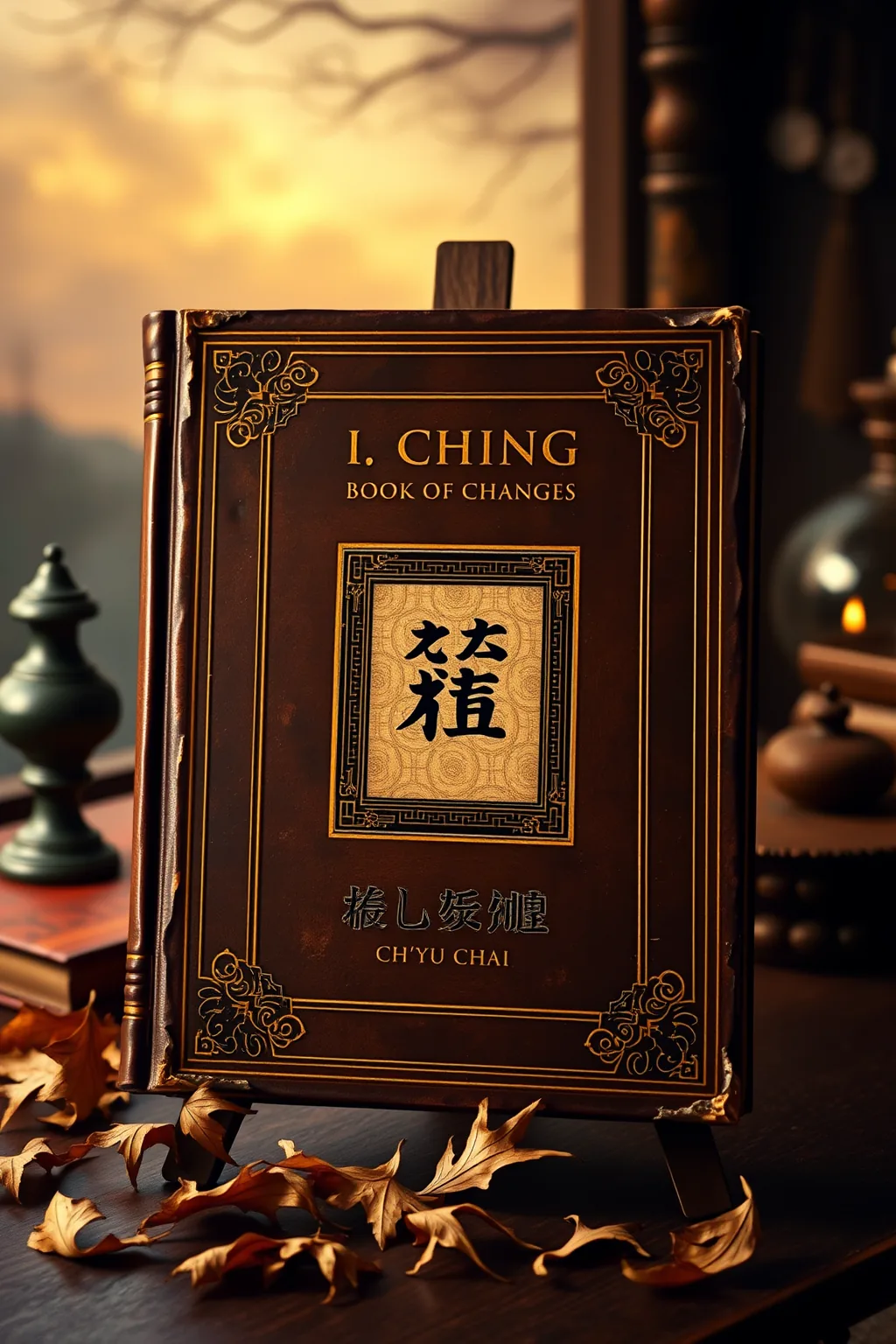
I ching book of changes
 61
61

I ching book of changes



Alaric Kestrel (Metaphysical Studies Reviewer) — The *I Ching: Book of Changes* by Ch'u Chai and Winberg Chai stands as a monumental contribution to Western understanding of this profound Eastern oracle. This edition masterfully unravels the complex symbolism of the hexagrams, presenting them not just as tools for divination, but as philosophical blueprints for navigating life's inherent transformations. The authors' scholarly yet accessible approach illuminates the esoteric insights woven into the text, making it invaluable for both seasoned practitioners and curious newcomers. Its strength lies in its clarity and faithful representation of the *I Ching's* core principles, offering a deeply resonant guide for self-discovery and spiritual alignment. An indispensable text for serious students of the occult and Eastern philosophies.
📝 Description
61
First published in 1964, this edition of the I Ching by Ch'u Chai and Winberg Chai translates the ancient Chinese text.
This edition of the I Ching: Book of Changes, translated by Ch'u Chai with Winberg Chai, presents the ancient Chinese text. It functions as a guide to understanding cosmic principles through its system of hexagrams. Each hexagram is built from yin and yang lines, representing different configurations of universal forces.
The book aims to help readers comprehend the interplay between destiny and personal choice. It provides a framework for navigating life's complexities. The translation preserves the original symbolism and contemplative tone, encouraging engagement with its philosophical content. It is intended for those interested in esoteric knowledge and spiritual understanding.
The I Ching, or Book of Changes, is a foundational text within Taoist philosophy and Chinese divination. Its origins date back over three millennia, making it one of the oldest continuously used books in the world. The text's system of 64 hexagrams, derived from combinations of six lines (broken for yin, solid for yang), is used to interpret situations and predict potential outcomes. It is not merely a fortune-telling device but a complex philosophical work that views the universe as being in constant flux, with hexagrams representing different phases of this change.
💡 Why Read This Book?
Uncover the ancient wisdom of the universe, gain profound self-awareness, and learn to navigate life's inevitable changes with grace and foresight. The *I Ching* offers a unique lens through which to understand causality, destiny, and personal agency. Ideal for spiritual seekers, philosophical scholars, and practitioners of divination seeking to deepen their connection to universal patterns and cosmic harmony.
⭐ Reader Reviews
Honest opinions from readers who have explored this book.
❓ Frequently Asked Questions
What is the primary purpose of the I Ching?
The *I Ching* serves as a profound source of wisdom for divination, ethical guidance, and philosophical contemplation, offering insights into the forces shaping existence and advising on the most auspicious course of action.
How are the hexagrams formed?
Hexagrams are formed by combining two trigrams, each consisting of three lines that are either solid (yang) or broken (yin). These 64 unique combinations represent archetypal situations and cosmic energies.
Is the I Ching only for fortune-telling?
While a powerful divinatory tool, the *I Ching* transcends mere fortune-telling. It is a philosophical text offering profound insights into human nature, societal dynamics, and the principles of cosmic order.
What is the role of yin and yang in the I Ching?
Yin (broken line) and yang (solid line) are fundamental dualistic forces representing complementary opposites. Their interplay within the hexagrams symbolizes the dynamic, ever-changing nature of reality.
Who are the authors and translators of this edition?
This edition is translated and presented by Ch'u Chai with Winberg Chai, offering a respected and accessible interpretation of this ancient text for modern readers.
🔮 Key Themes & Symbolism
The Dance of Yin and Yang
At the heart of the *I Ching* lies the intricate interplay of yin and yang, the primordial forces of darkness and light, passivity and activity, feminine and masculine. These opposing yet complementary energies are not static but are in constant motion, transforming into one another and creating the dynamic flux of the universe. Understanding their balance and movement is key to comprehending the ever-shifting circumstances of life and aligning oneself with the natural order.
Cycles of Change and Transformation
The *I Ching* is fundamentally a book of change. It illustrates that nothing is permanent and that all phenomena are subject to cyclical patterns of growth, decay, and renewal. By studying the 64 hexagrams, the reader learns to recognize these cycles, anticipate shifts in fortune, and adapt to changing conditions with wisdom and resilience. It teaches that challenges are temporary and opportunities arise from apparent setbacks, fostering a proactive and adaptable mindset.
The Oracle of Self-Knowledge
Beyond its divinatory function, the *I Ching* serves as a profound mirror for self-reflection. Each hexagram offers a symbolic representation of a situation, prompting the reader to examine their own attitudes, intentions, and actions. It encourages introspection, ethical consideration, and the cultivation of inner harmony. By consulting the *I Ching*, one seeks not just external answers but a deeper understanding of their own inner landscape and their place within the cosmic range.
💬 Memorable Quotes
Direct passages from the work, attributed to the author.
“The superior man acts before he speaks, and in so doing, he is acting in accordance with the principles of the Book of Changes.”
— This highlights the *I Ching's* emphasis on thoughtful action over impulsive speech, advocating for a deliberate approach guided by wisdom and cosmic alignment.
“The superior man is anxious to know what is right, and not what is profitable.”
— This emphasizes the ethical dimension of the *I Ching*, prioritizing moral conduct and integrity over material gain, guiding the reader towards righteous choices.
“Through the I Ching, the sage becomes one with Heaven and Earth.”
— This profound statement points to the ultimate goal of engaging with the *I Ching*: achieving a state of unity and profound connection with the fundamental principles of existence.
💡 Key Ideas
Editorial paraphrase of the work's core concepts — not direct quotes.
When one has attained clarity of purpose, one can then proceed to action.
This quote underscores the importance of inner clarity and intention as prerequisites for effective and meaningful action, a core tenet of the *I Ching's* philosophy.
The superior man understands that the forces of nature are not to be resisted, but to be understood and worked with.
This quote speaks to the *I Ching's* teaching on harmonizing with natural laws rather than opposing them, advocating for adaptability and flow.
🌙 Esoteric Significance
Tradition
The *I Ching* is deeply rooted in the philosophical and cosmological traditions of ancient China, particularly Taoism and Confucianism, but transcends them to touch upon universal esoteric principles. It is a prime example of hermetic wisdom, embodying the concept of 'as above, so below' and offering a framework for understanding the interconnectedness of all things through the fundamental forces of yin and yang.
Symbolism
The core symbolism lies in its 64 hexagrams, each a unique arrangement of six lines (yin or yang). These lines represent elemental forces, natural phenomena, human archetypes, and stages of transformation. The trigrams, the building blocks of hexagrams, further symbolize Heaven, Earth, Fire, Water, Thunder, Wind, Mountain, and Lake, providing a rich lexicon for interpreting the forces at play in any given situation.
Modern Relevance
In the modern era, the *I Ching* offers a powerful antidote to the fragmentation and uncertainty of contemporary life. It provides a timeless framework for ethical decision-making, personal growth, and navigating complex challenges. Its cyclical view of change speaks to ecological awareness, while its emphasis on mindfulness and inner harmony speaks to the growing interest in mental well-being and spiritual exploration in a fast-paced world.
👥 Who Should Read This Book
This revered text is essential for spiritual seekers yearning to understand the ebb and flow of life's energies. Scholars of Eastern philosophy and comparative religion will find it an indispensable primary source. Practitioners of divination, from novice to advanced, will discover a sophisticated system for gaining clear insights. Anyone seeking to cultivate wisdom, resilience, and a deeper connection to the cosmic order will find the *I Ching* to be an useful and life-altering companion.
📜 Historical Context
The *I Ching*, or *Book of Changes*, traces its origins to ancient China, with its earliest components dating back to the Western Zhou dynasty (c. 1046–771 BCE). It evolved over centuries, incorporating philosophical commentaries from Confucian scholars and Taoist mystics. During the Han dynasty (206 BCE–220 CE), it was established as one of the Five Classics of Confucianism, solidifying its place as a foundational text for Chinese thought, governance, and divination. Its influence extended far beyond China, impacting Korean, Japanese, and Vietnamese cultures, and later captivating Western intellectuals and mystics in the 20th century, becoming a touchstone for understanding Eastern philosophies and esoteric traditions.
📔 Journal Prompts
Reflect on a recent significant change in your life. Which *I Ching* hexagram(s) might best represent this transition, and why?
Consider a current dilemma. If you were to consult the *I Ching*, what question would you ask, and what do you anticipate its wisdom might reveal?
Explore the concept of balance between yin and yang in your daily life. Where do you find harmony, and where do you feel discord?
How does the *I Ching's* emphasis on transformation influence your perspective on challenges and setbacks?
Meditate on the symbolism of a specific hexagram that speaks to you. What personal lessons or insights does it offer?
🗂️ Glossary
Hexagram
A figure composed of six stacked horizontal lines, each line being either solid (yang) or broken (yin). There are 64 unique hexagrams in the *I Ching*, representing archetypal situations and cosmic principles.
Trigram
A figure composed of three stacked horizontal lines, each being either solid (yang) or broken (yin). There are eight basic trigrams, serving as the building blocks for the 64 hexagrams.
Yin
In the *I Ching*, represented by a broken line (— —). It symbolizes feminine, passive, dark, receptive, and yielding qualities. It is complementary to yang.
Yang
In the *I Ching*, represented by a solid line (—). It symbolizes masculine, active, light, creative, and assertive qualities. It is complementary to yin.
Oracle
A person or agency considered to be a source of wise counsel or prophetic predictions inspired by a deity or supernatural power. In this context, the *I Ching* itself functions as an oracle.
This book appears in 3 collections
🔮 Readers Also Liked
Browse all →







From the “I Ching” Collection
View all →








More Free Divination & Tarot Books
View all →