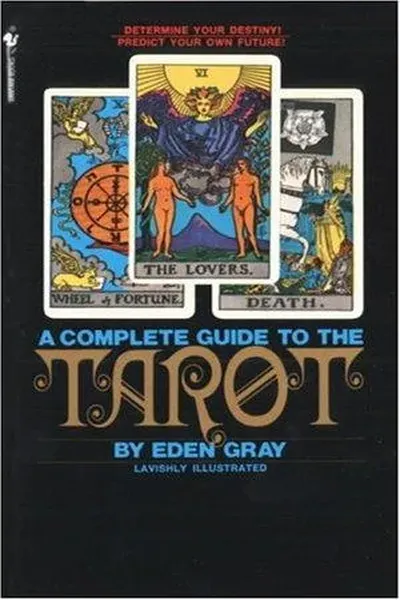
A complete guide to the tarot

 77
77

A complete guide to the tarot
Eden Gray's approach in "A Complete Guide to the Tarot" is admirably direct. The strength lies in its sheer comprehensiveness regarding the Rider-Waite-Smith deck, offering clear, if sometimes terse, interpretations for each card. It avoids the flowery language that often encumbers modern Tarot books, which is refreshing. However, this directness can also be a limitation; the explanations sometimes feel a bit too distilled, leaving little room for nuance or the intuitive leaps the cards often invite. For instance, the interpretation of The Tower often focuses solely on destruction without fully exploring the sudden illumination that can accompany such upheaval. This book provides a solid, no-nonsense framework for beginners, but seasoned readers might find themselves needing to supplement its insights with more interpretive material. It serves as a dependable lexicon rather than a philosophical treatise.
📝 Description
77
### What It Is This volume presents a foundational exploration of the Tarot, focusing on the Rider-Waite-Smith deck. It breaks down the meaning of each of the 78 cards, from the Major Arcana through the Minor Arcana's suits of Wands, Cups, Swords, and Pentacles. The work aims to provide a structured approach to understanding the symbolic language of the cards. It details divinatory meanings and offers guidance on interpreting card spreads.
### Who It's For This guide is intended for individuals new to Tarot, offering a clear entry point into its study. It suits those who prefer a systematic, traditional interpretation of card meanings. Readers seeking a comprehensive overview of the Rider-Waite-Smith system, without delving into highly esoteric or complex astrological correspondences, will find it useful. It's for the student who wants to build a solid understanding of core Tarot symbolism.
### Historical Context Published in 1970, Eden Gray's "A Complete Guide to the Tarot" emerged during a period of renewed interest in occultism and divination, particularly in the Western world. This era saw figures like Gerald Gardner popularizing Wicca and various esoteric traditions gaining traction outside academic circles. The book's focus on the widely adopted Rider-Waite-Smith deck, first published in 1909, positioned it as a practical manual for a growing community interested in practical application of Tarot for personal insight and fortune-telling. It followed in the wake of influential works by Arthur Edward Waite himself.
💡 Why Read This Book?
• Learn the specific meanings of all 78 Rider-Waite-Smith cards, as detailed by Eden Gray, providing a concrete foundation for interpretation. • Understand the structural breakdown of the Tarot into Major Arcana and the four suits (Wands, Cups, Swords, Pentacles), as explained in the book's early sections. • Gain practical methods for card interpretation and simple spreads, directly from the guide's instructional chapters, enabling immediate application.
⭐ Reader Reviews
Honest opinions from readers who have explored this book.
❓ Frequently Asked Questions
When was Eden Gray's 'A Complete Guide to the Tarot' first published?
Eden Gray's "A Complete Guide to the Tarot" was first published in 1970, a period marked by a resurgence of interest in esoteric studies and divination practices.
What Tarot deck does this guide primarily focus on?
The book primarily focuses on the Rider-Waite-Smith Tarot deck, detailing the meanings and symbolism of its 78 cards, including the Major and Minor Arcana.
Is 'A Complete Guide to the Tarot' suitable for absolute beginners?
Yes, it is highly suitable for absolute beginners due to its clear, structured approach to explaining card meanings and basic divination techniques.
Does the book cover advanced Tarot techniques?
While it provides a solid foundation, the book's primary focus is on fundamental meanings and basic spreads, rather than highly advanced or specialized techniques.
What is the historical significance of the Rider-Waite-Smith deck mentioned in the book?
The Rider-Waite-Smith deck, first published in 1909, revolutionized Tarot by featuring illustrated scenes on all Minor Arcana cards, making them more intuitive to interpret than earlier decks.
How does Eden Gray explain the symbolism of the Tarot cards?
Eden Gray explains Tarot symbolism through straightforward interpretations of each card's imagery and numerological associations, aiming for clarity and practical understanding.
🔮 Key Themes & Symbolism
Rider-Waite-Smith Symbolism
The work meticulously details the imagery and associated meanings of the 78 cards within the Rider-Waite-Smith Tarot deck. This system, influential since its 1909 debut, is presented as a coherent symbolic language. Gray breaks down the archetypal figures of the Major Arcana, such as The Fool and The Hierophant, and the elemental narratives of the Minor Arcana suits: Wands for action and creativity, Cups for emotion and relationships, Swords for intellect and conflict, and Pentacles for the material world and manifestation. Each card's visual cues are linked directly to its divinatory interpretation, making the deck's inherent symbolism accessible.
Divinatory Applications
Beyond mere card definitions, "A Complete Guide to the Tarot" provides practical instruction on using the cards for divination. It outlines the fundamental process of posing questions and interpreting the resulting spread. The book introduces several common layouts, such as the one-card draw for daily insight and the more complex Celtic Cross spread, explaining how the positions within a spread modify a card's meaning. This focus on application empowers readers to engage with the Tarot as a tool for self-reflection and foresight.
Card Interpretation Framework
Gray offers a structured methodology for understanding Tarot readings. This framework emphasizes the interconnectedness of cards within a spread and the importance of considering both upright and reversed meanings (though her interpretations often lean towards the former). The guide encourages readers to build their interpretation by synthesizing the individual meanings of each card, creating a narrative flow that addresses the querent's query. This systematic approach serves as a bedrock for developing one's own intuitive reading style.
The Esoteric Path
While presented as a practical guide, the book implicitly points towards the Tarot as a pathway to esoteric understanding. The archetypes and symbols within the cards can be seen as representations of universal forces and human experiences, aligning with broader Hermetic principles of correspondence. The journey through the Major Arcana, from The Fool's innocent beginning to The World's completion, suggests a process of spiritual or psychological evolution. The book serves as an accessible entry point into this deeper, symbolic understanding of life.
💬 Memorable Quotes
“The Fool represents new beginnings, spontaneity, and the leap of faith.”
— This concise statement captures the essence of The Fool card, highlighting its connection to embarking on uncharted paths and embracing the unknown with trust.
“The Magician signifies power, skill, and the manifestation of potential.”
— This interpretation emphasizes the active, focused energy of The Magician, pointing to the individual's ability to harness resources and bring ideas into tangible form.
“Cups represent emotions, relationships, and intuition.”
— This succinctly defines the domain of the Cups suit, linking it to the realm of feelings, interpersonal connections, and the subtle guidance of inner knowing.
“Swords are associated with thought, conflict, and truth.”
— This highlights the intellectual and often challenging nature of the Swords suit, connecting it to mental processes, struggles, and the pursuit of clarity.
“The Celtic Cross spread involves ten cards revealing different aspects of a situation.”
— This describes a specific, widely-used Tarot spread, indicating its complexity and its function in providing a multifaceted overview of a query.
🌙 Esoteric Significance
Tradition
This work aligns primarily with the Western Esoteric tradition, specifically as it pertains to the popularization of Tarot within a divinatory context. It draws heavily from the symbolism established by the Hermetic Order of the Golden Dawn through its members Arthur Edward Waite and Pamela Colman Smith. Gray's contribution is in making this intricate system accessible, presenting the cards as a structured symbolic language for personal insight rather than solely as a tool for ceremonial magic or complex Kabbalistic mapping.
Symbolism
Key symbols explored include the archetypal figures of the Major Arcana, such as The Hierophant representing tradition and spiritual authority, and The Chariot signifying willpower and control. The four suits of the Minor Arcana are also central: Wands embody creative fire and inspiration, Cups represent emotional flow and connection, Swords denote mental clarity and struggle, and Pentacles symbolize earthly matters and material security. The book guides readers to interpret these symbols within their specific card contexts and spread positions.
Modern Relevance
Contemporary Tarot practitioners, particularly those who favor the Rider-Waite-Smith deck, continue to rely on Gray's foundational interpretations. Her clear, direct approach serves as a common reference point for learning basic card meanings. Modern intuitive readers and those exploring psychological archetypes through Tarot often start with Gray's framework before developing more complex, personalized systems or integrating influences from Jungian psychology or other esoteric disciplines.
👥 Who Should Read This Book
• Beginning Tarot students seeking a clear, structured introduction to the Rider-Waite-Smith deck's meanings and basic interpretation methods. • Individuals interested in practical divination tools for self-reflection and guidance, who appreciate a direct, no-nonsense approach. • Comparative occultism researchers looking to understand foundational texts that shaped modern Tarot practice from the late 20th century onwards.
📜 Historical Context
Eden Gray's "A Complete Guide to the Tarot," released in 1970, arrived amidst a flourishing counter-culture movement that embraced mysticism and alternative spiritualities. This era saw a significant public engagement with occult traditions, partly fueled by figures like Timothy Leary exploring consciousness and the wider dissemination of Eastern philosophies. The book's pragmatic focus on the Rider-Waite-Smith deck, itself a product of early 20th-century occult revivalists Arthur Edward Waite and Pamela Colman Smith, made it a highly accessible manual. It offered a clear alternative to more academic or esoteric interpretations prevalent in earlier occult literature. While Waite himself was a prominent member of the Hermetic Order of the Golden Dawn, Gray's work democratized access to the deck's symbolism for a broader audience, distinct from the more specialized circles that might have engaged with Aleister Crowley's Thoth Tarot, for example.
📔 Journal Prompts
The Fool's journey through the Major Arcana: Map your own symbolic progression.
Reflect on the elemental associations of the Cups suit in your emotional landscape.
Analyze the role of Swords imagery in understanding a recent conflict or decision.
Consider the Pentacles' representation of manifestation in your daily life.
How does The Hierophant's symbolism inform your understanding of tradition?
🗂️ Glossary
Major Arcana
The 22 trump cards of the Tarot deck, representing significant life lessons, spiritual archetypes, and major life events. They often signify the overarching themes of a reading.
Minor Arcana
The 56 cards of the Tarot deck, divided into four suits (Wands, Cups, Swords, Pentacles). They typically represent the everyday events, challenges, and circumstances of life.
Wands
A suit in the Minor Arcana, associated with fire, creativity, passion, inspiration, action, and beginnings. It relates to energy, ambition, and the will.
Cups
A suit in the Minor Arcana, associated with water, emotions, relationships, intuition, love, and feelings. It governs the realm of the heart and emotional well-being.
Swords
A suit in the Minor Arcana, associated with air, intellect, thoughts, challenges, conflict, truth, and communication. It relates to the mind and mental processes.
Pentacles
A suit in the Minor Arcana, associated with earth, material possessions, finances, work, health, and the physical world. It governs practicality and manifestation.
Rider-Waite-Smith Deck
A highly influential Tarot deck first published in 1909, known for its fully illustrated Minor Arcana cards and rich symbolism, designed by Arthur Edward Waite and illustrated by Pamela Colman Smith.