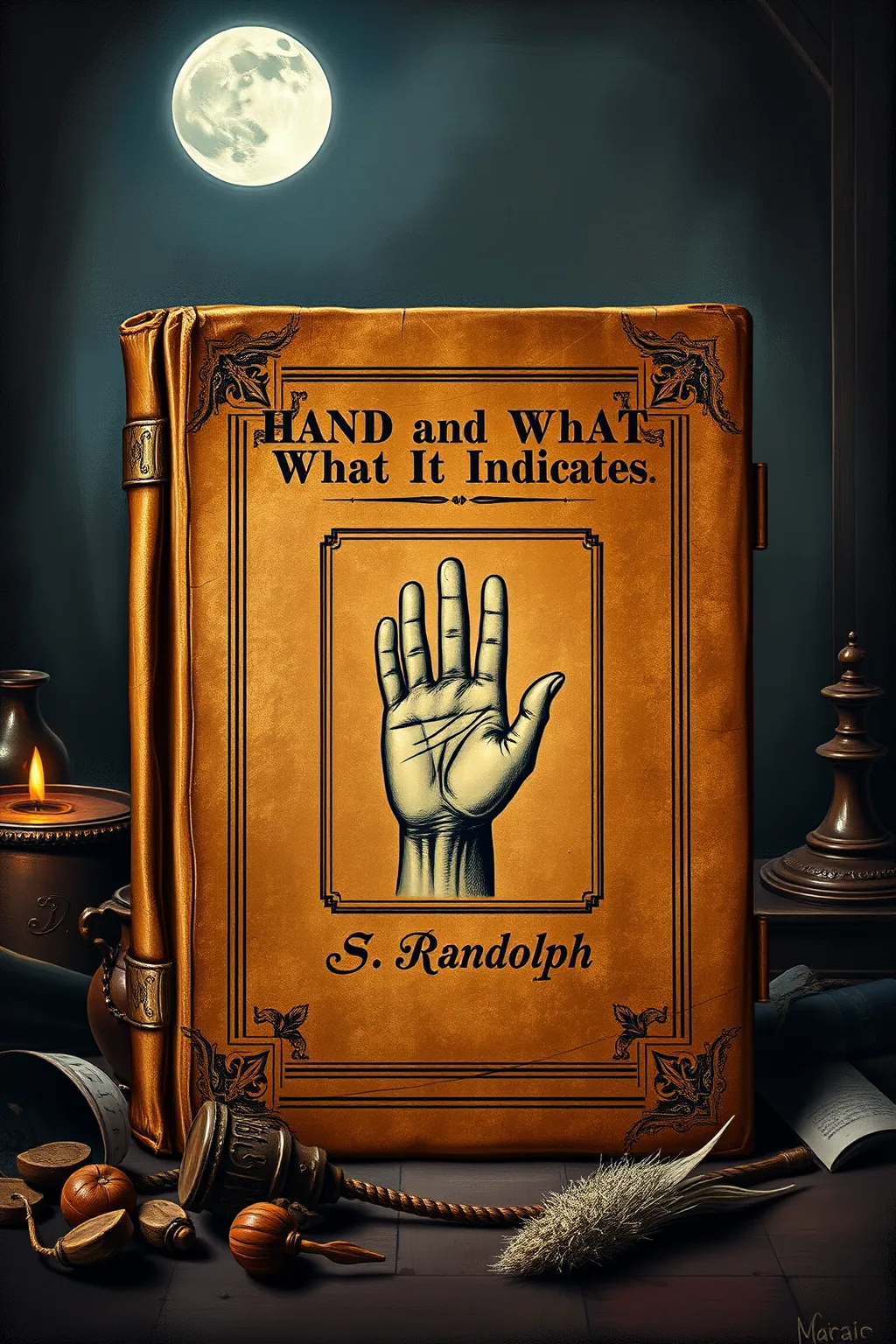
Hand and What It Indicates
 61
61

Hand and What It Indicates



Celeste Moreau, Divination & Symbolism Reviewer: S. Randolph’s “Hand and What It Indicates” stands as a cornerstone in the study of chiromancy, offering an unparalleled depth of esoteric insight. Randolph meticulously dissects the palm, not as a mere predictive tool, but as a living testament to the soul’s journey and the energetic blueprint of an individual. His prose, rich with symbolic resonance, guides the reader through the intricate interplay of lines and mounts, revealing profound truths about character, karmic patterns, and latent abilities. This text is indispensable for serious students of occult sciences and those seeking a holistic understanding of the hand’s sacred geometry. It transcends simple prognostication, offering a pathway to self-mastery through ancient, hidden knowledge.
📝 Description
61
S. Randolph's 1927 "Hand and What It Indicates" deciphers the palm as a map of human potential.
This 1927 book by S. Randolph examines palmistry, not as simple fortune-telling, but as a method for understanding character and innate abilities. Randolph details the significance of the hand's mounts, lines, and fingers, interpreting them as symbolic representations. The text guides readers to view the palm as a reflection of both individual nature and broader cosmic principles. It encourages a deeper self-awareness by connecting the physical form of the hand to inner states and life paths. The author aims to move beyond superficial predictions, focusing instead on the philosophical dimensions of self-knowledge and the interconnectedness of all things.
The work invites readers to consider the hand as a complex language. Randolph systematically breaks down the different elements of the palm, explaining their symbolic meanings. The intention is to provide a framework for personal insight, linking the physical markings to psychological traits and life trajectories. It is presented as a tool for serious study, rather than casual amusement, fostering a contemplative approach to understanding oneself and one's place in the world.
Published in 1927, "Hand and What It Indicates" aligns with the resurgence of interest in esoteric subjects during the early 20th century. This period saw a renewed engagement with hermeticism, astrology, and divination practices. Randolph's approach to palmistry fits within this milieu, treating the hand as a vehicle for understanding deeper spiritual and psychological truths, rather than merely a tool for predicting future events. It reflects a lineage of thought that seeks correspondence between the human body and the cosmos, a common theme in Western esotericism.
💡 Why Read This Book?
Unlock the secrets of your destiny and inner landscape. "Hand and What It Indicates" offers a profound exploration of palmistry as a mystical science, revealing hidden truths about character, potential, and life's journey. Ideal for spiritual seekers, practicing occultists, and scholars of ancient divination arts who desire a deeper connection to esoteric wisdom.
⭐ Reader Reviews
Honest opinions from readers who have explored this book.
❓ Frequently Asked Questions
What is chiromancy and its origins?
Chiromancy, or palmistry, is the ancient art of divining character and predicting future events through the study of the palm. Its origins are lost in antiquity, with roots found in Indian Vedic traditions and ancient Greek philosophies, later spreading across Asia and Europe.
How does the book explain the significance of hand shapes?
The book categorizes hand shapes (e.g., spatulate, conic, square) and links them to distinct elemental energies and core personality archetypes, providing a foundational understanding of an individual's inherent nature before delving into line analysis.
What are the main lines of the palm discussed in the book?
The primary focus is on the Life Line, Head Line, Heart Line, and Fate Line, with detailed explanations of their variations, breaks, and symbolic meanings, indicating major life events, mental faculties, emotional disposition, and destiny.
Can this book be used for self-discovery?
Absolutely. Randolph’s work encourages introspection, allowing readers to interpret their own palms for profound self-awareness, understanding their strengths, challenges, and the potential pathways available to them.
Is this book suitable for beginners in palmistry?
Yes, while rich in esoteric detail, the book is structured to guide beginners through the fundamentals, gradually introducing more complex interpretations, making it accessible yet deeply rewarding for newcomers to the art.
🔮 Key Themes & Symbolism
The Hand as a Cosmic Mirror
This theme explores the profound concept of the hand as a microcosm, reflecting the grand collection of the universe and the individual's place within it. Randolph posits that the intricate markings on the palm are not random but are divinely inscribed symbols, echoing celestial configurations and karmic imprints. It looks at the ancient Hermetic principle of 'As Above, So Below,' illustrating how the energies and patterns visible on the hand correspond to the larger energetic flows and destinies of existence. This perspective elevates palmistry from mere fortune-telling to a sacred practice of understanding one's soul's blueprint and its connection to the universal consciousness, encouraging a deeper, more philosophical engagement with the self.
Decoding the Language of Lines and Mounts
Central to Randolph's exploration is the meticulous deciphering of the palm's topography. This theme focuses on the symbolic language of the major and minor lines, each representing distinct facets of human experience – from life force and intellect to emotion and destiny. Equally important are the mounts, the fleshy elevations on the palm, which are understood as centers of planetary influence and specific character traits. The book teaches how to interpret the interplay between these elements, revealing the nuanced expression of personality, potential talents, inherent challenges, and the unfolding narrative of an individual's life journey, offering a comprehensive interpretive framework.
Palmistry as a Path to Self-Mastery
Beyond prediction, "Hand and What It Indicates" champions palmistry as a potent tool for personal growth and self-mastery. This theme emphasizes how understanding the revelations within one's palm empowers individuals to navigate life's complexities with greater awareness and intention. By recognizing ingrained patterns, latent abilities, and potential pitfalls, the reader can consciously make choices that align with their highest purpose and mitigate challenges. Randolph's approach encourages a proactive engagement with one's destiny, transforming passive reception of fate into active co-creation, thereby fostering resilience, wisdom, and a profound sense of agency in shaping one's life path.
💬 Memorable Quotes
Direct passages from the work, attributed to the author.
“Each line a whisper of fate, each mount a strong example of character.”
— This evokes the dual nature of palmistry as explored in the book – predicting future events while simultaneously revealing the inherent qualities of the individual.
“To read the hand is to read the soul's silent narrative.”
— This emphasizes the introspective and deeply personal aspect of chiromancy, suggesting it offers useful insights into one's inner being and life's purpose.
“The map of your life is held within your palm.”
— A direct and evocative statement about the guiding and revealing nature of the hand in understanding one's personal journey and potential.
“Knowledge of the hand grants knowledge of the self.”
— This expresses the book's ultimate aim: using the art of palmistry as a pathway to profound self-awareness and understanding.
💡 Key Ideas
Editorial paraphrase of the work's core concepts — not direct quotes.
The hand is a living parchment, etched by the cosmos.
This quote highlights the book's core philosophy: that the palm is not merely flesh and bone, but a sacred text imprinted with cosmic energies and destinies.
🌙 Esoteric Significance
Tradition
This work is deeply rooted in the Hermetic and Neoplatonic traditions, which view the cosmos and humanity as interconnected energetic systems. It draws upon ancient Vedic chiromancy and integrates it with Western occult philosophies, seeing the hand as a microcosm mirroring the macrocosm. The esoteric significance lies in its presentation of palmistry not just as a predictive art, but as a form of applied metaphysics, revealing the soul's journey and its energetic blueprint through symbolic interpretation.
Symbolism
The symbolism in "Hand and What It Indicates" is rich and layered. Lines represent flows of energy and life events (e.g., the Heart Line symbolizing emotional currents, the Head Line representing intellectual pathways). Mounts are interpreted as planetary influences (e.g., Mount of Venus for love and passion, Mount of Jupiter for ambition and leadership). Fingers can symbolize different aspects of the self or elemental forces. The overall symbolism aims to bridge the visible physical hand with the invisible energetic and spiritual forces that shape existence.
Modern Relevance
In an age often characterized by digital detachment and existential questioning, "Hand and What It Indicates" offers a profound reconnection to ancient wisdom and self-awareness. Its emphasis on the hand as a personal, tangible map provides a grounding counterpoint to abstract digital information. The book's insights into character, potential, and life's patterns remain remarkably relevant for personal development, mindfulness practices, and understanding human psychology from an esoteric perspective, guiding individuals toward greater self-understanding and intentional living.
👥 Who Should Read This Book
This foundational text is essential for aspiring palmists seeking a comprehensive understanding of chiromancy. It will deeply resonate with occult scholars interested in the history and practice of divination, and spiritual seekers looking for tools for self-discovery and personal growth. Practitioners of other esoteric arts, such as Tarot readers or astrologers, will find it an invaluable complement, offering a unique perspective on the energetic blueprint of an individual. Beginners will find its structure accessible, while advanced practitioners will appreciate its depth and nuanced interpretations.
📜 Historical Context
Written during a period of intense interest in esoteric knowledge and spiritualism, "Hand and What It Indicates" by S. Randolph emerged in the late 19th or early 20th century, a time when the veil between the material and metaphysical seemed to thin. This era saw a resurgence of occult studies, with figures like Madame Blavatsky and Arthur Edward Waite popularizing ancient wisdom traditions. Palmistry, alongside Tarot and astrology, was embraced by many seeking deeper meaning and guidance beyond conventional religious and scientific frameworks. Randolph's work fits within this milieu, contributing to a growing body of literature that aimed to systematize and disseminate these ancient arts for a modern, often spiritually seeking, audience. It reflects a desire to find order and predictability in a rapidly changing world through the lens of timeless, hidden lore.
📔 Journal Prompts
Reflect on the shape of your dominant hand. What elemental qualities does it suggest, and how do these manifest in your daily life?
Trace your Life Line. What major periods of change or vitality does it seem to indicate, and how have you experienced these?
Examine your Head Line. Does it run straight, slope downwards, or break? How does this relate to your thinking patterns and intellectual pursuits?
Consider the story your Heart Line tells. What does its depth, clarity, or any branching suggest about your emotional landscape and relationships?
Meditate on your Fate Line. If present, how does it connect to your sense of purpose and direction in life, and what forces seem to influence it?
🗂️ Glossary
Chiromancy
The practice of divination through the study of the palm, including its lines, mounts, and shape. It is often referred to synonymously with palmistry.
Mounts
The fleshy, raised areas on the palm, each associated with a specific planet and corresponding character traits or energies (e.g., Mount of Venus, Mount of Jupiter).
Phalanges
The segments of the fingers, each of which can carry symbolic meaning in palmistry, often related to specific attributes or stages of life.
Traces
Minor lines or markings on the palm that often qualify or elaborate on the meaning of the major lines, providing nuanced interpretations of events or characteristics.
Elemental Hands
A classification of hand shapes (e.g., Fire, Air, Water, Earth) based on their proportions, correlating them with fundamental personality archetypes and temperaments.
This book appears in 1 collection
🔮 Readers Also Liked
Browse all →








From the “Palmistry” Collection
View all →








More Free Divination & Tarot Books
View all →