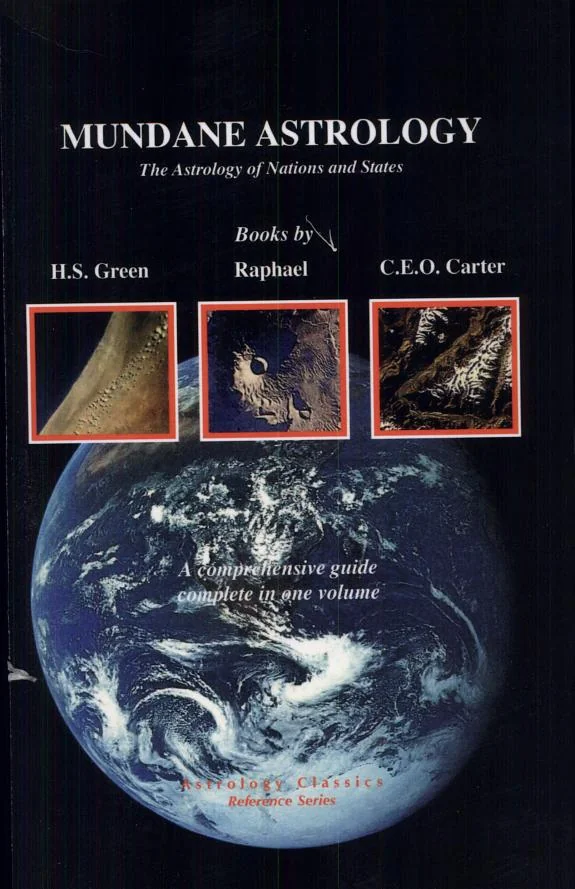
Mundane Astrology: The Astrology of Nations and States
 75
75

Mundane Astrology: The Astrology of Nations and States
The confluence of Green, Carter, and Raphael in *Mundane Astrology* presents a formidable resource for those examining the astrological underpinnings of national destinies. Green's planet-by-planet breakdown, while systematic, can feel somewhat detached from the dynamic interplay of forces. Carter and Raphael, however, offer a more integrated perspective, particularly Raphael's house-centric approach, which illuminates how terrestrial spheres of influence are activated by celestial ingress. The discussions on eclipses and earthquakes, while dated in their specific predictive frameworks, are historically significant for demonstrating the breadth of astrological inquiry into collective events. Its primary limitation lies in the sheer density of information, requiring dedicated study rather than casual perusal. The work's enduring strength is its comprehensive scope on a specialized, yet crucial, area of astrological practice.
📝 Description
75
This 2005 compilation gathers three 20th-century texts on the astrology of nations and states.
Mundane Astrology: The Astrology of Nations and States brings together three key works on the astrological interpretation of geopolitical events. H.S. Green presents a system based on planetary influences across the twelve houses. Charles E. O. Carter and Raphael offer their analyses, with Raphael focusing on planetary positions within specific houses. The book discusses how astrological events, such as eclipses, might correlate with terrestrial occurrences like seismic activity.
This collection is suited for students of traditional astrology who focus on historical or societal applications. It will interest those researching the astrological factors behind national events and leadership, as well as practitioners looking to grasp larger cosmic patterns affecting collective human experience. Historians of esotericism will also find value in its examination of astrological principles as applied in the early 20th century.
These essays emerged from a period in the early to mid-20th century when interest in esoteric subjects revived. Authors like H.S. Green, Charles E. O. Carter, and Raphael (Richard Stokes) were active in a movement that sought to apply astrological concepts to macro-level phenomena. This approach aimed to integrate astrology with a rational worldview, extending its application beyond individual horoscopes to encompass societal and national matters. Their work reflects a broader trend among occultists and astrologers of that time to systematize and modernize ancient traditions.
💡 Why Read This Book?
• Understand the planetary influences mapped across the twelve houses, as detailed by H.S. Green, to grasp how specific celestial energies might correlate with different societal domains. • Learn Raphael's method of analyzing mundane houses when planets occupy them, offering a distinct framework for interpreting global events tied to specific geographical or political spheres. • Explore the astrological interpretations of solar and lunar eclipses and their connection to earthquakes, as presented by both Green and Raphael, providing a historical perspective on disaster astrology.
⭐ Reader Reviews
Honest opinions from readers who have explored this book.
❓ Frequently Asked Questions
What specific historical periods does Mundane Astrology focus on?
While the book was compiled in 2005, the original texts by Green, Carter, and Raphael originate from the early to mid-20th century, reflecting astrological interpretations and world events of that era.
How does this book differ from personal horoscopes?
This book shifts the focus from individual charts to the astrological configurations of nations and states, analyzing collective events like wars, political shifts, and natural disasters.
Are the predictive methods in Mundane Astrology still relevant today?
The core principles of mundane astrology remain relevant for understanding collective dynamics, though specific predictive techniques may require adaptation to contemporary astrological thought and global contexts.
What is the astrological significance of eclipses discussed in the book?
The book explores how solar and lunar eclipses, when considered in relation to national charts or world events, are interpreted as portents of significant societal changes or upheavals.
Who were the primary authors contributing to this volume?
The primary authors are H.S. Green, Charles E. O. Carter, and Raphael (Richard Stokes), all notable figures in early to mid-20th-century astrological circles.
Does the book offer practical techniques for analyzing national charts?
Yes, it provides detailed methodologies, including planetary placements in houses and the interpretation of eclipses, for analyzing the astrological dynamics of nations and states.
🔮 Key Themes & Symbolism
Planetary House Dignities
The work meticulously details the influence of each planet as it transits through the twelve houses of a mundane chart. For instance, understanding Mars in the 10th house for a nation might signify periods of overt governmental action or conflict, whereas Jupiter in the 4th could suggest national prosperity rooted in its land or domestic policies. This systematic approach provides a framework for correlating celestial positions with terrestrial events and national characteristics.
Eclipse and Ingress Interpretation
A central theme is the astrological significance of solar and lunar eclipses, as well as planetary ingresses into zodiacal signs, when they occur in relation to the charts of nations. These events are often viewed as critical turning points, signaling periods of intense change, crisis, or significant developments that affect the populace and the state's trajectory.
National Chart Foundations
The book implicitly or explicitly engages with the concept of a 'national chart,' often derived from a country's independence date or founding moment. Analyzing the planetary positions and aspects within these foundational charts allows for an understanding of a nation's inherent strengths, challenges, and long-term destiny, providing a backdrop against which transits and progressions are interpreted.
Earthquakes and Terrestrial Events
Beyond political and social phenomena, the authors explore the correlation between specific astrological configurations, particularly eclipses and planetary alignments, and major natural disasters such as earthquakes. This demonstrates a comprehensive view of mundane astrology's scope, linking celestial patterns to seismic activity and other large-scale terrestrial events.
💬 Memorable Quotes
Direct passages from the work, attributed to the author.
“The effect of the planets in the houses is generally to be understood as ruling the affairs of the native belonging to the house.”
— This foundational statement emphasizes the house system as a framework for understanding how planetary energies manifest in specific areas of life, whether individual or collective, as applied in mundane astrology to national affairs.
“The solar eclipse is of great importance in mundane astrology.”
— This highlights the critical role eclipses play in astrological interpretations of national events, suggesting they act as significant markers or catalysts for change on a global or state level.
“The lunation following the eclipse is also important.”
— This points to the ongoing influence of celestial events, indicating that the astrological impact of an eclipse is further elaborated and potentially modified by the subsequent New Moon (lunation).
“The Ascendant and Midheaven are key points in any chart.”
— This reflects the fundamental astrological principle that the angles of a chart, the Ascendant (AC) and Midheaven (MC), hold significant weight in interpreting the overall dynamics and expression of the entity represented by the chart.
💡 Key Ideas
Editorial paraphrase of the work's core concepts — not direct quotes.
The position of the planets in the twelve houses of a nation’s chart signifies the general character of the nation.
This paraphrase captures the essence of how planetary placements within the houses of a country's astrological chart are used to define its core identity, strengths, and potential challenges.
🌙 Esoteric Significance
Tradition
This work firmly sits within the Western Esoteric Tradition, specifically drawing from Hermetic and Astrological lineages. It extends the application of traditional astrology, often focused on individual horoscopes, into the area of Mundane Astrology, a practice with ancient roots but significantly developed in the early 20th century by figures associated with the occult revival.
Symbolism
Key symbols include the twelve zodiacal signs and the seven classical planets, each imbued with traditional astrological meanings. Their placement within the twelve houses of a nation's chart represents the symbolic distribution of cosmic energies across different spheres of national life, from government (10th house) to populace (1st house) and resources (2nd house). Eclipses function as potent symbols of disruption and change.
Modern Relevance
Contemporary practitioners of political and mundane astrology, researchers of historical esotericism, and those interested in synchronicity and macro-level societal patterns continue to reference these foundational texts. The work provides a historical framework for understanding how astrological principles were applied to geopolitical analysis before the advent of widespread digital astrology tools.
👥 Who Should Read This Book
• Students of traditional astrology seeking to expand their knowledge beyond natal interpretation to understand the astrological influences on national and global events. • Historians of esotericism interested in the practical applications of occult philosophies during the early 20th century and their engagement with societal phenomena. • Comparative religion and sociology scholars exploring the historical role of divination and cosmological systems in understanding collective human experience and historical movements.
📜 Historical Context
The collected works in *Mundane Astrology* emerge from the fertile ground of early to mid-20th-century esoteric revivalism. This period saw a significant resurgence of interest in occult studies, fueled by intellectual currents that sought to reconcile ancient wisdom with modern science. Figures like Aleister Crowley and organizations such as the Hermetic Order of the Golden Dawn were actively reinterpreting and disseminating esoteric knowledge. H.S. Green, Charles E. O. Carter, and Raphael (Richard Stokes) were active participants in this milieu, contributing to a burgeoning field of astrology that sought to apply its principles beyond the individual to the collective sphere of nations and world events. This work distinguished itself from purely psychological astrology, which was gaining traction, by focusing on macro-level societal and political phenomena. The intellectual climate encouraged such broad applications, though often faced skepticism from the established scientific community.
📔 Journal Prompts
The planetary influence on the 10th house of a nation’s chart.
The symbolic meaning of a solar eclipse in mundane astrology.
Raphael's approach to house interpretation in national horoscopes.
The correlation between celestial events and terrestrial phenomena like earthquakes.
H.S. Green's planet-by-planet analysis of mundane influences.
🗂️ Glossary
Mundane Astrology
The branch of astrology concerned with the forecasting and interpretation of events on a national and international scale, including politics, economics, and natural disasters.
House System
A method of dividing the celestial sphere into twelve sections (houses), each representing different areas of life or experience, used in both natal and mundane astrology.
Solar Eclipse
An astronomical event where the Moon passes between the Sun and Earth, obscuring the Sun. In astrology, it is often seen as a potent indicator of significant change.
Lunar Eclipse
An astronomical event where the Earth passes between the Sun and Moon, casting a shadow on the Moon. In astrology, it is typically viewed as an indicator of emotional or public shifts.
Ingress
The moment a planet or key thinker enters a new zodiacal sign. Astrologers often interpret ingresses as marking shifts in planetary influence or thematic periods.
Ascendant (AC)
The zodiacal sign and degree rising on the eastern horizon at the moment of birth or the founding of an entity; considered a primary point of identity and outward presentation.
Midheaven (MC)
The highest point in the ecliptic at the moment of birth or founding; associated with career, public reputation, and ultimate goals.
This book appears in 2 collections
🔮 Readers Also Liked
Browse all →
![Mr. Patridge's [sic] judgement and opinion of this frost. Foretelling how long it is like to continue, according to the rules of astrology. ... 1709](/img/thumb/mr-patridge-s-sic-judgement-and-opinion-of-this-frost-foretelling-how-long-it-is-like-to-continue-according-to-the-rules-of-astrology-1709-patridge-mr.webp)
![[ Stephen Arroyo] Astrology](/img/thumb/stephen-arroyo-astrology.webp)





From the “Astrology” Collection
View all →







More Free Astrology & Cosmology Books
View all →