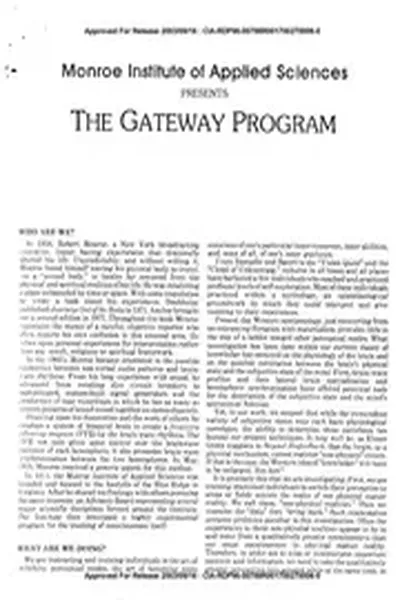
CIA Reading Room cia-rdp96-00787r000200080024-8: SKEPTICS CRITICIZED ON PARANORMAL ISSUE

 84
84

CIA Reading Room cia-rdp96-00787r000200080024-8: SKEPTICS CRITICIZED ON PARANORMAL ISSUE


By Ophelia Vance (Mystical Literature Reviewer) — This declassified report offers a bracing intellectual challenge, dissecting the critical failures within paranormal research movements. Dr. Marcello Truzzi's critique of his former colleagues serves as a potent reminder that genuine inquiry requires open-mindedness, not just skepticism. The document probes the philosophical underpinnings of how we approach the 'occult and U.F.O. phenomena,' urging scientists to confront their own biases. For students of parapsychology and esoteric thought, this text provides valuable context on the historical discourse surrounding anomalous experiences and the often-contentious path toward their understanding. It’s a vital piece for anyone seeking a nuanced perspective on the edges of reality.
📝 Description
84
This 1977 CIA document criticizes skeptics for their dismissal of paranormal claims.
The document, titled 'Skeptics Criticized on Paranormal Issue,' originates from the CIA's classified archives. It addresses the conflict between scientific skepticism and reported paranormal phenomena. The text analyzes the divisions within the study of psychic events, UFO sightings, and other unexplained occurrences.
It discusses the tension between rigorous questioning and automatic rejection of such claims. The author questions the basis of skepticism when faced with anomalies that standard scientific models cannot explain. For readers interested in esoteric philosophy, this document provides insight into how seemingly inexplicable events were analyzed within official circles. It encourages thought about the boundaries of human comprehension and the broader scope of consciousness and reality.
This report engages with the broader historical discussion on phenomena that lie outside mainstream scientific acceptance. It touches upon themes relevant to parapsychology and the study of anomalous experiences, areas often associated with esoteric traditions. The document's focus on the critical evaluation of evidence for the unexplained aligns with a long-standing interest in discerning truth from misinterpretation in unconventional fields.
💡 Why Read This Book?
This document challenges the rigid boundaries of mainstream skepticism, urging a more open and rigorous investigation into paranormal phenomena. It's essential for seekers of hidden knowledge, scholars of anomalous experiences, and practitioners who understand the subtle energies and phenomena that exist beyond empirical verification. Read it to sharpen your critical thinking and expand your understanding of the unexplained.
⭐ Reader Reviews
Honest opinions from readers who have explored this book.
❓ Frequently Asked Questions
What is the core argument of this document?
The document criticizes skeptical movements for becoming overly focused on disproving paranormal reports rather than conducting fair and open investigations into them, as argued by sociologist Dr. Marcello Truzzi.
Who is Dr. Marcello Truzzi?
Dr. Marcello Truzzi is a sociologist of science who was instrumental in initiating campaigns to investigate paranormal phenomena but later diverged from his colleagues over their approach.
What types of phenomena are discussed?
The text specifically mentions 'occult and U.F.O. phenomena,' suggesting a broad scope of anomalous occurrences that defy conventional scientific understanding.
What is the significance of the 'CIA Reading Room' designation?
This designation indicates the document originated from or was reviewed by the CIA, suggesting its content was considered of potential interest for intelligence or informational purposes, adding a layer of intrigue.
Is this a scientific paper or a historical document?
It functions as both a historical document, shedding light on a specific intellectual debate, and a piece that engages with scientific and philosophical arguments concerning anomalous phenomena.
🔮 Key Themes & Symbolism
The Nature of Skepticism
This theme dissects the role and potential pitfalls of skepticism in the face of unexplained phenomena. It explores how a rigid adherence to doubt can obstruct the path of genuine discovery, contrasting it with a more open yet critical approach. The document questions whether skepticism, when wielded as a weapon of dismissal, becomes a barrier to understanding the full spectrum of reality, including the subtle and the extraordinary. It prompts reflection on the intellectual courage required to examine claims that lie outside established paradigms.
Investigating the Unseen
This theme centers on the methodologies and challenges of investigating phenomena that fall outside conventional scientific purview, such as occult and U.F.O. reports. It highlights the tension between the desire to understand the unknown and the institutional resistance or biases that often accompany such investigations. The text implies that a truly scientific approach must be adaptable and willing to consider evidence, even if it challenges current understanding. It underscores the importance of fair inquiry and the potential for significant discoveries if the unseen is approached with intellectual integrity.
The Sociological Lens on Science
Examining the work of Dr. Marcello Truzzi, this theme studies the sociological dynamics that shape scientific discourse, particularly concerning controversial subjects. It illustrates how the social and intellectual currents within a scientific community can influence the direction and acceptance of research. The document implicitly criticizes the potential for groupthink and the formation of dogmatic stances, even within ostensibly objective fields. It encourages a critical self-awareness of the human element in scientific pursuit and the need to guard against ideological rigidity.
💬 Memorable Quotes
Direct passages from the work, attributed to the author.
“The movement became more preoccupied with denouncing such reports than with investigating them fairly.”
— This poignant observation highlights a critical flaw in certain skeptical approaches, suggesting a bias towards dismissal over objective analysis, hindering true understanding of anomalous claims.
“Merit Legitimate Inquiry”
— A powerful assertion that even unusual or seemingly outlandish claims possess inherent value and warrant serious, methodical investigation, rather than immediate rejection.
“Scholar Tells Scientists That...”
— This framing emphasizes the intellectual authority and persuasive intent of the scholar, positioning the document as a direct challenge to the established scientific community's norms.
“Occult and U.F.O. Phenomena”
— These terms broadly encompass the mysterious and extraordinary, signaling the document's engagement with subjects often relegated to the fringes of mainstream discourse.
“SKEPTICS CRITICIZED ON PARANORMAL ISSUE”
— The direct and unequivocal title sets the stage for a critical examination of how skepticism itself can become an obstacle to exploring the paranormal.
🌙 Esoteric Significance
Tradition
While not directly tied to a single esoteric tradition, this document appeals to the skeptical-yet-open-minded approach found in philosophical skepticism and certain branches of Hermeticism that emphasize discerning truth through rigorous observation and questioning. It touches upon the Gnostic principle of seeking hidden knowledge and the challenge of confronting established doctrines, whether religious or scientific.
Symbolism
The 'shadows of perception' and 'whispers of the unknown' serve as potent metaphors for the liminal spaces between the known and the unknown. The act of 'declassification' itself symbolizes the revelation of hidden truths, moving from secrecy to potential understanding. The critique of skepticism points to the symbolic struggle between dogmatism (the rigid fortress of accepted belief) and genuine inquiry (the questing explorer.
Modern Relevance
In an age saturated with information and misinformation, the document's call for critical yet open investigation is more relevant than ever. It provides a framework for working through the complex field of conspiracy theories, pseudo-science, and genuine anomalies, encouraging a balanced approach that respects both evidence and the possibility of the extraordinary in fields like consciousness studies, quantum physics, and the ongoing exploration of U.F.O.s.
👥 Who Should Read This Book
This text is important for **Seekers of Hidden Knowledge** who are curious about the persistent anomalies that challenge our understanding of reality. **Scholars of Anomalous Phenomena** will find it a crucial historical piece, informative the intellectual struggles in parapsychology and ufology. **Practitioners of Esoteric Arts** may glean insights into the societal and scientific attitudes that can either hinder or support the exploration of subtle energies and altered states. **Critical Thinkers** of all disciplines will benefit from its examination of intellectual biases and the importance of rigorous, open-minded inquiry into all phenomena, regardless of their perceived strangeness.
📜 Historical Context
This document emerges from a period of intense cultural and intellectual curiosity surrounding paranormal phenomena, roughly spanning the mid to late 20th century. The Cold War era fostered an environment where unconventional research, including parapsychology and the study of U.F.O.s, was sometimes pursued by governmental and intelligence agencies, albeit often covertly. The rise of popular interest in the occult, ufology, and psychic abilities created a cultural backdrop where scientific skepticism was challenged by anecdotal evidence and widespread belief. Dr. Marcello Truzzi's critique reflects a growing academic awareness of the need for rigorous, unbiased investigation into these subjects, pushing back against both uncritical acceptance and dogmatic dismissal. The document's declassification offers a rare window into the internal debates and considerations surrounding the serious study of the unexplained.
📔 Journal Prompts
How does your personal definition of 'skepticism' align with or diverge from the critique presented in this document?
Reflect on a time you encountered information that challenged your existing beliefs. What was your initial reaction, and how did you proceed?
Consider the 'occult and U.F.O. phenomena' mentioned. What makes these subjects so resistant to mainstream scientific acceptance?
If you were tasked with designing a fair investigation into a paranormal claim, what principles would guide your methodology?
How can the principles discussed in this document be applied to evaluating information encountered in today's digital landscape?
🗂️ Glossary
Paranormal Phenomena
Events or abilities that are considered outside the scope of normal scientific understanding, such as telekinesis, ESP, or unexplained aerial phenomena (U.F.O.s).
Skepticism
An attitude of doubt or a disposition to incredulity, either in general or toward a particular subject. In a scientific context, it implies requiring evidence before acceptance.
Occult
Relating to or dealing with mystical or supernatural phenomena, often involving secret knowledge or practices beyond the mundane.
U.F.O.
Unidentified Flying Object. A term used for any perceived aerial phenomenon that cannot be immediately identified or explained by the observer.
Sociologist of Science
An academic who studies the social aspects of scientific development, including the creation, dissemination, and acceptance of scientific knowledge within society.
This book appears in 1 collection
🔮 Readers Also Liked
Browse all →![The celestial science of astrology vindicated, from the calumny of those who are biggotted [sic] against what they do not understand, by R. Phillips. 1785](/img/thumb/the-celestial-science-of-astrology-vindicated-from-the-calumny-of-those-who-are-biggotted-sic-against-what-they-do-not-understand-by-r-phillips-1785-phillips-r-astrologer.webp)








More by CIA Reading Room
All books →



From the “Astrology” Collection
View all →







More Free Astrology & Cosmology Books
View all →