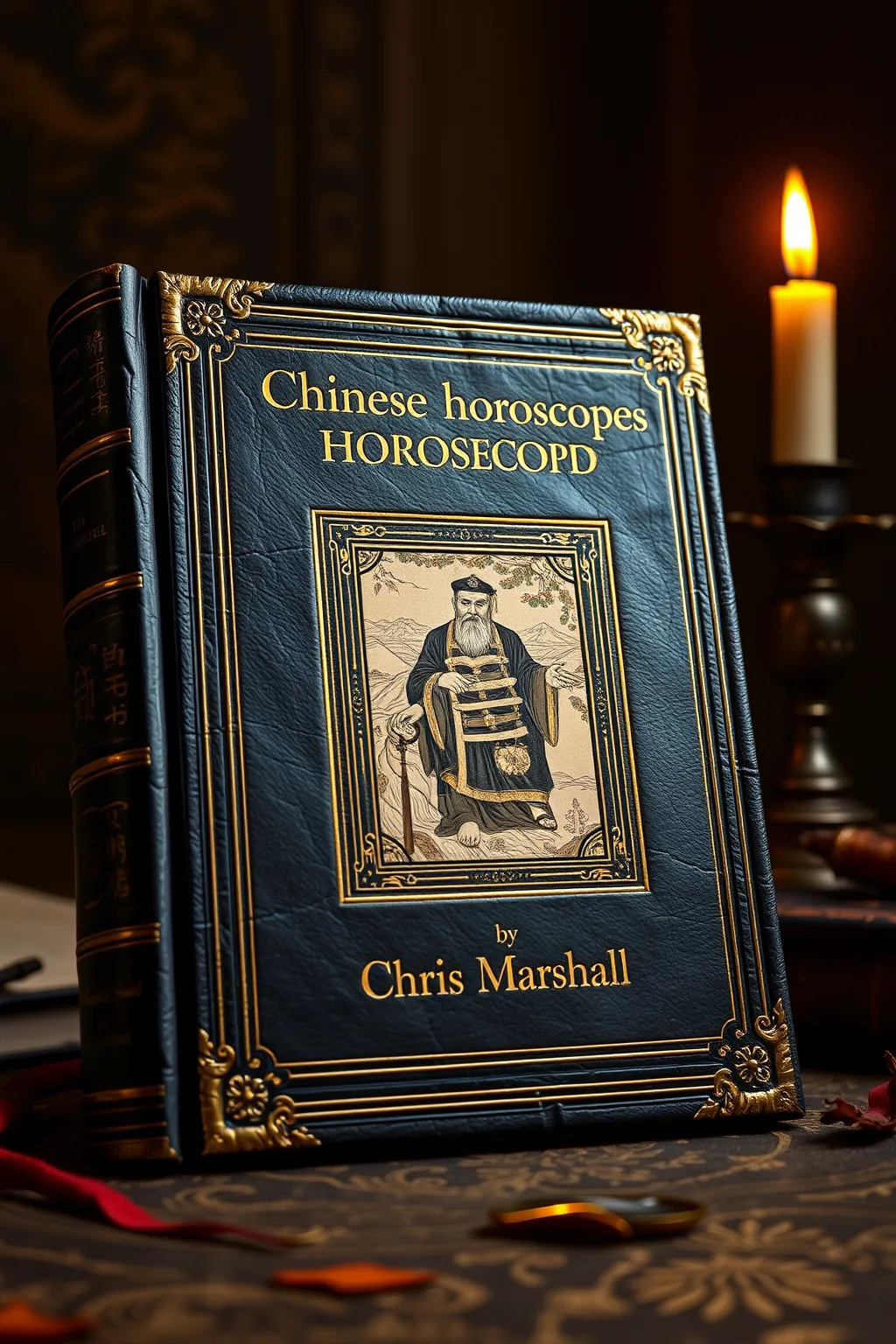
Chinese horoscopes
 61
61

Chinese horoscopes


Ophelia Vance, Mystical Literature Reviewer: Chris Marshall's 'Chinese Horoscopes' stands as a beacon for those drawn to the esoteric currents of Eastern wisdom. This volume transcends rudimentary astrological charts, offering a deeply insightful exploration of the philosophical and spiritual dimensions of the Chinese zodiac. Marshall masterfully deciphers the complex symbolism, revealing the profound interconnectedness between the celestial bodies and the human psyche. His authoritative yet accessible prose guides readers through the intricate dance of the elements and animal signs, providing tools for self-understanding and cosmic alignment. Ideal for serious students of astrology, practitioners of Eastern philosophies, and seekers of profound self-knowledge, this book is an indispensable addition to any esoteric library.
📝 Description
61
Chris Marshall's 2008 book explains the Chinese zodiac's philosophical roots.
Published in 2008, Chris Marshall's book examines the Chinese zodiac system. It goes beyond simple animal year associations to look at the underlying philosophy. Marshall connects the zodiac to Taoist ideas, including yin and yang and the Five Elements theory. He discusses the symbolic meaning of each animal sign and how these meanings apply to character, relationships, and life events. The book aims to provide a comprehensive understanding of how these celestial influences are thought to shape human experience.
Marshall details the twelve zodiac animals and their associated elemental qualities. He explains the cyclical nature of these energies and their supposed impact on destiny. Readers can learn about the specific symbolism tied to each archetype. This understanding is presented as a way to interpret personality traits and life paths. The work serves as a resource for those interested in astrological systems and their connection to broader philosophical concepts.
This work is situated within the tradition of Chinese cosmology and divination. It draws on a system that has been part of East Asian culture for centuries, linking celestial observations to earthly events and human character. The book engages with concepts like the cyclical flow of time and the balance of opposing forces, central to many esoteric practices that seek to understand order in the universe. It examines how these ancient frameworks are applied to individual lives.
💡 Why Read This Book?
Uncover the ancient secrets of the Chinese zodiac and its profound influence on your life. This book offers a unique perspective on destiny, relationships, and personal growth, rooted in millennia of Eastern wisdom. Ideal for seekers of self-knowledge, practitioners of esoteric arts, and anyone wishing to understand the subtle energies that shape our world, it provides a roadmap to greater harmony and cosmic awareness.
⭐ Reader Reviews
Honest opinions from readers who have explored this book.
❓ Frequently Asked Questions
What are the 12 Chinese zodiac animals?
The 12 Chinese zodiac animals are the Rat, Ox, Tiger, Rabbit, Dragon, Snake, Horse, Goat, Monkey, Rooster, Dog, and Pig. Each is associated with a specific year in a 12-year cycle, influencing personality and destiny.
How do the Five Elements relate to Chinese horoscopes?
The Five Elements (Wood, Fire, Earth, Metal, Water) interact with the zodiac animals, adding layers of complexity and nuance to astrological interpretations. They represent dynamic forces influencing character and life events.
Can Chinese horoscopes predict the future?
While Chinese horoscopes offer insights into potential tendencies and cycles, they are primarily tools for self-understanding and awareness, not deterministic predictions. They guide rather than dictate.
Is this book suitable for beginners?
Yes, this book is written in an accessible yet profound manner, making it suitable for both beginners curious about Chinese astrology and those with existing knowledge seeking deeper understanding.
What is the philosophical basis of Chinese horoscopes?
The system is deeply rooted in Taoist philosophy, emphasizing balance, harmony, the interplay of yin and yang, and the cyclical nature of the universe. It seeks to align human life with these cosmic principles.
🔮 Key Themes & Symbolism
The Twelve Animal Archetypes
Study the profound symbolism of the Rat, Ox, Tiger, Rabbit, Dragon, Snake, Horse, Goat, Monkey, Rooster, Dog, and Pig. Each animal embodies unique energetic signatures and archetypal patterns that influence personality, motivations, and life's journey. Marshall illuminates how these archetypes manifest in individuals, offering insights into their strengths, challenges, and innate potentials, providing a rich framework for self-discovery and understanding the diverse set of human experience.
The Dynamic Dance of the Five Elements
Explore the intricate relationship between the zodiac animals and the Five Elements (Wood, Fire, Earth, Metal, Water). This section unravels how these elemental forces, constantly interacting in cycles of creation and destruction, shape and refine the inherent characteristics of each animal sign. Understanding these elemental dynamics is crucial for grasping the subtle shifts in energy that influence destiny, relationships, and the unfolding of life's events, offering a sophisticated layer of astrological interpretation.
Cosmic Alignment and Personal Harmony
Discover how the principles of Chinese horoscopes can be applied to achieve greater personal harmony and alignment with the natural rhythms of the universe. Marshall guides readers in understanding their birth animal and element, and how to read through the energies of the current year. This theme emphasizes the practical application of esoteric knowledge for fostering well-being, making informed decisions, and living a life more attuned to the cosmic order, promoting a sense of balance and purpose.
💬 Memorable Quotes
Direct passages from the work, attributed to the author.
“Within the cycle of the dragon, power and wisdom intertwine.”
— This evocative phrase expresses the archetypal energy of the Dragon sign, emphasizing its dual nature of potent strength and profound, ancient knowledge often associated with this auspicious symbol.
“Embrace the Rat's cunning; it is the spark of survival in the cosmic dance.”
— This interpretation encourages readers to see the 'cunning' of the Rat not as negative, but as an essential adaptive trait, a vital spark for navigating life's challenges within the grander scheme.
💡 Key Ideas
Editorial paraphrase of the work's core concepts — not direct quotes.
The stars whisper secrets, but the zodiac sings the song of our soul.
This quote highlights the deep, personal connection between astrological influences and the inner essence of an individual, suggesting that celestial patterns reveal fundamental truths about one's being.
The path of the Horse is paved with ambition, yet guided by the wind.
This quote illustrates the dynamic tension within the Horse archetype – a drive for achievement tempered by an innate need for freedom and responsiveness to external influences.
The silent wisdom of the Serpent reveals truths hidden in plain sight.
This quote points to the intuitive and perceptive nature of the Serpent sign, suggesting that profound understanding can be gained by observing subtle clues and inner knowing, often overlooked by others.
🌙 Esoteric Significance
Tradition
The esoteric significance of Chinese horoscopes is deeply rooted in Taoist philosophy and traditional Chinese cosmology. It is not merely a system of prediction but a profound exploration of the harmonious interplay between heaven, earth, and humanity. This tradition emphasizes the cyclical nature of existence, the energetic forces of yin and yang, and the transformative power of the Five Elements, offering a holistic framework for understanding self and the universe.
Symbolism
Key symbols include the twelve animals, each representing a unique set of characteristics and energetic archetypes, and the Five Elements (Wood, Fire, Earth, Metal, Water), symbolizing dynamic forces that interact and transform. The lunar calendar itself is a potent symbol of cyclical time and natural rhythms. Together, these elements form a complex symbolic language that maps the energetic range of individual lives and the broader cosmos, revealing hidden patterns and potentials.
Modern Relevance
In contemporary times, Chinese horoscopes offer a powerful lens for self-discovery and personal development, providing an alternative to Western astrological systems. They encourage mindfulness of natural cycles, foster a deeper connection to ancestral wisdom, and offer practical insights for navigating relationships and life's challenges. The emphasis on balance and harmony resonates strongly in our modern, often chaotic world, providing a pathway to inner peace and a more profound understanding of one's place within the grand cosmic order.
👥 Who Should Read This Book
This comprehensive exploration of Chinese horoscopes is essential for a diverse range of readers. **Beginners** will find a clear and engaging introduction to this rich astrological tradition. **Scholars** of Eastern philosophy and comparative religion will appreciate the depth of historical and cultural context. **Seekers** of self-knowledge and spiritual growth will discover clear insights into their own nature and potential. **Practitioners** of esoteric arts, from Feng Shui to traditional Chinese medicine, will find invaluable knowledge to enrich their understanding and practice, offering a holistic approach to life and well-being.
📜 Historical Context
The system of Chinese horoscopes, deeply embedded within Chinese culture, has evolved over thousands of years, with its roots tracing back to ancient astronomical observations and philosophical schools, notably Taoism. Its development is intertwined with the imperial calendar, agricultural cycles, and traditional beliefs about fate and cosmic influence. The 12-year cycle of animals, combined with the Five Elements, provided a framework for understanding human nature, predicting auspicious times for significant events like marriages and business ventures, and maintaining social order. This intricate system served not only as a divinatory tool but also as a moral compass, reflecting a worldview where humanity and the cosmos were in constant, reciprocal dialogue. Its enduring popularity speaks to its profound resonance and adaptability across centuries, influencing art, literature, and daily life.
📔 Journal Prompts
Reflect on the dominant animal archetype of your birth year. How do its perceived traits manifest in your daily life and decision-making?
Consider the Five Elements associated with your birth year and month. How do these elements interact within you, and what might this suggest about your energetic balance?
Explore a significant challenge you faced recently. How might the energetic influences of the current year's animal sign have played a role, or how could understanding your own animal archetype have offered a different approach?
In what ways do you feel a connection to the 'cosmic dance' described in the text? How can you cultivate greater harmony with the natural rhythms of life?
Beyond your birth animal, which other zodiac animal's traits do you admire or find challenging in yourself and others? What can you learn from their archetypal energy?
🗂️ Glossary
Yin and Yang
Fundamental Taoist concepts representing complementary opposing forces. Yin is feminine, passive, dark, and receptive, while Yang is masculine, active, light, and assertive. Their interplay creates balance and harmony in the universe.
Five Elements (Wu Xing)
The five fundamental elements of Wood, Fire, Earth, Metal, and Water, which are believed to be in constant motion and interaction, generating and controlling each other. They are crucial in understanding the dynamic nature of Chinese astrology.
Lunar Calendar
A calendar based on the phases of the moon. The Chinese zodiac is intrinsically linked to the lunar cycle, with each animal sign governing a specific lunar year.
Archetype
A universal, primordial image, symbol, or pattern of behavior that is part of the collective unconscious. In Chinese horoscopes, each animal represents a distinct archetype.
Elemental Cycle
The cyclical relationships between the Five Elements, including the Generative (Creation) cycle and the Controlling (Destruction) cycle. These cycles illustrate how elements influence and transform one another.
This book appears in 3 collections
🔮 Readers Also Liked
Browse all →









More by Marshall, Chris
All books →

From the “Astrology” Collection
View all →



More Free Astrology & Cosmology Books
View all →