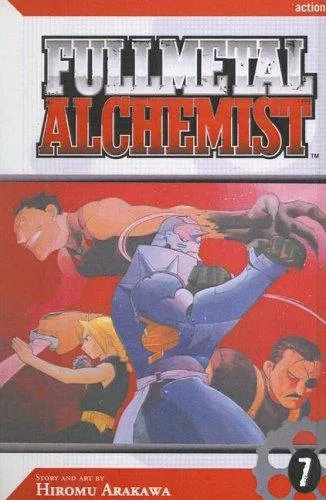
鋼の錬金術師 7
 81
81

鋼の錬金術師 7
The Elric brothers’ quest in Volume 7 of Fullmetal Alchemist intensifies, showcasing Arakawa’s consistent ability to escalate stakes while maintaining character integrity. A particular strength lies in the depiction of the ethical compromises faced by State Alchemists, as exemplified by the internal conflicts and external pressures on characters like Major General Olivier Mira Armstrong. The pacing, while generally effective, occasionally feels rushed in its exposition of new antagonists and their motivations, particularly concerning the deeper lore of the homunculi. The sequence where Edward confronts the ramifications of the military's involvement in alchemical experimentation provides a stark, memorable illustration of the series' critical stance on unchecked authority.
This volume solidifies Fullmetal Alchemist 7 as a pivotal installment, grappling with the darker implications of its established world.
📝 Description
81
Fullmetal Alchemist 7, published in 2004, continues the Elric brothers' quest for redemption.
This seventh volume in Hiromu Arakawa's manga series follows Edward and Alphonse Elric as they attempt to recover their bodies after a failed alchemical ritual. Their world operates on the Law of Equivalent Exchange, a principle that dictates the cost of all alchemical transmutation. The narrative deepens the brothers' involvement with the State Military and introduces them to darker forces at play.
Arakawa's storytelling weaves complex character arcs with a meticulously constructed alchemical system. This volume specifically examines the machinations of shadowy groups and the ethical quandaries inherent in alchemical research. Readers will find themselves questioning the true price of ambition and sacrifice as the Elrics confront the consequences of their pursuit of power.
The series draws on alchemical traditions, particularly Western esotericism, where transmutation and the pursuit of ultimate knowledge are central themes. The concept of Equivalent Exchange reflects alchemical principles of balance and consequence, while the creation of homunculi touches on forbidden arts and the manipulation of life itself. The narrative questions the moral boundaries of such pursuits, situating the Elrics' quest within a framework of occult philosophy and the search for forbidden secrets.
💡 Why Read This Book?
• You will gain a deeper understanding of the ethical quandaries surrounding alchemical research and the military's role, as explored through the character arcs present in Volume 7, offering a critical perspective on power. • You will witness the unfolding consequences of the Law of Equivalent Exchange, illustrated through specific plot developments concerning the Elric brothers' pursuit of the Philosopher's Stone, highlighting the narrative's commitment to its established rules. • You will experience the intricate character dynamics and escalating plot, particularly the introduction and development of new antagonists and their complex motivations, providing a unique blend of action and philosophical inquiry.
⭐ Reader Reviews
Honest opinions from readers who have explored this book.
❓ Frequently Asked Questions
When was Fullmetal Alchemist Volume 7 first published in Japan?
Fullmetal Alchemist Volume 7 was first published in Japan in 2004, continuing the serialization of Hiromu Arakawa's popular manga series that began in 2001.
What are the main themes explored in Fullmetal Alchemist Volume 7?
This volume delves into themes of sacrifice, the military's control over alchemical knowledge, the nature of humanity versus artificial beings (homunculi), and the pursuit of forbidden power.
Who are some key characters featured prominently in Volume 7?
Key characters include Edward and Alphonse Elric, along with significant appearances by figures like Olivier Mira Armstrong and the homunculi, as the narrative expands its scope.
Does Volume 7 introduce new antagonists or plot elements?
Yes, Volume 7 often deepens the mythology surrounding the homunculi and introduces or elaborates on the machinations of the antagonists pulling strings from behind the scenes.
What is the Law of Equivalent Exchange in the context of Fullmetal Alchemist?
The Law of Equivalent Exchange is the fundamental principle of alchemy in the series, stating that to gain something, one must give up something of equal value. It's a core concept explored throughout the narrative.
Is Volume 7 a good entry point for new readers of Fullmetal Alchemist?
No, Volume 7 is part of an ongoing series. It is best read after volumes 1-6 to fully grasp the characters, plot, and established world-building of the Fullmetal Alchemist narrative.
🔮 Key Themes & Symbolism
The Cost of Ambition
Volume 7 scrutinizes the relentless pursuit of goals, particularly the quest for the Philosopher's Stone. It examines how the desire for power or restoration can lead characters to compromise their ethics, echoing alchemical principles where immense power demands an equivalent, often terrible, price. The narrative highlights the moral decay and personal sacrifices incurred by those who chase forbidden knowledge or seek to overturn natural laws, questioning whether the ends truly justify the means.
Military Control and Corruption
This installment further exposes the State Military's complex and often sinister role in the world of alchemy. It reveals how the institution utilizes alchemists as tools, engaging in morally questionable research and operations. The volume contrasts the ideals of scientific advancement with the harsh realities of military objectives, showing how power structures can corrupt even potentially beneficial disciplines, leading to exploitation and suffering for individuals.
Humanity and Artificiality
The nature of the homunculi and their place in the world is a persistent theme. Volume 7 looks at the blurred lines between human and artificial existence, exploring whether beings created through alchemical means possess souls or true sentience. This raises profound questions about identity, creation, and what it fundamentally means to be human, especially when confronted by beings who mimic human emotions and desires.
The Law of Equivalent Exchange
At the heart of the series' philosophical underpinnings is the Law of Equivalent Exchange. Volume 7 consistently reinforces this principle, showing its application in both grand alchemical feats and personal tragedies. The narrative uses this law to explore consequences, karma, and the inescapable balance of the universe, suggesting that all actions, especially those that defy natural order, come with a predetermined cost.
💬 Memorable Quotes
Direct passages from the work, attributed to the author.
“The Law of Equivalent Exchange states that to obtain, something of equal value must be lost.”
— This core tenet of alchemy dictates the narrative's consequences. It serves as a constant reminder that the Elric brothers' quest, and indeed all alchemical pursuits, are bound by a universal balance, ensuring that power and knowledge come at a significant price.
“Even if we lose everything, we have to keep going.”
— This sentiment captures the enduring spirit of the protagonists. It reflects their determination to overcome immense hardship and loss, underscoring their commitment to their goals despite the severe costs imposed by the Law of Equivalent Exchange.
“There are things that cannot be obtained, no matter how much you pay.”
— This statement offers a nuanced counterpoint to the strict Law of Equivalent Exchange. It suggests that some values, like true innocence or lost lives, cannot be restored through any material or alchemical transaction, emphasizing the irreplaceable nature of certain losses.
💡 Key Ideas
Editorial paraphrase of the work's core concepts — not direct quotes.
This is not alchemy. This is war.
Spoken in a context of military conflict, this line highlights the perversion of alchemical science when weaponized. It differentiates between the controlled pursuit of knowledge and the destructive application of power in battle, critiquing the militarization of scientific disciplines.
We are not gods. We are merely humans who play with fire.
This quote acknowledges the hubris inherent in attempting to manipulate fundamental laws, like those of alchemy. It serves as a cautionary note about the dangers of overreaching and the potential for unintended, catastrophic consequences when humans tamper with forces beyond their true understanding.
🌙 Esoteric Significance
Tradition
While not explicitly aligned with a single esoteric tradition, Fullmetal Alchemist draws heavily from Hermetic principles, particularly the concept of the Philosopher's Stone and the Law of Equivalent Exchange, which reflects the Hermetic axiom 'As Above, So Below'. The series' alchemical system, while fictionalized, engages with the Hermetic goal of transmutation and understanding the fundamental nature of matter and spirit. It presents a secularized, scientific interpretation of alchemical processes, stripping away much of the overt mysticism but retaining the core philosophical quest for knowledge and transformation.
Symbolism
The Ouroboros, a serpent eating its own tail, appears as a symbol associated with the homunculi, representing cycles, self-devouring, and eternity—concepts central to alchemical symbolism. The concept of the Philosopher's Stone itself is a potent alchemical motif, symbolizing perfection, immortality, and the ultimate goal of transmutation. The series also employs the alchemical process stages (Nigredo, Albedo, Citrinitas, Rubedo) as thematic underpinnings for character and plot development, representing stages of purification and transformation.
Modern Relevance
Contemporary discussions around bioethics, artificial intelligence, and the ethics of scientific advancement find echoes in Fullmetal Alchemist's exploration of homunculi and forbidden alchemy. Thinkers examining the boundaries of human enhancement, the potential dangers of unchecked scientific ambition, and the philosophical implications of creating artificial life often reference the series. Its narrative provides a relatable, albeit fictional, framework for contemplating these complex modern issues, making its themes relevant to current debates in science and philosophy.
👥 Who Should Read This Book
• Fans of intricate world-building and morally complex narratives who appreciate stories that explore the consequences of scientific ambition and power structures. • Students of comparative mythology and symbolism interested in how ancient alchemical concepts, like the Philosopher's Stone and the Ouroboros, are reinterpreted in modern popular culture. • Readers seeking adventure stories with well-developed characters and a strong thematic core that questions the nature of humanity, sacrifice, and the pursuit of knowledge.
📜 Historical Context
The early 2000s saw manga like Fullmetal Alchemist gain significant international traction, moving beyond niche audiences. Hiromu Arakawa’s work, serialized in Monthly Shonen Gangan from August 2001, tapped into a growing global appetite for sophisticated fantasy narratives that blended action with complex ethical dilemmas. This period was marked by a flourishing of shonen manga that explored mature themes, challenging the perception of the genre. While not directly engaging with a specific competing school of thought in the same way a philosophical treatise might, Fullmetal Alchemist’s intricate alchemical system can be seen as a unique fictional framework distinct from the more common magic systems in contemporary fantasy. Its reception was overwhelmingly positive, lauded for its compelling plot and character development, which contributed to its widespread popularity and subsequent anime adaptations.
📔 Journal Prompts
The Law of Equivalent Exchange as applied to the Elric brothers' journey.
Reflect on the symbolism of the Ouroboros in relation to the homunculi.
The ethical compromises made by State Alchemists like Major General Olivier Mira Armstrong.
Consider the narrative's portrayal of military control over scientific disciplines.
Examine the concept of artificial life versus true humanity presented in Volume 7.
🗂️ Glossary
Alchemy
In the context of Fullmetal Alchemist, alchemy is a science based on the Law of Equivalent Exchange, allowing for the transmutation of matter without a Philosopher's Stone, provided sufficient understanding and materials.
Law of Equivalent Exchange
The fundamental principle governing alchemy in the series: to gain something, one must give up something of equal value. This governs all alchemical transformations.
Philosopher's Stone
A legendary alchemical substance said to allow for the Law of Equivalent Exchange to be bypassed, enabling transmutation without sacrifice. Its creation and nature are central to the plot.
Homunculi
Artificial humans created through forbidden alchemy, often possessing unique powers and distinct personalities. They are antagonists with complex motivations tied to their creator.
Transmutation Circle
A diagram inscribed on a surface used to channel alchemical energy and perform transformations. The complexity and accuracy of the circle dictate the outcome of the transmutation.
State Alchemist
Alchemists employed by the Amestrian military, granted special privileges but often tasked with morally ambiguous missions. They are identified by their State Alchemist title and pocket watch.
Equivalent Exchange
A practical application or understanding of the core alchemical law, often invoked by characters to justify actions or explain consequences.
🔮 Readers Also Liked
Browse all →









More by 荒川弘
All books →





More Free Alchemy & Hermeticism Books
View all →