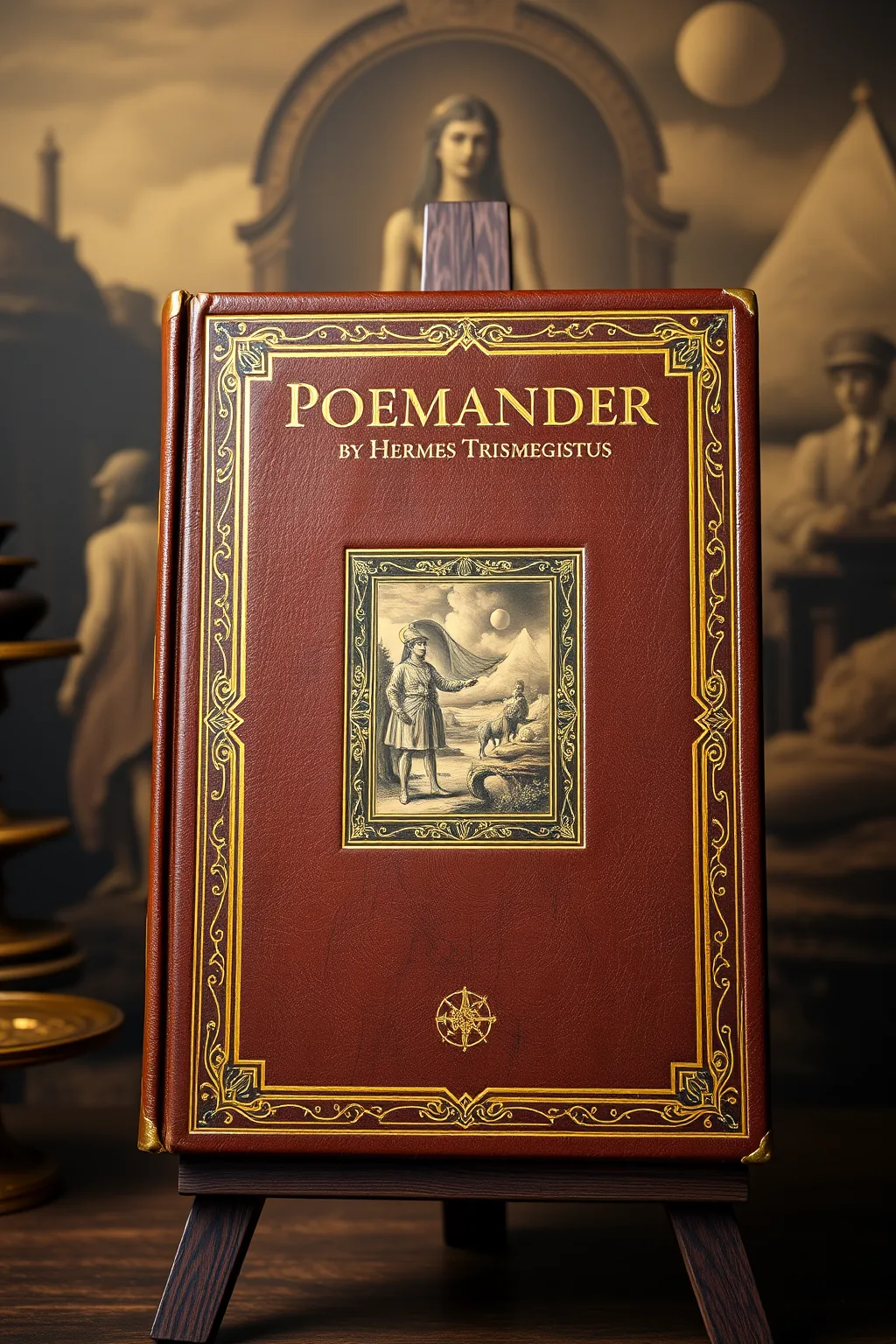
Poemander
 77
77

Poemander
The Poemander offers a stark, almost starkly beautiful, cosmology that has shaped Western esoteric thought for centuries. Its strength lies in its direct, unadorned presentation of divine revelation, particularly the vision of creation stemming from the supreme Mind. The narrative of the descent and ascent of the soul through the planetary spheres, while a common motif, is rendered here with a particular gravitas. However, the text can feel repetitive, especially in its cataloging of the creative acts. The passage detailing the creation of humanity, influenced by the 'Demiurge' and the 'Seven Rulers,' is particularly potent for understanding early Gnostic-adjacent ideas about cosmic hierarchy and human nature. The work serves as a vital, if challenging, gateway to ancient mystical thought.
📝 Description
77
The Poemander, attributed to Hermes Trismegistus, presents divine revelations about God, the cosmos, and humanity.
The Poemander comprises dialogues and revelations concerning the nature of God, the universe, and humanity's place within it. Attributed to the legendary Hermes Trismegistus, the text unfolds as a series of divine insights granted to Poimandres, identified as 'The Mind of Creation,' by the supreme deity.
This collection of Greek philosophical and religious dialogues, also known as the Corpus Hermeticum, was likely compiled between the 1st and 3rd centuries CE. This era fostered a blend of Greek philosophy, such as Platonism and Stoicism, with Egyptian and Jewish mystical traditions. The work explores humanity's connection to the divine and its potential for spiritual ascent.
The Poemander is a central text in Western esotericism, influencing Gnosticism and Neoplatonism. It articulates a cosmology where the divine Mind, Nous, initiates creation through emanations. The text emphasizes the human capacity for spiritual awakening and return to the divine through knowledge, or gnosis. Its philosophical inquiries and creation narratives shaped later Hermetic traditions, including alchemy and mystical theology.
💡 Why Read This Book?
• Grasp the foundational Hermetic concept of Nous, the supreme Mind, as a creative force, understanding its influence on later esoteric traditions. • Trace the early Gnostic-influenced cosmology of the soul's journey through the seven planetary spheres, a motif central to many mystical paths. • Explore the ancient understanding of humanity's divine spark and the path to deification through gnosis, as articulated in the dialogues concerning creation.
⭐ Reader Reviews
Honest opinions from readers who have explored this book.
❓ Frequently Asked Questions
What is the primary philosophical tradition associated with the Poemander?
The Poemander is a key text of Hermeticism, a philosophical and religious tradition attributed to Hermes Trismegistus. It blends Greek philosophical concepts, particularly Platonism, with Egyptian religious ideas.
When were the texts compiled?
While attributed to an ancient figure, the surviving Greek texts of the Poemander (part of the *Corpus Hermeticum*) were likely compiled between the 1st and 3rd centuries CE.
What is the concept of 'Nous' in the Poemander?
Nous, often translated as Mind or Intellect, is presented as the supreme, creative divine principle from which all creation emanates. It is the ultimate source of all being and knowledge.
What does the Poemander say about the creation of humanity?
The work describes humanity's creation as a complex process involving the supreme Mind and the 'Seven Rulers' of the planets, imbuing humans with a divine spark but also connecting them to the material world.
Is the Poemander a religious or philosophical text?
It functions as both. It contains theological doctrines about God and creation, alongside philosophical inquiries into the nature of reality, the soul, and knowledge (gnosis).
What is the significance of Poimandres in the text?
Poimandres is the divine being who reveals the secrets of creation and the cosmos to Hermes Trismegistus in the opening dialogue, acting as a messenger of divine wisdom.
🔮 Key Themes & Symbolism
The Supreme Mind (Nous)
The Poemander posits Nous as the ultimate, uncreated divine intellect, the primordial source from which all existence springs forth. This concept is central to understanding the text's cosmology, as it describes creation as a series of emanations from this singular, all-encompassing Mind. The work details how Nous projects the Word, which in turn brings forth the rest of creation, establishing a hierarchical yet unified cosmic order. This idea profoundly influenced Neoplatonism and subsequent mystical traditions, offering a monotheistic framework for creation within a polytheistic or syncretic world.
Cosmic Creation and Emanation
The text provides a detailed, albeit allegorical, account of the universe's genesis. Creation is not a singular event but a process of unfolding, where the divine Mind brings forth successive layers of reality, from the heavens down to the material world. The influence of the seven planetary spheres, governed by 'powers,' is depicted as shaping earthly existence and influencing human destiny. This hierarchical structure, originating from a single divine source, was a common feature in ancient cosmogonies and shaped later alchemical and astrological thought.
The Divine Spark and Gnosis
A core theme is the presence of a divine spark within humanity, a fragment of the supreme Mind trapped within the material body. The Poemander suggests that liberation and return to the divine are possible through gnosis – a direct, intuitive knowledge of God and the cosmos. This pursuit of spiritual knowledge as a means of salvation is a hallmark of Gnostic and Hermetic traditions, emphasizing the soul's inherent divinity and its potential for transcendence beyond the material realm.
The Soul's Journey
The work outlines a cosmological and spiritual journey for the soul. After the body's dissolution, the soul must read through the spheres of the seven planets, shedding the influences and passions associated with each. Successfully passing these trials allows the soul to ascend back to its divine origin, reuniting with the supreme Mind. This concept of an arduous spiritual ascent, overcoming cosmic obstacles, became a recurring motif in mystical literature and contemplative practices across various traditions.
💬 Memorable Quotes
Direct passages from the work, attributed to the author.
“Mind alone is the God of gods, and of all things.”
— This statement captures the central tenet of the Poemander's theology: the absolute supremacy and singular nature of the divine Intellect (Nous) as the ultimate creator and ruler of all existence.
“The visible creation is the shadow of God.”
— This aphorism suggests that the material world, while real, is merely an imperfect reflection or manifestation of a higher, divine reality. It implies a hidden, true order that underlies all visible phenomena.
“Man is a microcosm, a small world, containing the sun and moon.”
— This highlights the Hermetic belief in the correspondence between the macrocosm (universe) and the microcosm (human being), asserting that humanity possesses within itself the essential principles and patterns of the entire cosmos.
“To know God is the highest good.”
— This emphasizes the salvific power of knowledge (gnosis) within the Hermetic framework. True understanding of the divine is presented not just as philosophical insight but as the ultimate path to spiritual liberation and well-being.
“The spheres of the planets are instruments of fate.”
— This reflects an ancient understanding of astrology and cosmic influence, where the celestial bodies and their movements are seen as forces that shape earthly events and human lives within the created order.
🌙 Esoteric Significance
Tradition
The Poemander is a central to the Hermetic tradition, a lineage tracing back to the syncretic deity Hermes Trismegistus. It bridges Greek philosophical inquiry (especially Platonism) with ancient Egyptian religious concepts. Within this tradition, it serves as a foundational text, presenting a unified cosmology that posits a single, supreme divine Mind (Nous) as the source of all existence, a concept that profoundly shaped later esoteric thought, including Neoplatonism, Renaissance Hermeticism, and modern occultism.
Symbolism
Central to the Poemander's symbolism is the figure of Nous itself, representing pure intellect and the unmanifest divine. The seven planetary spheres are another key motif, symbolizing cosmic forces, astrological influences, and stages of the soul's journey. The creation narrative often employs light and darkness, order and chaos, to represent the unfolding of the cosmos from the divine Mind into the material realm, with humanity embodying a connection between these two poles.
Modern Relevance
Contemporary practitioners of Western esoteric traditions, including ceremonial magicians, alchemists, and students of Hermetic philosophy, continue to draw heavily from the Poemander. Its concepts of the divine Mind, cosmic hierarchy, and the soul's ascent inform modern interpretations of spiritual development. Thinkers and groups exploring comparative mysticism, Gnosticism, and the history of ideas frequently engage with the text to understand the roots of Western spiritual thought and its enduring influence on contemporary consciousness.
👥 Who Should Read This Book
• Students of Western Esotericism: Those seeking to understand the historical and philosophical roots of traditions like alchemy, astrology, and ceremonial magic will find the Poemander indispensable. • Comparative Religion Scholars: Individuals researching the intersections of Greek philosophy, Egyptian religion, and early mystical thought will benefit from its unique syncretic worldview. • Seekers of Ancient Wisdom: Readers interested in pre-Christian philosophical and theological perspectives on creation, the divine, and humanity's place in the cosmos will find clear insights.
📜 Historical Context
The Poemander emerged from the intellectual ferment of the Roman Empire, specifically between the 1st and 3rd centuries CE, a period marked by intense syncretism. Greek philosophical ideas, particularly Neoplatonism and Stoicism, mingled freely with Egyptian religious traditions and Jewish mysticism, creating fertile ground for texts like the *Corpus Hermeticum*. This era saw various schools of thought vying for spiritual authority; alongside burgeoning Christianity, mystery cults and Gnostic sects offered alternative paths to salvation. The Poemander, attributed to the legendary Hermes Trismegistus, offered a compelling alternative cosmology and theology that resonated with those seeking a philosophical yet mystical understanding of the universe. Its reception was significant, influencing Renaissance thinkers like Marsilio Ficino, who translated it in the 15th century, seeing it as a pre-Christian revelation, and later figures in Western esotericism. While not subject to overt censorship in its early compilation period, its ideas were often viewed with suspicion by orthodox religious authorities.
📔 Journal Prompts
The creation of humanity from the divine Mind and the 'Seven Rulers'.
The role of Nous as the supreme creator and source of all being.
The soul's potential for liberation through gnosis.
The symbolic meaning of the seven planetary spheres.
The concept of man as a microcosm reflecting the macrocosm.
🗂️ Glossary
Nous
Greek for 'Mind' or 'Intellect.' In the Poemander, it refers to the supreme, divine, creative intelligence that is the source of all existence.
Poimandres
The divine being or 'Mind of Creation' who appears to Hermes Trismegistus in the first dialogue, revealing cosmic secrets and divine knowledge.
Gnosis
Greek for 'knowledge.' In the context of the Poemander, it refers to intuitive, spiritual knowledge or direct insight into divine truths, seen as essential for salvation.
Demiurge
A term often used in Gnostic and Platonic contexts for a lesser creator god or craftsman who fashioned the material world, distinct from the supreme, transcendent God (Nous).
Macrocosm
The universe considered as a complex, unified whole. The Hermetic principle of 'as above, so below' emphasizes the correspondence between the macrocosm and the microcosm.
Microcosm
The human being, seen as a miniature or lesser universe that reflects the structure and principles of the greater cosmos (macrocosm).
Emanation
The process by which creation or existence flows or proceeds from a divine source, often in a hierarchical series of stages, as described in the Poemander's cosmology.
🔮 Readers Also Liked
Browse all →









More by Hermes Trismegistus.
All books →


More Free Alchemy & Hermeticism Books
View all →