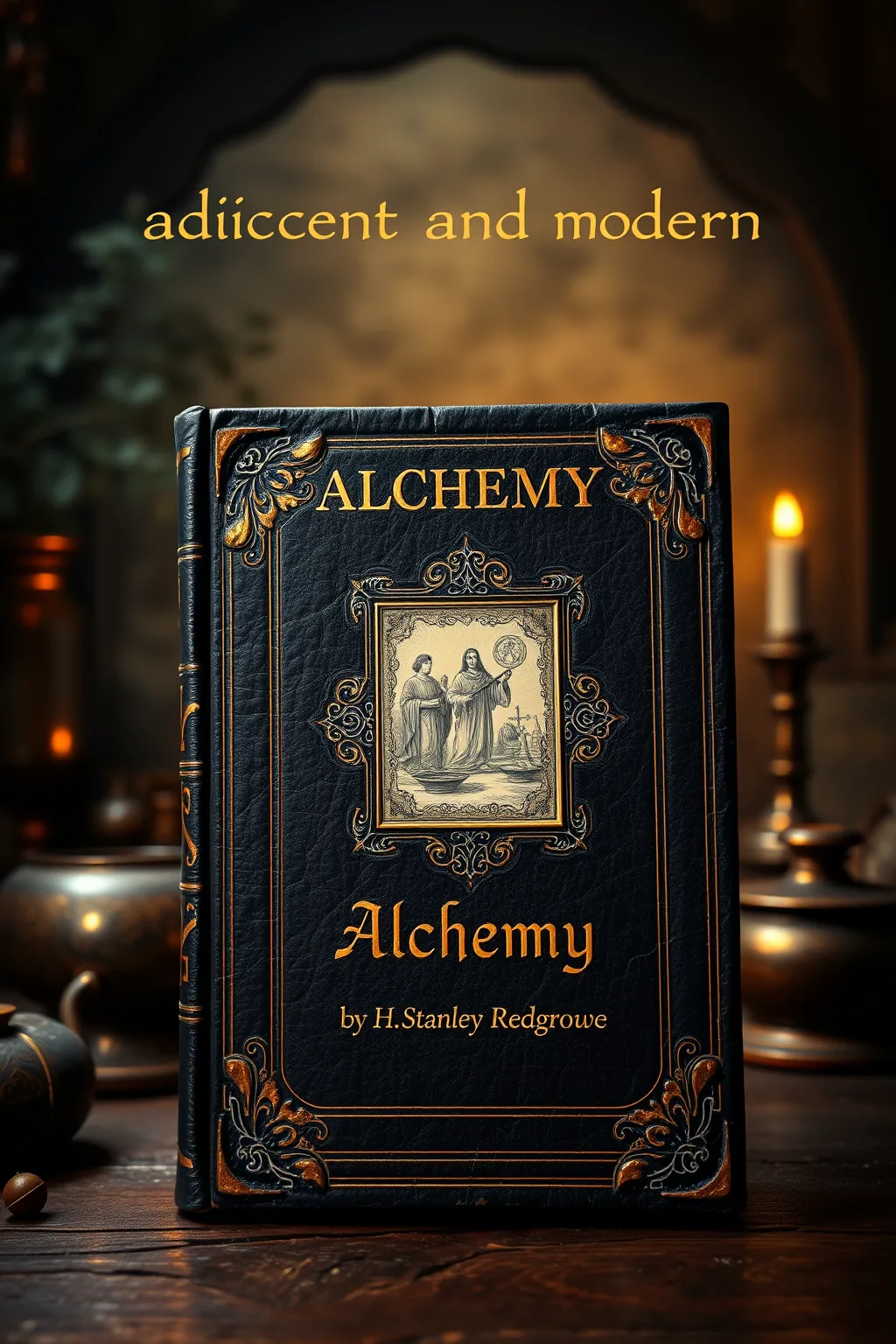
Alchemy: ancient and modern
 71
71

Alchemy: ancient and modern
Redgrove's "Alchemy: Ancient and Modern" is a commendable effort to ground the study of alchemy in historical fact and philosophical inquiry, a welcome departure from purely speculative treatises. The strength of the book lies in its systematic approach, presenting a lucid account of alchemical theories and their evolution from antiquity. Redgrove’s detailed exploration of concepts like the *prima materia* is particularly illuminating. However, the work occasionally feels constrained by its academic rigor, sometimes prioritizing historical documentation over the lived, experiential dimension that many practitioners associate with alchemy. The discussion on the symbolic stages, such as the *albedo*, while informative, could benefit from a more direct engagement with the psychological interpretations that were emerging concurrently in the early 20th century. Despite this limitation, the book offers a solid foundation for understanding alchemy's intellectual heritage.
📝 Description
71
H. Stanley Redgrove's 1922 book examines alchemy not as gold-making, but as philosophy.
Published in 1922, "Alchemy: Ancient and Modern" by H. Stanley Redgrove offers a scholarly survey of the alchemical tradition. Redgrove traces the roots of alchemy and its varied expressions, framing it as a complex philosophical and spiritual discipline rather than a direct method for producing material gold. He argues that alchemy served as a precursor to modern chemistry, detailing its theoretical foundations and its symbolic language. The work is suited for serious students of esoteric history and philosophy, appealing to those interested in the historical progression of ideas that shaped early scientific thought and metaphysical systems. Readers who prefer a structured, academic study of alchemy, distinct from practical laboratory guidance, will find considerable depth here. It is especially relevant for understanding the intellectual currents of the late 19th and early 20th centuries.
Redgrove's meticulous research places alchemy within a broader intellectual history. The book systematically breaks down alchemical theory, moving past simple ideas of transmuting base metals. It addresses concepts such as the *prima materia*, the fundamental substance from which all things are said to originate, and the symbolic significance of alchemical processes.
Redgrove's 1922 work emerged during a period of renewed scholarly and popular interest in occultism and historical psychologies. His book engaged with prevailing interpretations that sought to harmonize alchemy's mystical elements with emerging scientific understanding. This era coincided with early explorations of alchemy's symbolic dimensions in relation to the human psyche, a perspective that would later gain significant traction. Redgrove's research situates alchemy within a larger intellectual history, recognizing its origins in Hellenistic Egypt and its development through medieval Islamic and European traditions.
💡 Why Read This Book?
• Gain a structured understanding of alchemical theory and its historical progression, moving beyond sensationalized myths about gold-making. Redgrove details the *prima materia* and the stages of the Great Work, providing a clear conceptual framework. • Appreciate alchemy's connection to early scientific thought and philosophical systems. The book highlights the intellectual currents of the early 20th century, explaining how scholars like Redgrove approached its study. • Explore the symbolic language of alchemy through its core concepts. You will learn about the meaning of stages like the *albedo* and *rubedo*, offering insights into transformation.
⭐ Reader Reviews
Honest opinions from readers who have explored this book.
❓ Frequently Asked Questions
What is the historical origin of alchemy discussed in Redgrove's book?
Redgrove traces alchemy's origins to Hellenistic Egypt, examining its development through medieval Islamic and European traditions. He highlights its complex philosophical and spiritual dimensions from these early stages.
Does "Alchemy: Ancient and Modern" provide practical alchemical recipes?
No, the book focuses on the philosophical, theoretical, and historical aspects of alchemy. It explores the concepts and symbolic language rather than offering practical instructions for laboratory work.
What is the 'prima materia' as explained by H. Stanley Redgrove?
Redgrove explains the *prima materia* as the fundamental, undifferentiated substance from which all alchemical transformations are believed to originate. It represents the chaotic potential preceding order and form.
When was "Alchemy: Ancient and Modern" first published?
The book was first published in 1922, positioning it within a period of significant interest in esoteric studies and the historical roots of science.
How does Redgrove connect alchemy to modern science?
Redgrove presents alchemy as a significant precursor to modern chemistry, emphasizing its theoretical frameworks and symbolic language as foundational elements that influenced later scientific inquiry.
What are the alchemical stages of 'albedo' and 'rubedo'?
The *albedo* represents a stage of purification or whitening in alchemy, while the *rubedo* signifies a later stage of reddening or completion. Redgrove explores these as key symbolic phases of the Great Work.
🔮 Key Themes & Symbolism
The Philosophical Great Work
Redgrove meticulously details the *Main work*, or Great Work, not as a literal pursuit of gold, but as a profound process of spiritual and philosophical transformation. He dissects the symbolic stages, moving from the initial chaos of the *prima materia* through purification (the *albedo*) towards completion (the *rubedo*). This exploration reveals alchemy as a system for understanding cosmic order and inner regeneration, deeply embedded in a philosophical quest for perfection and knowledge that transcends material concerns.
Alchemy as a Proto-Science
A central theme is Redgrove's argument for alchemy's historical significance as a precursor to modern chemistry. He examines alchemical theories regarding elements, substances, and processes, showing how these early investigations, though couched in symbolic and mystical language, laid groundwork for empirical observation and theoretical development. The book highlights the intellectual transition from alchemical thought to scientific methodology, recognizing the practical experimentation that underpinned theoretical alchemical discourse.
Symbolic Language of Transformation
The work underscores alchemy's rich symbolic lexicon. Redgrove explains key symbols and their meanings, illustrating how alchemists communicated complex philosophical and spiritual ideas through allegorical narratives and imagery. Concepts like the union of opposites (e.g., solar and lunar principles) and the transformative power of the Philosopher's Stone are presented as vehicles for conveying profound truths about nature and the human condition.
Historical and Cultural Roots
Redgrove situates alchemy within its historical milieu, tracing its lineage from ancient Egypt and Greece through Islamic scholars and European alchemists. This contextualization reveals how alchemical traditions absorbed and transmuted ideas from various philosophical and religious streams, creating a unique synthesis. The book emphasizes the cultural impact of alchemy, its influence on art, literature, and intellectual history across centuries.
💬 Memorable Quotes
Direct passages from the work, attributed to the author.
“The alchemical work was often regarded as a symbolic representation of the purification and perfection of the human soul.”
— This interpretation highlights Redgrove's focus on the spiritual dimension of alchemy. It suggests that the physical processes described in alchemical texts were frequently allegorical, pointing towards an inner transformation of the practitioner.
“The *prima materia* is the chaotic, undifferentiated substrate from which all forms emerge.”
— This defines the foundational concept of alchemical potential. Redgrove presents the *prima materia* not just as a physical substance but as a philosophical principle representing primordial matter and possibility.
“Alchemy's theoretical frameworks contributed to the eventual development of chemical science.”
— This statement emphasizes Redgrove's view of alchemy's intellectual legacy. He argues that the systematic inquiry into matter, even in its ancient form, provided essential conceptual building blocks for later scientific disciplines.
“The symbolism of alchemy served as a vehicle for transmitting esoteric knowledge across generations.”
— This underscores the role of allegory and metaphor in alchemical tradition. Redgrove suggests that the complex imagery and narratives were crucial for preserving and communicating profound, often hidden, philosophical and spiritual teachings.
💡 Key Ideas
Editorial paraphrase of the work's core concepts — not direct quotes.
The stages of the Great Work, such as the *albedo*, signify progressive refinement and purification.
This paraphrased concept explains the symbolic progression within the alchemical process. Redgrove uses these stages to illustrate a journey of spiritual or philosophical development, moving from a less refined state to a more perfected one.
🌙 Esoteric Significance
Tradition
Redgrove's work aligns with the Hermetic tradition, exploring alchemy as a path of knowledge and transformation rooted in ancient wisdom. It departs from purely mystical or religious interpretations by emphasizing its philosophical coherence and its historical connections to the development of scientific thought. The book situates alchemy within a lineage of esoteric disciplines that seek to understand the fundamental nature of reality and the human place within it, presenting it as a sophisticated system of cosmology and psychology.
Symbolism
Key symbols include the *prima materia*, representing the chaotic potential from which all matter arises, and the dualistic principles (e.g., Sun/Moon, King/Queen) symbolizing the union of opposites necessary for transformation. The stages of the Great Work, such as the *albedo* (whitening) and *rubedo* (reddening), are central motifs representing purification and the achievement of the ultimate goal, often understood as spiritual perfection or enlightened consciousness.
Modern Relevance
Contemporary practitioners of Western esoteric traditions, particularly those in Hermetic and Rosicrucian circles, still draw upon Redgrove's meticulous historical and theoretical analyses. His work provides a solid foundation for understanding the symbolic language and philosophical underpinnings of alchemy, informing modern approaches to ritual, meditation, and psychological integration that echo alchemical principles. Thinkers exploring the intersection of consciousness studies and historical spiritual practices find value in his balanced perspective.
👥 Who Should Read This Book
• Students of Hermeticism and Western Esotericism: Those seeking a foundational understanding of alchemy's historical development and theoretical framework will find Redgrove's systematic approach invaluable. • History of Science Enthusiasts: Readers interested in the transition from ancient philosophies to early modern science will appreciate the book's exploration of alchemy as a precursor to chemistry. • Comparative Religion Scholars: Individuals studying the evolution of spiritual and philosophical ideas across cultures will benefit from Redgrove's examination of alchemy's diverse roots and symbolic expressions.
📜 Historical Context
Published in 1922, "Alchemy: Ancient and Modern" emerged during a fertile period for esoteric scholarship. The early 20th century saw a resurgence of interest in Hermeticism, Kabbalah, and ancient philosophies, partly fueled by movements like Theosophy and early psychoanalytic explorations of the unconscious. Redgrove's work engaged with this milieu, presenting a systematic, academic survey of alchemy that sought to trace its historical trajectory and theoretical underpinnings. This era also witnessed figures like Carl Jung beginning to analyze alchemical symbolism, offering psychological interpretations that contrasted with purely historical or mystical readings. Redgrove's approach, while scholarly, positioned alchemy as a legitimate subject of study, distinct from mere superstition, and acknowledged its complex relationship with the nascent field of chemistry, positioning it as a vital intellectual ancestor.
📔 Journal Prompts
The *prima materia*'s role as a symbol of potential and chaos.
Alchemical stages like the *albedo* and their allegorical meaning.
Connecting the historical pursuit of the Great Work to personal growth.
The alchemical union of opposites as a philosophical concept.
Redgrove's perspective on alchemy's influence on early chemistry.
🗂️ Glossary
Prima Materia
The fundamental, undifferentiated substance or chaotic potential from which all alchemical transformations are believed to originate. It is the starting point of the Great Work, representing raw, unformed matter.
Main work
The Great Work, referring to the entire alchemical process. It is often interpreted not only as the physical transmutation of metals but also as a spiritual or philosophical process of purification and perfection.
Albedo
The 'whitening' stage in the alchemical process, symbolizing purification, cleansing, and the initial stages of refinement in the Great Work.
Rubedo
The 'reddening' stage in the alchemical process, representing the culmination of the Great Work, often associated with the achievement of the Philosopher's Stone and spiritual completion or enlightenment.
Philosopher's Stone
A legendary alchemical substance believed to be capable of transmuting base metals into gold or silver, and also possessing the power to cure all diseases and grant immortality.
Hermeticism
A philosophical and religious tradition based on writings attributed to Hermes Trismegistus. It emphasizes gnosis (knowledge) and the interconnectedness of the macrocosm and microcosm.
Transmutation
In alchemy, the process of changing one element or substance into another, most famously the transformation of base metals into gold.
🔮 Readers Also Liked
Browse all →








More by H. Stanley Redgrove
All books →



More Free Alchemy & Hermeticism Books
View all →