Zhuangzi
Zhuangzi is a foundational Taoist text featuring stories and maxims that explore spontaneity, freedom, and the illusory nature of dualities.
The Zhuangzi, named after its traditional author Zhuang Zhou (Master Zhuang), is a seminal text of Taoism, alongside the Tao Te Ching. Written during China's Warring States period, it comprises stories, allegories, and maxims that illustrate the path of the ideal Taoist sage. The work frequently employs humor and irreverence to explore themes of embracing spontaneity, achieving freedom from societal conventions, and recognizing the arbitrary nature of distinctions like good/bad, life/death, and human/nature.
In contrast to the moralistic focus of many contemporaries, Zhuang Zhou advocated for a life of carefree wandering and alignment with nature, leading to oneness with the Tao. Beyond its philosophical depth, the Zhuangzi is celebrated as a masterpiece of Classical Chinese literature, influencing writers and poets for over two millennia. Its earliest known commentary dates to the Han dynasty, and it is considered a crucial pre-Qin text for understanding Chinese literary traditions.
The Author and His Work
The Zhuangzi text is traditionally attributed to Zhuang Zhou, known as "Zhuangzi" or "Master Zhuang." While concrete biographical details are scarce, historians generally place his birth around 369 BC in the state of Song. The text itself, a collection of stories and sayings, is considered one of the two primary texts of Taoism. It uses allegories, parables, and fables, often with a humorous or irreverent tone, to convey its philosophical insights. The core message emphasizes embracing natural spontaneity and achieving liberation from worldly constraints and conventional distinctions.
Philosophical Themes and Literary Significance
Central to the Zhuangzi's philosophy is the critique of dualistic thinking, highlighting the ultimate falsity of dichotomies such as good versus bad, large versus small, and life versus death. Zhuang Zhou promoted a path of effortless action (wu wei) and alignment with the natural flow of the Tao, advocating for freedom from societal norms and intellectual constructs. This approach contrasts with the emphasis on duty and morality prevalent among other philosophers of his era. The work is also highly regarded for its literary merit, considered a pinnacle of Classical Chinese literature and a significant influence on subsequent writers and poets.
Textual History and Authorship
The extant version of the Zhuangzi, comprising 33 chapters, was compiled around AD 300 by Guo Xiang. Earlier, a 52-chapter version existed. The first seven chapters, known as the 'inner chapters,' are widely accepted as being authored by Zhuang Zhou himself. The authorship of the remaining 'outer' and 'miscellaneous' chapters remains a subject of scholarly debate, with many believing they represent later additions or interpretations by various schools of thought, reflecting a process of accretion over time. Despite these debates, the core chapters are generally dated to the 4th to 2nd centuries BC, with the text's influence evident in other Warring States period writings.
Notable Passages and Concepts
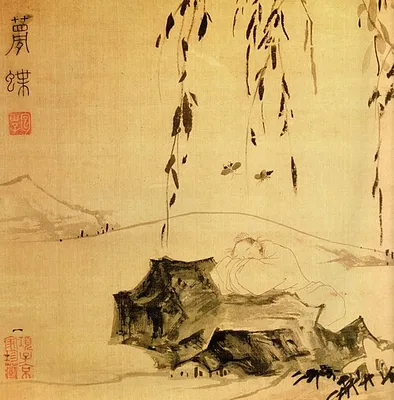
The Zhuangzi is renowned for its imaginative and thought-provoking passages. The most famous is the "Butterfly Dream," where Zhuang Zhou questions whether he is a man dreaming he is a butterfly or a butterfly dreaming he is a man, illustrating the blurred lines between reality and illusion and the arbitrary nature of perceived distinctions. Other notable elements include whimsical characters and narratives that challenge conventional logic and reasoning, often pushing arguments to absurd conclusions to demonstrate the limitations of human knowledge. The text's playful yet profound exploration of existence and consciousness makes it a cornerstone of Taoist thought.
Key Ideas
- Embracing spontaneity and natural flow
- Achieving freedom from societal conventions and dualistic thinking
- Oneness with the Tao (the Way)
- Critique of the limitations of human knowledge and rational distinctions
- The illusory nature of dichotomies (e.g., life/death, dream/reality)
Books by Zhuangzi
10 free public domain books · Read online or download