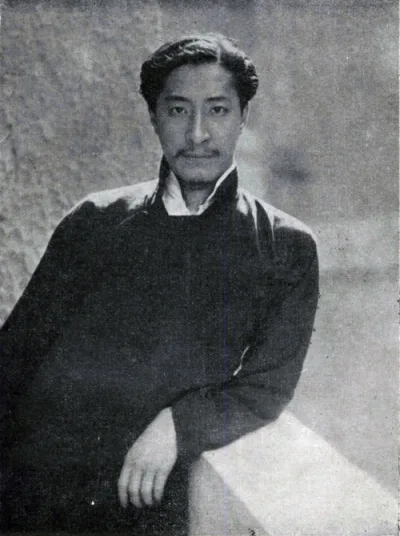
Shao Xunmei was a Shanghai-born poet and publisher known for his Western influences and decadent literary style.
Shao Xunmei, born Shao Yunlong in 1906 in Shanghai, was a prominent Chinese poet and publisher who drew heavily from Western literary traditions. Hailing from a wealthy and influential family, his background included connections to prominent figures like Sheng Xuanhuai. Shao's early life was marked by public attention and a significant period of travel and education in Europe between 1923 and 1927, where he was influenced by writers such as Algernon Charles Swinburne and Charles Baudelaire. This European sojourn culminated in his first poetry collection, "Parade and May," published in 1927.
Throughout his career, Shao utilized the name Sinmay Zau and occasionally Hao Wen. He was a contributor to "T'ien Hsia Monthly" and owned "Modern Sketch." His personal life was often a subject of public interest, involving relationships with notable women, including actress White Lotus and writer Emily Hahn. His association with Hahn during the Japanese invasion of China led to her being treated as an "honorary Asian" due to a documented marriage, which also served to protect Shao's publishing interests. Despite his literary pursuits, Shao faced periods of imprisonment, notably in 1958, which significantly impacted his health. He died in 1968.
Shao's literary legacy is complex; while he was a notable figure in Shanghai's literary scene, some critics, like Jonathan Hutt, noted his detachment from the contemporary Chinese literary landscape, suggesting he was more influenced by Western decadence. His work, including collections like "Twenty-five Poems," received mixed critical reception and he is often remembered as a minor poet with decadent tendencies, though some scholars have worked to rehabilitate his image.
Early Life and European Education
Born Shao Yunlong in 1906 into a prosperous Shanghai family, Shao Xunmei, also known as Sinmay Zau, hailed from a privileged background. His grandfather was a high-ranking official, and his father married into the influential Sheng family. Shao's upbringing was in the affluent Bubbling Well Road area of Shanghai. His early life was marked by public scrutiny and romantic involvements. At seventeen, he embarked on a four-year tour of Europe, studying in Cambridge and Paris. During this period, he developed a deep admiration for Western literary figures like Algernon Charles Swinburne and Charles Baudelaire, whose works significantly shaped his own artistic sensibilities. This transformative European experience concluded with the publication of his poetry collection, "Parade and May," in 1927.
Literary Career and Western Influences
Shao Xunmei's literary output was characterized by a strong engagement with Western aesthetic movements, particularly decadence. His works, such as "Fire and Flesh" and "Flower-like Evil," explicitly drew inspiration from Swinburne and Baudelaire, respectively. He was a publisher and contributor to various journals, including "T'ien Hsia Monthly," and owned "Modern Sketch." Despite his prolific writing and publishing activities, his poetry collections, like "Twenty-five Poems" (1936), did not always achieve widespread acclaim, and his popularity began to wane by the mid-1930s. Critics have noted his distinct orientation towards Western literary trends, sometimes at the expense of deeper engagement with the Chinese literary milieu of his time.
Personal Life and Later Years
Shao Xunmei's personal life was often intertwined with his public persona, marked by relationships with notable figures like actress White Lotus and writer Emily Hahn. His association with Hahn during wartime Shanghai offered a degree of protection during the Japanese occupation, as a documented marriage allowed her to be considered an "honorary Asian." This period also saw Shao reportedly engaging in habits like drinking and gambling, with Hahn covering some expenses. Later in life, Shao faced imprisonment for writing a letter to a friend in the United States, leading to a significant decline in his health upon release. He died in 1968, and his legacy continues to be debated, with some viewing him as a minor poet overshadowed by his Western influences.
Key Ideas
- Influence of Western decadence on Chinese literature
- Transnational literary exchange between East and West
Books by
3 free public domain books · Read online or download