Darcy Kuntz
The Golden Dawn was a British secret society focused on Hermeticism and magic, profoundly influencing Western occultism.
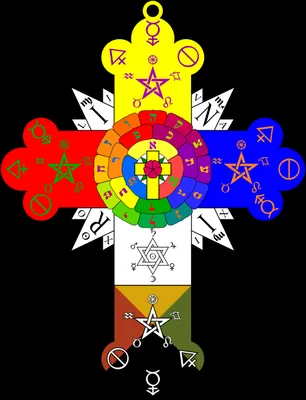
The Hermetic Order of the Golden Dawn, active in late 19th and early 20th century Britain, was a significant magical order rooted in Western esoteric traditions. It drew inspiration from Rosicrucianism and Freemasonry, emphasizing the study and practice of occult Hermeticism and metaphysics. The Order's teachings and rituals, particularly those concerning theurgy and spiritual development, laid the groundwork for many later occult movements, including Wicca and Thelema, making it a major force in 20th-century Western occultism.
The Order was founded by Freemasons William Robert Woodman, William Wynn Westcott, and Samuel Liddell Mathers, who were also members of the Societas Rosicruciana in Anglia. The system was structured hierarchically, similar to Masonic lodges, but notably admitted women on equal terms with men. The foundational elements were derived from the 'Cipher Manuscripts,' which outlined specific grade rituals and a curriculum covering Hermetic Qabalah, astrology, tarot, geomancy, and alchemy. The Order developed into distinct levels: the First Order for philosophical study and the Second Order for magical practices, with a purported Third Order of 'Secret Chiefs' guiding them.
Origins and Structure
The Hermetic Order of the Golden Dawn emerged from a desire to systematize Western esoteric knowledge. Its structure was based on the 'Cipher Manuscripts,' decoded by William Wynn Westcott, which provided the framework for its graduated system of teachings and rituals. The Order was divided into three main parts: the First Order, focused on esoteric philosophy and personal development through Hermetic Qabalah, elemental studies, astrology, tarot, and geomancy; the Second Order (Rosae Rubeae et Aureae Crucis), dedicated to advanced magical practices like scrying and astral travel; and the Third Order, purportedly guided by unseen 'Secret Chiefs' who communicated with the leaders of the Second Order. This hierarchical structure, while influenced by Freemasonry, was unique in its equal admission of women.
Development and Influence
Founded officially with the establishment of the Isis-Urania Temple in London in 1888, the Golden Dawn quickly expanded, establishing other temples across Britain and even in Paris. The Order attracted a diverse membership, including notable figures from the arts and intellectual circles, such as W. B. Yeats, Aleister Crowley, Florence Farr, and Arthur Machen. Its teachings on ritual magic and spiritual development proved highly influential, shaping the trajectory of Western occultism throughout the 20th century. Many contemporary magical traditions owe a significant debt to the foundational concepts and practices developed within the Golden Dawn.
Internal Strife and Splintering
By the late 1890s, the Golden Dawn experienced significant internal conflict, primarily centered around leadership disputes with Samuel Liddell Mathers. Dissatisfaction grew among members regarding Mathers's authority and his close association with Aleister Crowley. A key point of contention was the desire of some members to directly contact the 'Secret Chiefs' rather than relying on Mathers as an intermediary. This culminated in a revolt in 1899-1900, leading to the expulsion of Mathers and the eventual splintering of the Order. Prominent factions that emerged from these disputes included the Stella Matutina, formed by members like Robert Felkin, and a group that retained the Isis-Urania name, associated with A. E. Waite.
Key Ideas
- Hermetic Qabalah as a framework for spiritual development.
- Theurgy and spiritual development as central practices.
- A hierarchical system of initiation and magical training.
- The concept of 'Secret Chiefs' as guiding spiritual entities.
- The integration of astrology, tarot, geomancy, and alchemy into occult studies.