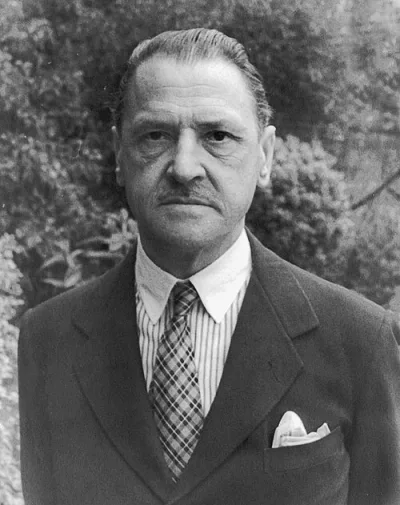
William Somerset Maugham was a prolific English writer known for his novels, plays, and short stories, whose work often explored human nature and societal norms.
William Somerset Maugham, born in Paris in 1874, was an English author celebrated for his extensive body of plays, novels, and short stories. After spending his early years in France and receiving his education in England and Germany, he pursued medical studies in London, qualifying as a physician in 1897. However, he chose to dedicate himself fully to writing, never practicing medicine. His literary career began with the novel 'Liza of Lambeth,' which gained attention for its realistic portrayal of slum life. He achieved significant fame as a playwright, with multiple productions running concurrently in London's West End. Later, Maugham shifted his focus primarily to novels and short stories, producing acclaimed works such as 'Of Human Bondage,' 'The Moon and Sixpence,' and 'The Razor's Edge.' Despite his immense popularity and high sales, some critics dismissed his work, though recent assessments often recognize the depth and skill in his writing, particularly in 'Of Human Bondage.' Maugham's prose style was noted for its clarity, though sometimes criticized for its use of clichés. His life experiences, including service in the British Secret Service during World War I and extensive travels, provided material for his fiction. Maugham passed away in 1965 at the age of 91.
Early Life and Education
Born in Paris to English parents who lived in France, William Somerset Maugham spent his first decade there before moving to England. His family had a strong legal background, with his father being a prosperous solicitor. Maugham's early life was marked by the loss of both parents by his early teens, after which he was sent to live with an uncle in Kent. This transition proved difficult, leading to shyness and a stammer. He attended schools in England and later studied literature and philosophy at Heidelberg University in Germany, where he experienced his first romantic relationship and began writing. Despite familial expectations and his own early literary ambitions, his guardian steered him toward medicine. He studied at St Thomas's Hospital Medical School in London, qualifying in 1897.
Literary Career and Themes
Maugham's writing career spanned over six decades, beginning with his first novel, 'Liza of Lambeth,' which depicted working-class life and garnered attention for its directness. He first achieved national recognition as a playwright, notably having four plays running simultaneously in London's West End by 1908. After 1933, he largely abandoned theatre to concentrate on novels and short stories. His novels, including 'Of Human Bondage,' 'The Moon and Sixpence,' 'The Painted Veil,' 'Cakes and Ale,' and 'The Razor's Edge,' explored various aspects of human nature and societal dynamics. His short stories were collected in volumes like 'The Casuarina Tree' and 'The Mixture as Before.' Maugham's writing is characterized by a clear, lucid prose style, though it sometimes drew criticism for its reliance on conventional phrases. His work often drew from his personal experiences, including his time with the British Secret Service and his extensive travels.
Personal Life and Later Years
Maugham's personal life was complex. He had relationships with both women and men, attempting to navigate societal norms of his time. He married Syrie Wellcome in 1917, with whom he had a daughter, Liza, but the marriage ended after twelve years. His primary long-term partner was Gerald Haxton, with whom he traveled extensively, gathering material for his stories. They resided together on the French Riviera, where Maugham hosted many guests. Following Haxton's death in 1944, Alan Searle became his secretary and companion. Maugham ceased writing novels after World War II. His final years were affected by illness and diminished mental capacity. He died in 1965 at the age of 91.
Key Ideas
- Exploration of human nature and societal conventions
- Realistic portrayal of diverse social strata
- Lucid prose style
Notable Quotes
“I saw how men died. I saw how they bore pain. I saw what hope looked like, fear and relief; I saw the dark lines that despair drew on a face.”
“I took to it as a duck takes to water.”
Books by
3 free public domain books · Read online or download